2.06 Snap and Spring: Energy Stored Between Magnets
investigate how changing the distance between two magnets changes the energy stored in the system.
- I can create a model that shows two objects that are not moving and interact with each other from a distance.
- I can identify and show the type of force (electric, magnetic, or gravitational) that acts between the two objects in my model.
- I can show the distance between the two objects and where potential energy is stored in the system.
- I can describe how each object in my model can exert a force on the other, which can transfer energy between them.
- I can explain how changing the position of the two objects changes the potential energy stored in the system.
Phase 2: Investigate
Warm-Up ~5 min
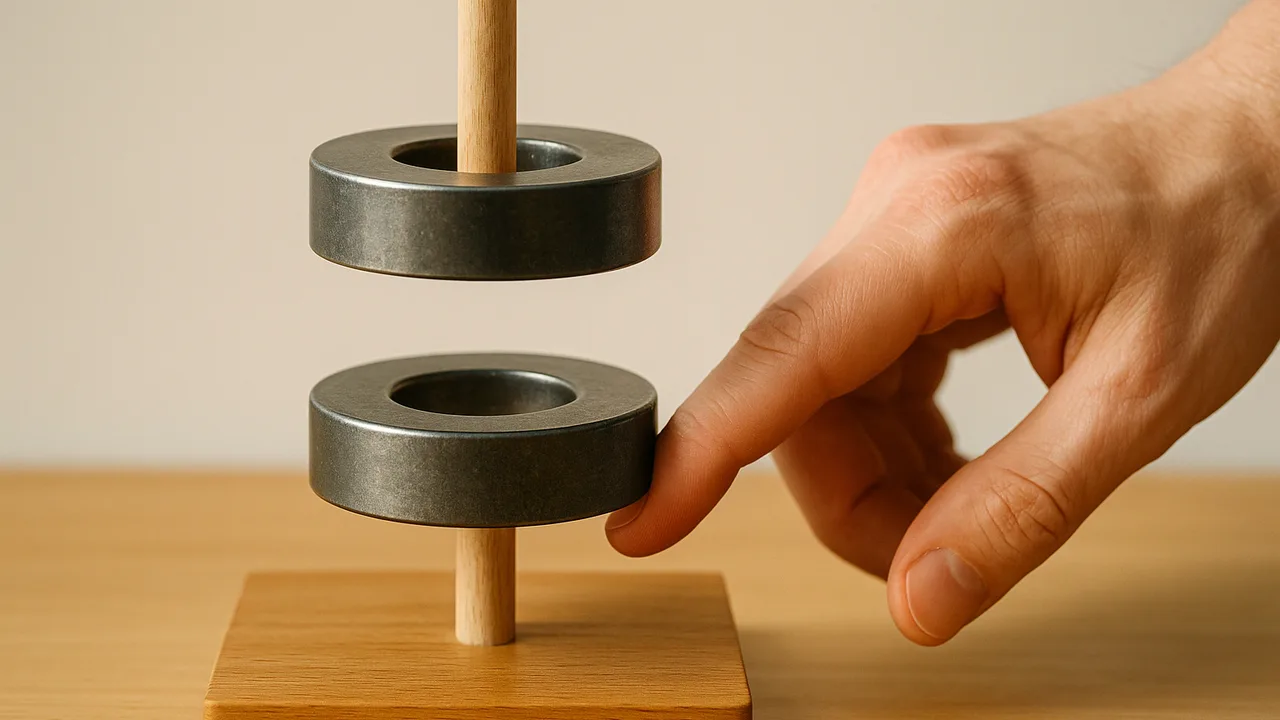
Do Now. Stack two ring magnets on a pencil so they repel and the top one floats. Press the top magnet down a little, then let go. Predict before you press it farther.
If you press the top magnet closer to the bottom one before letting go, what happens?
Instruction ~10 min
Explore first. Test A (repel): press the top ring magnet to four different gaps, release it, and record how high it jumps. Test B (attract): place a steel ball on a ruler track. Release it at 6, 4 and 2 cm from a magnet. Describe how fast it rolls and how loud the click is.
| Test | Starting gap (cm) | How hard to hold? (easy / medium / hard) | Result: jump height (cm) or speed and sound | More or less stored energy? |
|---|---|---|---|---|
| A: repel | 2.0 | |||
| A: repel | 1.5 | |||
| A: repel | 1.0 | |||
| A: repel | 0.5 | |||
| B: attract | 6 | |||
| B: attract | 4 | |||
| B: attract | 2 |
Naming the idea. When two objects interact at a distance, energy can be stored in the way they are arranged. Scientists call this potential energy. It belongs to the whole system, not to one object. Changing the distance between the objects changes the stored energy.
Worked example 1: repelling magnets. Ava pushed two repelling magnets from a 2 cm gap to a 0.5 cm gap. She had to push harder and harder. Her push added energy to the system. When she let go, that stored energy turned into motion, and the top magnet jumped. A smaller gap meant more stored energy.
Worked example 2: attracting objects. Diego pulled a steel ball away from a magnet. Pulling it apart took a force, so he added energy. Released from far away, the ball sped up the whole way and hit with a loud click. For attracting objects, a bigger gap stores more energy.
The same idea with gravity. Lifting a book higher above Earth takes a force and stores more energy in the Earth–book system. Drop it, and the stored energy becomes motion.
Guided Exercises ~15 min
Use your data table and your sketches. Discuss each card with your team.
Independent Practice ~10 min
Connect the idea to the sorting line.
A steel can on a belt passes under the magnet and snaps up to it. Draw a before-and-after model of the can–magnet system. Show the distance, the type of force and when the stored energy is greatest.
How confident are you that you can I can model how the distance between two objects changes the energy stored in the system.
Closure ~5 min
Arrangement matters: changing the distance between interacting objects changes the stored energy. Next time, we test the weakest but most far-reaching force of all: gravity.
Exit ticket: draw a model of two magnets that are not moving and are interacting at a distance. Label the type of force, the distance and where the potential energy is stored.
Teacher notes
Materials (per team): 2–4 ceramic ring magnets, a pencil or dowel in a clay base, a ruler, a steel ball bearing or marble-sized steel ball, a grooved ruler or folded card track, a bar magnet taped at the track’s end.
Setup: test that ring magnets repel when stacked; flip one if not. Mark gap distances on the pencil with tape.
Listen for: “the energy is in the magnet.” Steer to the system: the energy depends on both objects and the gap. Students often think closer always means more energy; the attract case shows the opposite. Keep it qualitative; no potential energy calculations (MS-PS3-2 boundary).
Support / stretch: give a model template with two boxes and a gap arrow. Stretch: predict the result with three stacked ring magnets, then test.