2.19 Modeling the Sorting Line
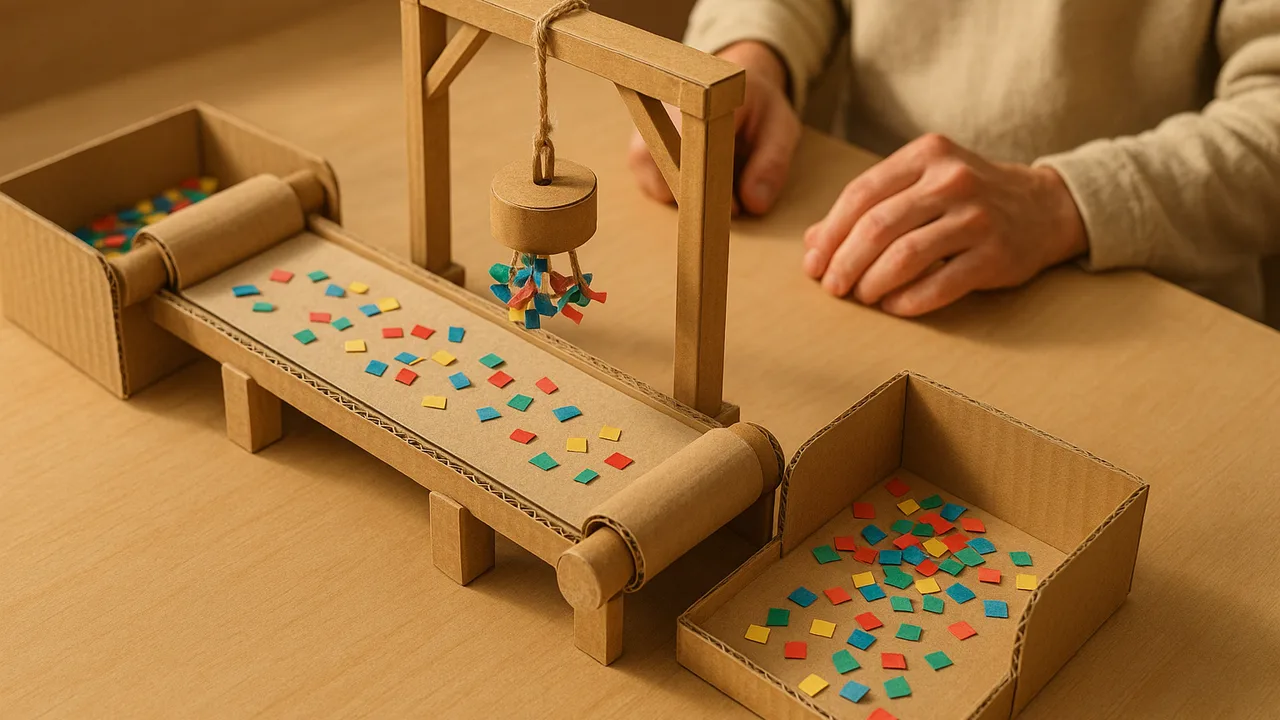
build a model of the sorting line that shows its parts, inputs, outputs, criteria and constraints, and where energy is stored between the magnet and a can.
- I can develop a model that shows the problem I am trying to solve, including its criteria and constraints.
- I can identify and show the parts of my proposed solution, including the inputs and outputs in my model.
- I can explain how each part of my proposed solution affects how it works.
- I can describe how my proposed solution connects to the problem I am trying to solve.
- I can explain how each part of my proposed solution relates to the problem and how the data from my model shows how well the solution works.
- I can create a model that shows two objects that are not moving and interact with each other from a distance.
- I can identify and show the type of force (electric, magnetic, or gravitational) that acts between the two objects in my model.
- I can show the distance between the two objects and where potential energy is stored in the system.
Phase 4: Build
Warm-Up ~5 min
Do Now. A city planner shows you a toy-size model of a new park before it is built. Why build a model first instead of just building the park?
What is the main reason engineers build models?
Instruction ~10 min
Sorting engineers, a single sorter is not a sorting line. The recycling center needs a system: a belt carries the mixed stream, an electromagnet pulls steel up, a switch drops the steel into a bin, and everything else rides on. Today you will build a tabletop model of that line.
A good engineering model shows four things: the parts, the inputs (what goes in), the outputs (what comes out) and the criteria and constraints it must meet. It also shows how each part helps solve the problem.
Worked example 1: a labeled model. Mei’s team made a belt from a long strip of poster board, pulled by hand at a steady pace. Their labels: Input: mixed caps, foil and beads, plus electrical energy from the cells. Parts: belt, electromagnet arm held 0.5 cm above the belt, switch, steel bin. Outputs: steel in the steel bin; foil and plastic off the belt’s end. Criteria are written on a sticky note beside the model.
Worked example 2: energy between the magnet and a cap. Picture a steel cap sitting still on the belt, 1 cm below the switched-on magnet. Neither object is moving, but they still interact through the magnetic field. Mei pulls the cap 3 cm away. She has to use a force to do it, so she adds energy to the magnet-cap system. That energy is stored in the system as potential energy. If she lets go close enough, the cap jumps back to the magnet. The same is true in reverse for two magnets that repel: pushing them closer together takes a force and stores energy.
| Model part | What it does | Which criterion it helps meet |
|---|---|---|
| Belt | ||
| Electromagnet arm | ||
| Switch | ||
| Bins |
Guided Exercises ~15 min
Build your model as you go. Fill in the parts table.
Independent Practice ~10 min
Finish your model.
For each part of your sorting line model, write one sentence explaining how it affects whether the line meets a criterion.
Explain how your model connects to the recycling center's problem. What does your model show that a single hand-held sorter could not?
Closure ~5 min
Model built, sorting engineers. Next class we look at the force the magnet must beat: gravity.
Exit ticket: name one input, one part and one output of your sorting line, and the criterion that part helps meet.
How confident are you that you can I can build a model of my solution that shows its parts, inputs, outputs, criteria and constraints.
Teacher notes
Materials: poster board strips (about 10 cm × 80 cm), books or blocks to hold the electromagnet arm at 0.5 cm, tape, two bins per team, the Version 2 sketches, sticky notes.
Setup: one student pulls the belt at a steady pace while another works the switch. Keep energy talk qualitative: no calculations of potential energy.
Listen for: “energy is in the magnet” (it is stored in the magnet-cap SYSTEM because of their positions); models with no criteria shown.
Support / stretch: give a model template with input and output arrows drawn. Stretch: add a second sorting station for aluminum and explain what it would need.