2.05 Build an Electromagnet: Turns, Current and Paper Clips
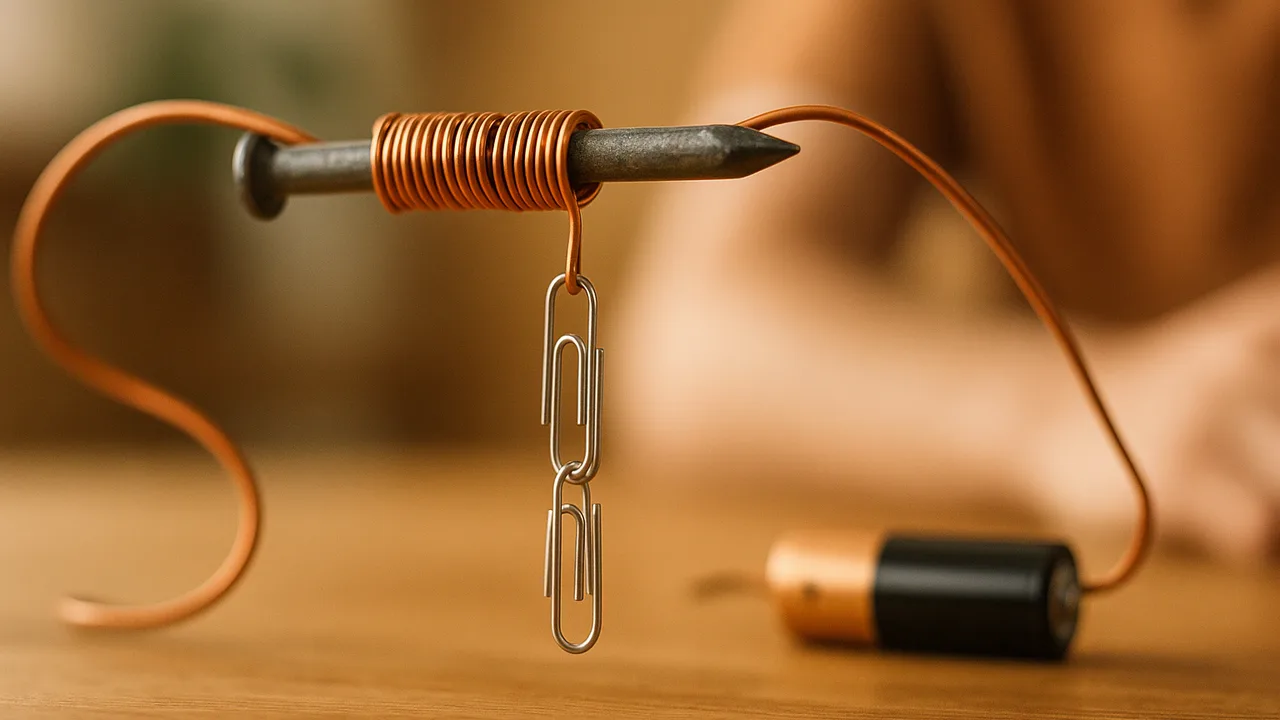
collect data on how the number of coil turns and the electric current change the strength of an electromagnet.
- I can ask questions about data to figure out how changing the electric current or the number of wire turns affects the strength of a magnetic force.
- I can ask questions about data to find out how the distance or orientation between objects changes the strength of electric or magnetic forces.
- I can ask questions about data to understand how the amount or type of electric charge, or the strength of magnets, affects electric or magnetic forces.
- I can use data and science ideas to make a hypothesis that predicts how strong electric or magnetic forces will be when I change certain factors.
- I can use my hypothesis to explain how different changes could lead to different outcomes in the strength of electric or magnetic forces.
Phase 2: Investigate
Warm-Up ~5 min
Do Now. Your teacher wraps insulated wire around a steel nail and connects it to a battery for a few seconds. The nail picks up paper clips. Then the teacher disconnects one wire. Predict first.
What will the paper clips do when the circuit is opened?
Instruction ~10 min
Explore first. Wrap a nail with 10, 20, 30 and 40 turns of wire. For each, close the circuit for a few seconds and count the clips it lifts. Then keep 30 turns and test with one cell, then two cells in a holder. Run three trials each.
| Turns | Cells | Trial 1 (clips) | Trial 2 (clips) | Trial 3 (clips) | Average |
|---|---|---|---|---|---|
| 10 | 1 | ||||
| 20 | 1 | ||||
| 30 | 1 | ||||
| 40 | 1 | ||||
| 30 | 2 |
Naming the idea. An electric current is a flow of charge through a wire. Current flowing through a coil makes a magnetic field. A steel or iron core inside the coil makes the field much stronger. This device is an electromagnet, and it works only while current flows.
Worked example 1: turns and clips. Jamal’s team recorded these sample data averages with one cell: 10 turns, 3 clips; 20 turns, 6 clips; 30 turns, 8 clips; 40 turns, 11 clips. Doubling from 10 to 20 turns roughly doubled the clips. More turns gave a stronger electromagnet. The pattern is close to proportional, but not perfect.
Worked example 2: from data to hypothesis. Mei saw that two cells lifted more clips than one cell with the same 30 turns. She wrote a hypothesis: “If we increase the current, the electromagnet will lift more clips, because more current makes a stronger magnetic field.” A good hypothesis predicts a result and gives a reason.
Why fair tests matter. Change only one variable at a time. Use the same nail, the same clips and the same lifting height. Otherwise you cannot tell which change caused the result.
Guided Exercises ~15 min
Use the sim and your data table. Discuss each card before you answer.
Independent Practice ~10 min
Graph and question your own data.
Make a line graph of turns (x-axis) versus average clips (y-axis) for your one-cell data. Describe the pattern. Is it close to proportional? Write one question the graph raises.
How confident are you that you can I can use data to explain how turns and current change an electromagnet's strength.
Closure ~5 min
More turns and more current make a stronger electromagnet, and it only works while current flows. Next time, we explore the energy stored between magnets.
Exit ticket: the recycling center's electromagnet is too weak to lift heavy steel cans. Using today's data, describe two ways to make it stronger and explain why each would work.
Teacher notes
Materials (per team): a large steel nail or bolt, 2–3 m of thin insulated (enameled or plastic-coated) copper wire, 1–2 D cells in a holder, a switch or clip lead, 30+ small steel paper clips, sandpaper for wire ends. Devices with the Magnets and Electromagnets sim.
Setup: pre-strip wire ends. A switch or clip lead keeps contact short. Batteries drain fast in a short coil, so rotate fresh cells and keep contact to a few seconds.
Listen for: “the battery is a magnet.” The current, not the battery itself, makes the field. Data will be noisy; the trend matters more than exact counts. Worked-example numbers are sample data. No formulas (MS-PS2-3 boundary).
Support / stretch: provide nails pre-wound with 10 and 30 turns. Stretch: test a plastic straw core against a steel core with the same turns and report the difference.