2.25 Showcase: Presenting the Sorting Line to the Recycling Center
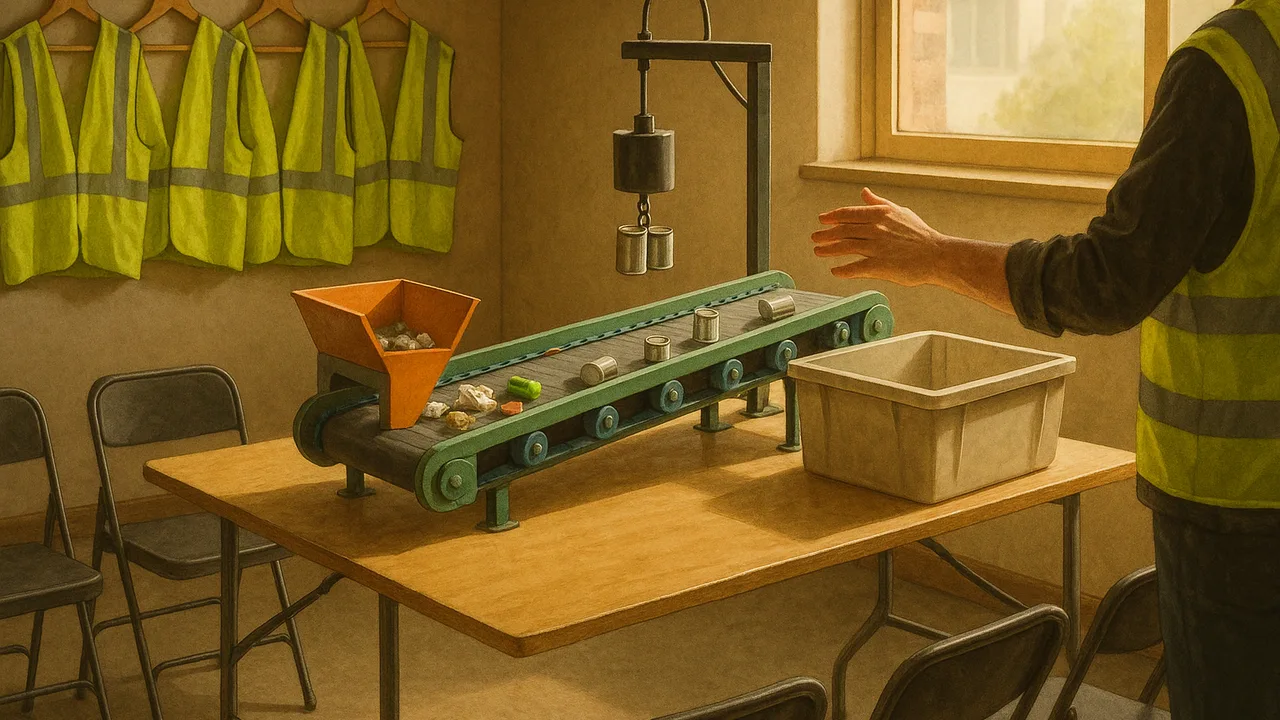
present our sorting line design to the recycling center and defend it with data, a model and the science of forces at a distance.
- I can use data to identify the best features from each design that could be combined to create a better solution.
- I can explain how each part of my proposed solution affects how it works.
- I can describe how my proposed solution connects to the problem I am trying to solve.
- I can explain how each part of my proposed solution relates to the problem and how the data from my model shows how well the solution works.
- I can describe the data that will show two objects can exert forces on each other without touching.
- I can describe the data that will help me tell the difference between electric and magnetic forces.
- I can describe the data that will show the force on one object is caused by its interaction with a second object, such as when the force disappears if the second object is removed.
Phase 5: Prove It
Warm-Up ~5 min
Do Now. The recycling center manager has five minutes for your team. What three things must they hear before they decide?
Which opening is strongest for a client presentation?
Instruction ~10 min
Sorting engineers, today you present to the client. Each team has 5 minutes to present and 2 minutes for questions. Every member speaks.
The five-part talk: (1) the problem and criteria; (2) how we compared designs and combined the best features; (3) our sorting line model and its limits; (4) the science: how the field acts on steel without touching, and the energy changes; (5) trial data and an honest recommendation.
Worked example 1: explaining the science simply. Mei: “The coil makes a magnetic field when current flows. Steel caps feel a pull across the gap and jump up. When we switch off, the field mostly disappears, gravity wins and the caps drop into the bin. Aluminum doesn’t feel that pull, so it rides on.”
Worked example 2: an honest recommendation. Jamal: “We recommend a coil with many turns, a flat core end and the arm close to the belt. Our model used light bottle caps, so a full-size line needs a much stronger magnet, and we suggest testing it with real crushed cans.” Naming limits builds trust.
Guided Exercises ~15 min
Rehearse with your team, then present. While others present, use the blocks to take notes.
Independent Practice ~10 min
After the showcase.
Write a one-paragraph recommendation to the recycling center: which features should their sorting line use, and why? Use evidence from at least two teams.
Project task: The Recycling Center Sorting Line
Design, build, model, test and present a magnetic sorting line that pulls steel cans out of a mixed recycling stream for a city recycling center. It must sort at least 9 of 10 steel cans in 60 seconds, pick up no aluminum or plastic, release the steel when switched off and run on a safe low-voltage battery. Defend your design with trial data, a model of the line and the science of forces at a distance.
Submission workflow
- Build three electromagnet sorters that differ in one factor and predict their strength from data.
- Run timed sorting trials for rate and accuracy, then combine the best features of several designs.
- Model the sorting line, run what-if tests and name the model’s limits.
- Take peer critique, build Version 2 and run the official sorting trial against every criterion.
- Present to the recycling center: problem, combined design, model, science, data and an honest recommendation.
How it is scored
| Criterion | What proficient looks like |
|---|---|
| Testing and combining designs | Data from three or more designs is organized in a table and graph; the best features are chosen with evidence and combined, and trade-offs are named. |
| Modeling the solution | The model shows parts, inputs, outputs, criteria and constraints; what-if data is used to improve the design; at least two limits are explained. |
| Science of forces at a distance | Explains how the coil’s magnetic field acts on steel without contact, how turns, current and distance change the force, how gravity pulls the steel down, and how energy is stored and transferred as caps move and stop. |
| Results and communication | Trial data is compared with every criterion; the recommendation is honest and clear; every member speaks and answers questions with evidence. |
Closure ~5 min
You solved a real problem for a real client, sorting engineers. Next: the unit checkpoint, then two catch-up and stretch days.
Exit ticket: which question from our Wonder Board can you now answer? Write the question and your answer.
How confident are you that you can I can defend a design to a client with data, a model and science.
Teacher notes
Materials: final sorters and model lines, graphs and feature tables on posters or slides, rubric copies for visitors, a timer.
Setup: invite staff from a local recycling program or your school’s facilities team; a video call works if they cannot attend. Visitors can score the “Results and communication” row. Run one live demo per team.
Listen for: “the magnet attracts all metal” (only iron-containing metals like steel); talks that skip limits; one student doing all the talking.
Support / stretch: give the five-part talk frame and allow note cards. Stretch: ask teams how they would add an aluminum station to the line.