1.24 Trail Test Day: Testing Against the Criteria
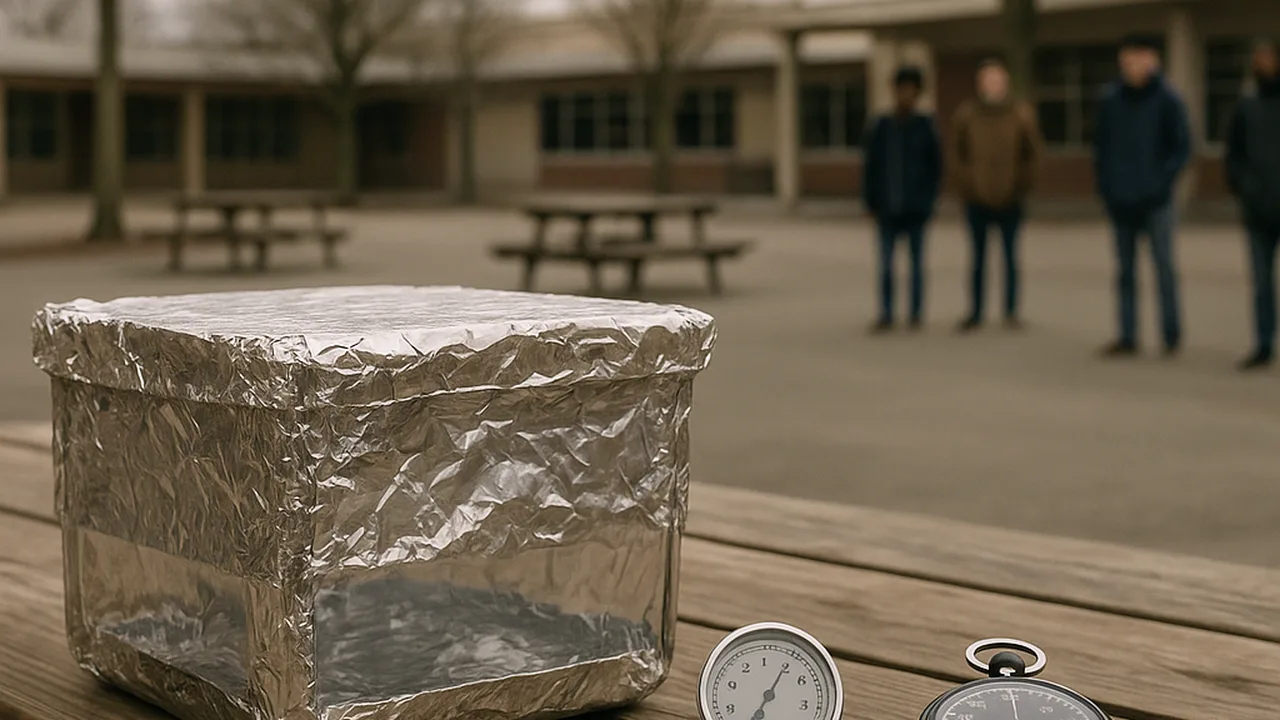
run a final test of my warmer in trail-like conditions and judge it against every criterion and constraint with data.
- I can use my test results to analyze how well my device meets the criteria and constraints, and identify which parts of my design worked best.
- I can use what I know about thermal energy transfer and my test results to evaluate how well my device meets the criteria and constraints.
- I can define the criteria for a solution that meet the needs of the people or groups affected by the problem.
- I can explain who the solution is meant to help and use criteria to compare different solutions, including using numbers when needed.
Phase 5: Prove It
Warm-Up ~5 min
Do Now. On a real trail, the air may be cold and windy. Predict how a cold, breezy test spot will change your warmer’s results, and why.
Compared with the warm classroom, in a cold, breezy spot your meal will most likely…
Instruction ~10 min
Engineers, today is Trail Test Day. Each team runs its version 2 warmer in a “trail station”: a cooler spot near an open window, a hallway with a fan on low, or outside if the weather allows. Every team uses the same station rules.
The rules. Goggles on for activation. The meal is 100 g of water at the same starting temperature. Record the meal temperature every 5 minutes for 20 minutes. Record how the outside feels. Weigh the sealed warmer before and after. Check every seam for leaks.
| Criterion or constraint | Target | Our result | Met? |
|---|---|---|---|
| Rise by 10 minutes | at least 15 °C | ||
| Above start at 20 minutes | at least 10 °C | ||
| Heater material | 20 g or less | ||
| No flame, no electricity, no leaks | all three | ||
| Safe to hold | outside comfortable to hold | ||
| Classroom-safe chemistry | calcium chloride only |
Worked example 1: an honest verdict (sample data). Malik’s team: a 15 °C rise at exactly 10 minutes, 11 °C above the start at 20 minutes, 20 g of heater material, no leaks, outside warm. “We met every criterion, but just barely on the 10-minute rise. In class we rose 17 °C, so the cold station cost us 2 degrees. A colder day could make us miss.”
Worked example 2: explaining a miss. Rosa’s team’s meal rose only 12 °C by 10 minutes. Their data showed the fastest rise in the first 5 minutes, then a flat line. “Our felt got damp from condensation and stopped trapping air well, so more energy escaped. A plastic layer outside the felt might fix it.” A miss with a clear reason is still useful data.
Guided Exercises ~15 min
Use the sample results and then your own.
Independent Practice ~10 min
Write your Trail Test report.
Fill in the criteria table. Graph your meal temperature over 20 minutes. Draw a line 15 °C above the start and mark whether you crossed it by 10 minutes.
Write a verdict for the hiking club: does your warmer meet the criteria and constraints? Use the rate of temperature change and what you know about insulation to explain your result, and name one limitation.
Closure ~5 min
The data is in. Next class, you pitch your warmer to the hiking club.
Exit ticket: if you had one more day, what single change would you make, and which criterion would it improve?
How confident are you that you can I can use test data to evaluate how well my device meets the criteria and constraints.
Teacher notes
Materials: goggles, version 2 warmers, one fresh pack per team, thermometers, scales, timers, a small fan on low or a cool spot, towels, a lined disposal bin.
Setup: set up two or three identical trail stations. Keep the meal water at room temperature in one jug so every team starts the same. Dispose of used packs as your school directs for calcium chloride solution.
Listen for: teams hiding a miss; “it would have worked” without data.
Support / stretch: give a verdict sentence frame. Stretch: compare your class and cold-station runs and estimate how much the breeze slowed the warming.