2.14 Ideate: Brainstorming the Sorting Line
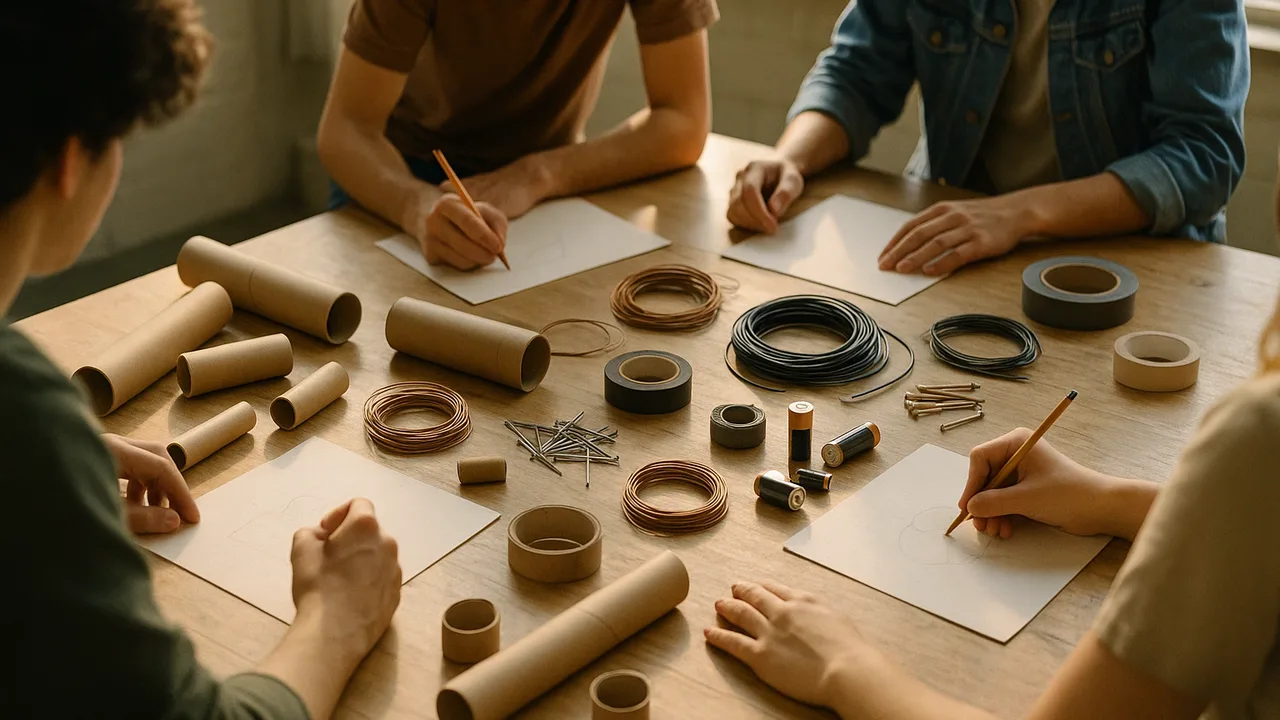
brainstorm at least three sorting-line designs grounded in the science of magnetic fields and electromagnets, and ask questions to test them.
- I can ask questions about electric and magnetic forces that can be tested with experiments or investigations in places like my classroom or a museum.
- I can use data and science ideas to make a hypothesis that predicts how strong electric or magnetic forces will be when I change certain factors.
- I can use my hypothesis to explain how different changes could lead to different outcomes in the strength of electric or magnetic forces.
Phase 3: Make Sense
Warm-Up ~5 min
Do Now. Reread the class criteria and constraints from 2.09. Circle the one criterion you think will be hardest to meet. Be ready to say why.
Which magnet type best fits the “drop the steel into the right bin” criterion?
Instruction ~10 min
Brainstorm rules. Go for quantity first. Build on others’ ideas. No criticism during the brainstorm. Every idea must connect to a science idea from this unit.
Worked example 1: three idea sketches. Priya’s team listed: (A) an overhead electromagnet that switches on over the belt, then off over a bin; (B) a permanent magnet inside a turning drum at the end of the belt, so steel clings to the drum and drops off behind it; (C) a magnet beside a slide, so steel curves toward one bin and aluminum slides straight. Each uses magnetic fields; A also uses current control.
Worked example 2: linking ideas to science. For idea A, Diego wrote: “More turns and current make a stronger field, so it can lift cans from a bigger gap.” For idea C, he wrote: “The pull is strongest close to the magnet, so the slide must pass near it.” Each link is backed by our data.
Worked example 3: testable questions. For idea B, Mei asked, “At what belt speed does the drum still catch at least 8 of 10 steel cans?” That question names a variable to change and a result to measure. It is ready for the Build phase.
| Idea | Sketch | Science idea it uses | Criteria it should meet | A testable question |
|---|---|---|---|---|
| 1 | ||||
| 2 | ||||
| 3 | ||||
| 4 (optional) |
Real-world link. Many recycling facilities use magnets above belts or inside drums to pull out steel. Some also use other machines for aluminum. Our designs follow the same science.
Guided Exercises ~15 min
Brainstorm with your team, then check each idea against the science.
Independent Practice ~10 min
Choose and justify.
Pick the idea you would build first. Explain why it best fits the criteria and constraints, and name one variable you would change in your first test and why.
How confident are you that you can I can brainstorm designs grounded in science and ask questions to test them.
Closure ~5 min
Our science is ready, and so are our ideas. Next, in the Build phase, we prototype, test and improve a model sorting line for the recycling center.
Exit ticket: write two testable questions about your chosen design: one about the magnet's distance from the cans and one about its strength.
Teacher notes
Materials: chart paper, markers, brainstorm table, class criteria and constraints from 2.09, sample magnets and cans for quick checks.
Setup: time the brainstorm (8 minutes), then 10 minutes to link ideas to science. Save the posters; part 2 of the unit starts from them.
Listen for: ideas with no science link, and “magnets can pick out aluminum.” Real facilities do use special machines for aluminum, but they are beyond this unit; keep the focus on steel. Keep claims about real facilities general.
Support / stretch: give one idea per team to start from. Stretch: list one trade-off for each idea, such as speed versus accuracy.