2.01 The Crane That Drops a Car
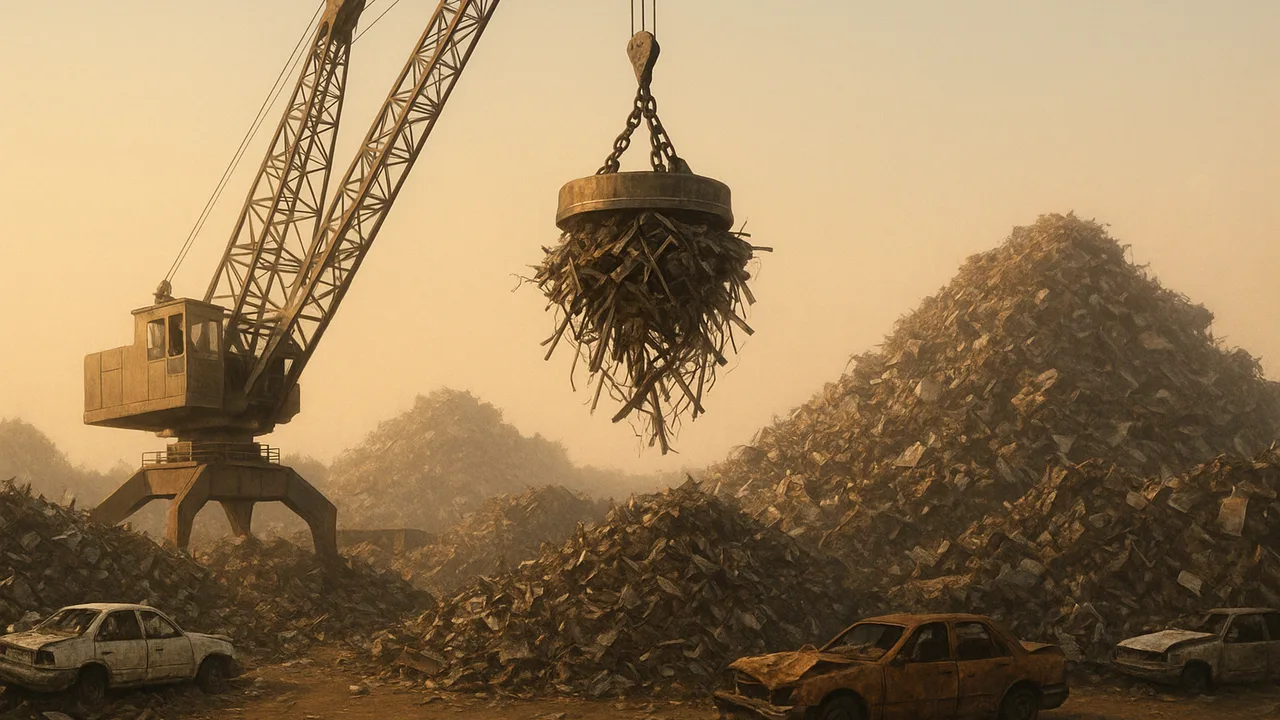
The Recycling Center Sorting Line
How do objects push and pull without touching, and how can we use that to sort steel from everything else in a recycling stream?
The mystery: At a scrapyard, a crane lifts a whole car with a giant magnet, then drops it the moment the operator flips a switch. Maglev trains float above their tracks. A balloon rubbed on hair sticks to the wall.
Questions we will figure out together in this unit:
- Why does a magnet pick up steel but not aluminum?
- How can a crane turn its magnet on and off?
- Does a magnet get weaker when it is farther away?
- Why does a rubbed balloon stick to the wall?
- Is gravity the same kind of force as magnetism?
- How does a maglev train float?
- Can you make a magnet stronger with more electricity?
- Does a magnet’s pull go through paper or plastic?
describe how objects can push or pull each other without touching, and explain the recycling center’s sorting problem.
- I can identify the phenomenon being investigated, including how objects can interact with each other even when they are not touching.
- I can ask questions about electric and magnetic forces that can be tested with experiments or investigations in places like my classroom or a museum.
Phase 1: Spark
Warm-Up ~5 min
Do Now. Your teacher holds a strong magnet a few centimeters above a pile of paper clips, then slowly lowers it. Before the magnet comes down, make your prediction.
What will the paper clips do as the magnet comes closer?
Instruction ~10 min
The phenomenon. At a scrapyard, a crane swings a giant round magnet over a wrecked car. The car rises into the air. Then the operator flips a switch, and the car drops instantly. Maglev trains float above their tracks. A balloon rubbed on hair sticks to a wall. In each case, something pushes or pulls without touching.
A request from our client. A city recycling center collects a mixed stream of cans, bottles, paper and cartons. Workers sort much of it by hand. The center wants a magnetic sorting line that pulls steel cans out of the stream automatically. It must not grab aluminum cans or plastic, and it must let the steel go into the right bin.
Sorting engineers, here is your mission. Design and test a model sorting line for the recycling center. First, you need to understand forces that act at a distance: magnetic, electric and gravitational.
Worked example 1: contact force or non-contact force? In grade 6 you studied pushes and pulls such as a kick or friction. Those are contact forces, because the objects touch. A magnet lifting a clip across a gap is a non-contact force. So is gravity pulling a dropped apple down. Ask, “Are the objects touching when the force acts?”
Worked example 2: a testable question. Malik asked, “Why are magnets cool?” No experiment can answer that. Priya asked, “Does a magnet pick up fewer paper clips when it is held farther away?” She can change one thing, distance, and count clips. A testable question names something to change and something to measure.
Our teams. Teams of four rotate roles each lesson. The Materials Manager gets and returns supplies. The Recorder keeps the data table. The Tester runs each trial. The Reporter and Safety Lead checks safety rules and shares the team’s thinking.
Guided Exercises ~15 min
Work through these with your team. Use the arrows to move between cards. Talk it over before you lock in an answer.
Independent Practice ~10 min
Start the class Wonder Board on your own.
Write two questions about forces at a distance. Make at least one of them testable in our classroom: name what you would change and what you would measure.
How confident are you that you can I can describe a force that acts between objects that are not touching.
Closure ~5 min
Add your sticky notes to the Wonder Board. Next time, we sort a sample recycling stream and find out which items a magnet actually pulls.
Exit ticket: describe the phenomenon we are investigating in your own words. Include one example where two objects interact without touching, and say how you know they are not touching.
Teacher notes
Materials: one strong bar or ceramic magnet, a pile of steel paper clips, sticky notes, chart paper for the Wonder Board, a roles chart. A short video of a scrapyard magnet crane makes a strong hook; preview it first. If you can, have a recycling worker or facilities staff member deliver the request.
Setup: post the driving question and the client request. Keep the Wonder Board up all unit; lessons 2.03–2.13 answer most of its questions.
Listen for: “magnets attract all metals.” Do not correct yet; 2.02 tests it. Some students think gravity needs air; note the idea for 2.07.
Support / stretch: give a frame: “If we change ___, will ___ change?” Stretch: ask students to rank three of the Wonder Board questions from most to least testable and explain the ranking.