1.11 Where the Heat Goes: Modeling Energy Transfer
model how thermal energy moves from warmer to cooler matter and explain how mass and type of matter affect the temperature change.
- I can plan what data to collect in my investigation, including the initial and final temperatures, the types of matter, and the mass of each sample.
- I can explain how I will use my data to show how changes in temperature relate to the mass and type of matter, and to the change in average kinetic energy of the particles.
- I can explain how thermal energy moves from hotter objects to colder objects.
- I can describe the materials I use in my design, including their properties like thickness, heat conductivity, and reflectivity, and explain how these help minimize or maximize thermal energy transfer.
- I can show how my device solves the problem by minimizing or maximizing thermal energy transfer.
Phase 3: Make Sense
Warm-Up ~5 min
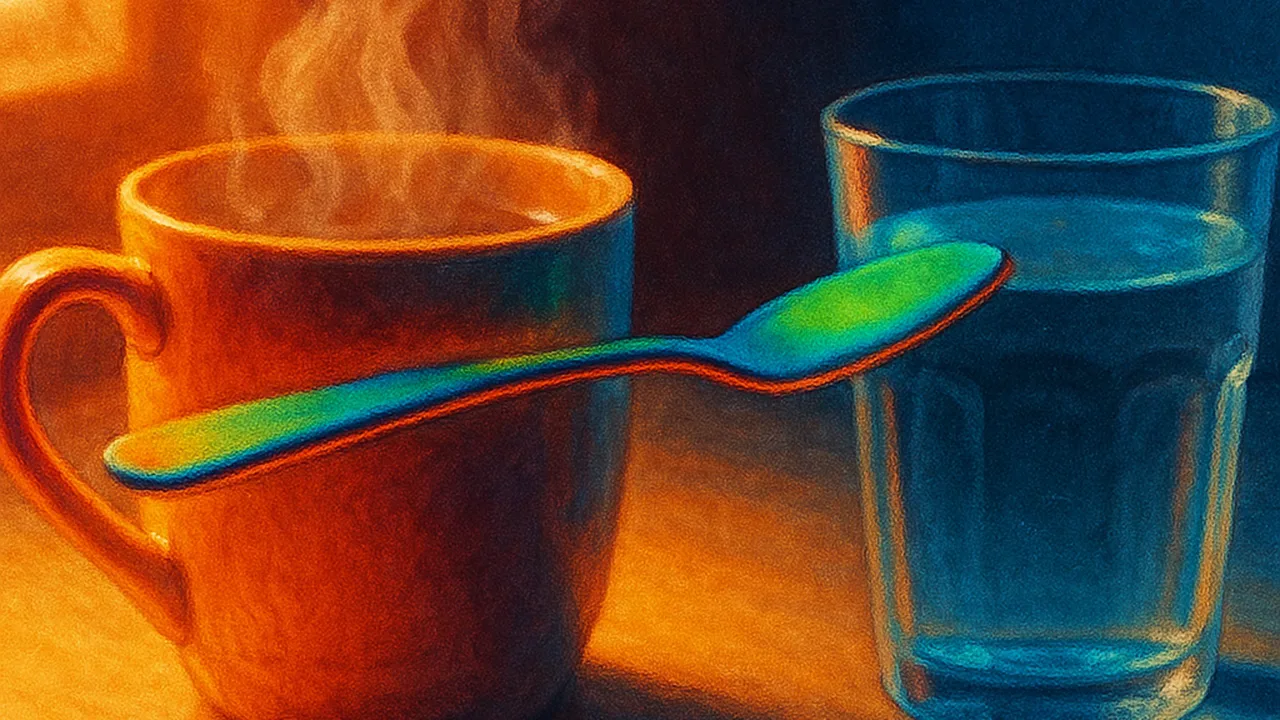
Do Now. A metal spoon and a wooden spoon have sat in the same room all night. Your hand says the metal one feels colder. Is it really colder? Write your answer.
A thermometer touches each spoon. What will it read?
Instruction ~10 min
Reading: energy on the move. Particles in all matter are always moving. When a warm object touches a cooler one, faster particles collide with slower ones and pass along some of their energy. Thermal energy moves from the warmer object to the cooler one. This continues until both reach the same temperature. The energy is not used up; it is shared.
Temperature tells us the average kinetic energy of particles. If a small amount of matter receives energy, each particle gets a bigger share and the temperature rises a lot. If a large amount receives the same energy, each particle’s share is smaller, so the temperature rises less. Different materials also respond differently: equal masses of sand and water reach different temperatures with the same energy input.
Worked example 1: a particle model of Part A. Ava drew 10 fast particles (warm water) next to 10 slow particles (cold water), then next to 40 slow particles. With 10, each slow particle gained a lot of speed. With 40, the same energy spread thinner, so each gained less. Her drawing explains our data: more mass, smaller temperature change.
Worked example 2: planning a test. Jamal wants to know whether a heater warms soup or water more. He plans to use the same heater, 200 g of each, the same pouch, and the same starting temperature. He will record the start and highest temperatures in °C, and the mass in grams. Only the type of matter changes.
Try the model. The PhET sim lets you heat blocks and beakers of different materials and watch energy move.
Guided Exercises ~15 min
Use the sim and your 1.08 data. Talk it through with your team.
Independent Practice ~10 min
Model the meal warmer.
Draw a particle model of a heater pouch warming a meal. Show energy moving from the heater into the food and also leaking into the air. Label where particles speed up and slow down.
Plan a test of whether rice or water warms more in the same pouch. List the measurements, the units and when you will take them.
Closure ~5 min
Energy flows from warm to cool and is shared among particles. Next time, we decide which heat source fits our warmer best.
Exit ticket: why would a big meal need more heater material than a small one to reach the same temperature? Use the word particles.
Teacher notes
Materials: a metal spoon, a wooden spoon, a thermometer probe, devices for the PhET sim, 1.08 data.
Setup: test the sim on student devices beforehand; the Intro screen is enough.
Listen for: “cold moves into my hand” and mixing up temperature with total thermal energy. No calculation of total energy; the 10°C prediction is a proportional comparison only, and real results lose some energy to the air.
Support / stretch: provide a particle drawing template. Stretch: explain why a large lake changes temperature more slowly than a small puddle.