1.05 The Sealed-Bag Balance: Does Mass Disappear?
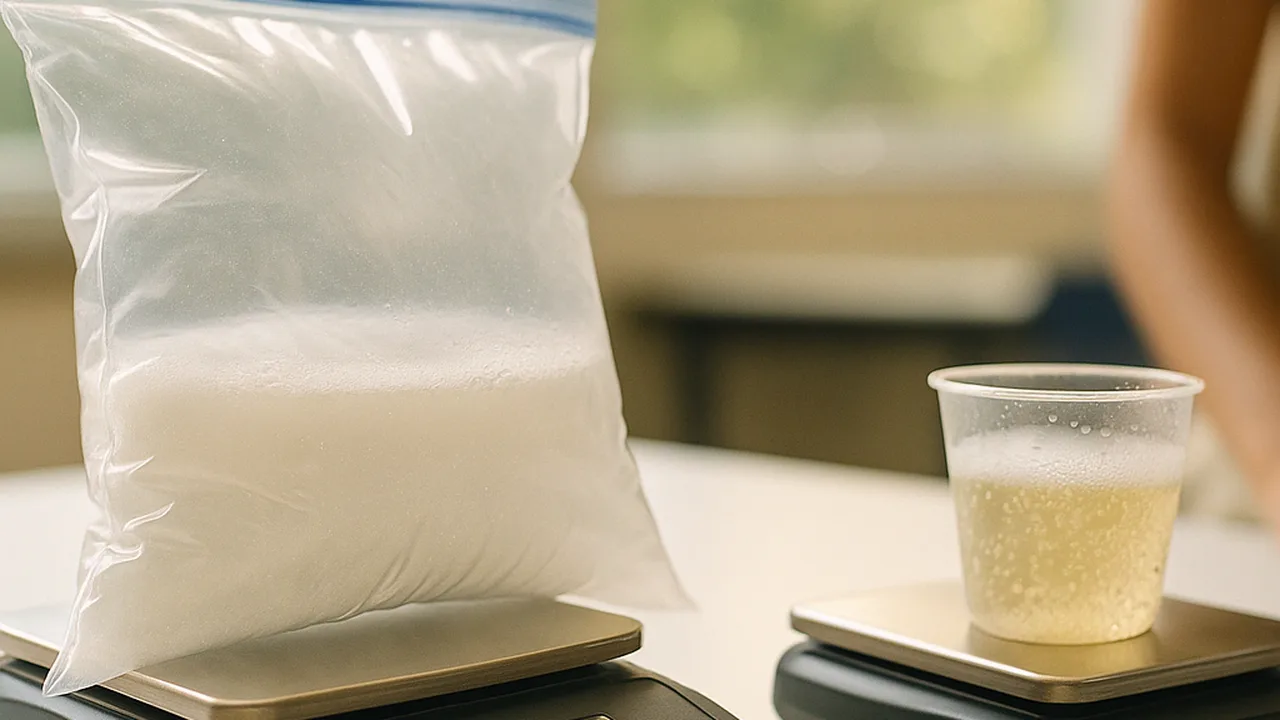
measure the mass of a reaction in a sealed bag and an open cup and explain why the total mass of a closed system stays the same.
- I can use my model to explain that mass is conserved in a chemical reaction because the number and types of atoms stay the same, and each type of atom always has the same mass.
Phase 2: Investigate
Warm-Up ~5 min
Do Now. A bag holds a small cup of vinegar standing upright, with baking soda in the corner of the bag. The bag is sealed and sits on a balance. Predict what the balance will read after the two mix.
After the baking soda and vinegar react inside the sealed bag, the mass on the balance will…
Instruction ~10 min
Explore first. Run the reaction twice: once sealed in a zip bag and once in an open cup. Measure the total mass before and after each time. For the cup, put the baking soda on a small paper square on the balance pan, beside the vinegar cup, so everything is weighed together.
| Trial | Mass before (g) | Mass after (g) | Change (g) | What I observed |
|---|---|---|---|---|
| Sealed bag, trial 1 | ||||
| Sealed bag, trial 2 | ||||
| Open cup, trial 1 | ||||
| Open cup, trial 2 |
Name the ideas. A closed system lets no matter in or out. An open system lets matter cross its boundary. The law of conservation of mass says that in a chemical reaction, the total mass of the products equals the total mass of the reactants. Matter is not created or destroyed; it is rearranged.
Worked example 1: the sealed bag. These are sample data. Priya’s sealed bag read 182.4 g before mixing and 182.3 g after. A change of 0.1 g is about the size of the balance’s own uncertainty. The bag puffed up, so a gas formed, yet the total mass held steady.
Worked example 2: the open cup. Also sample data. Diego’s open cup read 96.0 g before and 94.8 g after. The 1.2 g did not vanish. It left as carbon dioxide gas that floated out of the cup into the room, outside the system he was weighing.
Why it matters for the warmer. If our heater makes a gas, that gas has mass and takes up space. A sealed pouch could swell. Engineers must plan where every product goes.
Guided Exercises ~15 min
Use your class data. Work with your team on each card.
Independent Practice ~10 min
Explain the numbers.
Make a bar graph of the mass change for each trial. Explain why the sealed and open results differ, using the words closed system and open system.
A classmate says, “The open cup proves reactions destroy matter.” Write a respectful reply using your data.
Closure ~5 min
Mass stayed the same when nothing could escape. Next time, we zoom in with models to see why: what happens to the atoms?
Exit ticket: explain why a heater pouch that makes gas should be designed with the gas in mind. Use the idea of conservation of mass.
Teacher notes
Materials (per team): goggles, quart-size zip bags, small plastic cups (medicine-cup size) that fit inside the bag, baking soda, vinegar, an electronic balance reading to 0.1 g, paper squares, paper towels.
Setup: practice the upright-cup trick: stand the vinegar cup in the bag, seal it, weigh it, then tip the cup to mix.
Listen for: “gas weighs nothing” and “the bag got lighter because it is full of air.” A very puffy bag can read slightly lower because it pushes aside more room air, which buoys it a little; keep amounts small to limit this. Treat differences of about 0.1–0.2 g as measurement uncertainty.
Support / stretch: provide a subtraction frame for the Change column. Stretch: predict whether a hand warmer gains or loses mass as it works in open air, given that it takes in oxygen.