2.18 Inside a Recycling Center: Magnets and Eddy Currents
explain how recycling centers use magnetic fields to sort steel and aluminum, and judge whether evidence shows fields act without contact.
- I can identify the phenomenon being investigated, including how objects can interact with each other even when they are not touching.
- I can explain the purpose of the investigation, which is to show that fields exist between objects that exert forces on each other without being in contact.
- I can evaluate if the investigation’s design and data can show that fields exist between objects that act on each other without touching.
Phase 4: Build
Warm-Up ~5 min
Do Now. A recycling truck dumps a mixed load: steel cans, aluminum cans, plastic bottles and paper. A magnet can grab the steel. How could anyone pull out the aluminum, which a magnet will not pick up?
Drop a strong magnet down a thick aluminum tube. What happens?
Instruction ~10 min
Sorting engineers, a field is a region where an object feels a force without being touched. A magnet has a magnetic field around it. A charged balloon has an electric field. You cannot see a field, but you can see its effects: iron filings line up, a compass needle turns, a cap jumps to a coil.
Worked example 1: planning a field investigation. Ava wants to show that the sorter’s field reaches the caps. Her plan changes the distance (0.5, 1, 2 and 3 cm), and it changes the field strength (one cell or two). It uses a compass as the detector: if the needle swings, a field is present. Each change answers a question: Does the force reach across space? Does a stronger field reach farther? Is the force really there?
Worked example 2: is the evidence good enough? Diego says, “The caps jumped up, so there is a field.” Kofi asks, “Could static from your sleeve have done it?” So they repeat the test with the coil switched off. Nothing jumps. Then they switch it on and the compass swings. Two kinds of evidence, plus a switched-off control, make the claim much stronger.
Read the case study below. Recycling centers use these same ideas at a much bigger scale.
Guided Exercises ~15 min
Read the case study first, then work through the blocks.
Independent Practice ~10 min
Plan and judge.
Write a 4-step plan to show that your sorter's magnetic field reaches across a gap. Explain why your plan changes the distance AND the field strength, and what your detector is.
Diego's only evidence was “the caps jumped.” Explain whether that is enough to prove a field exists, and what would make it stronger.
🔎 Mini case study: Mini case study: how recycling centers sort metals ~7 min
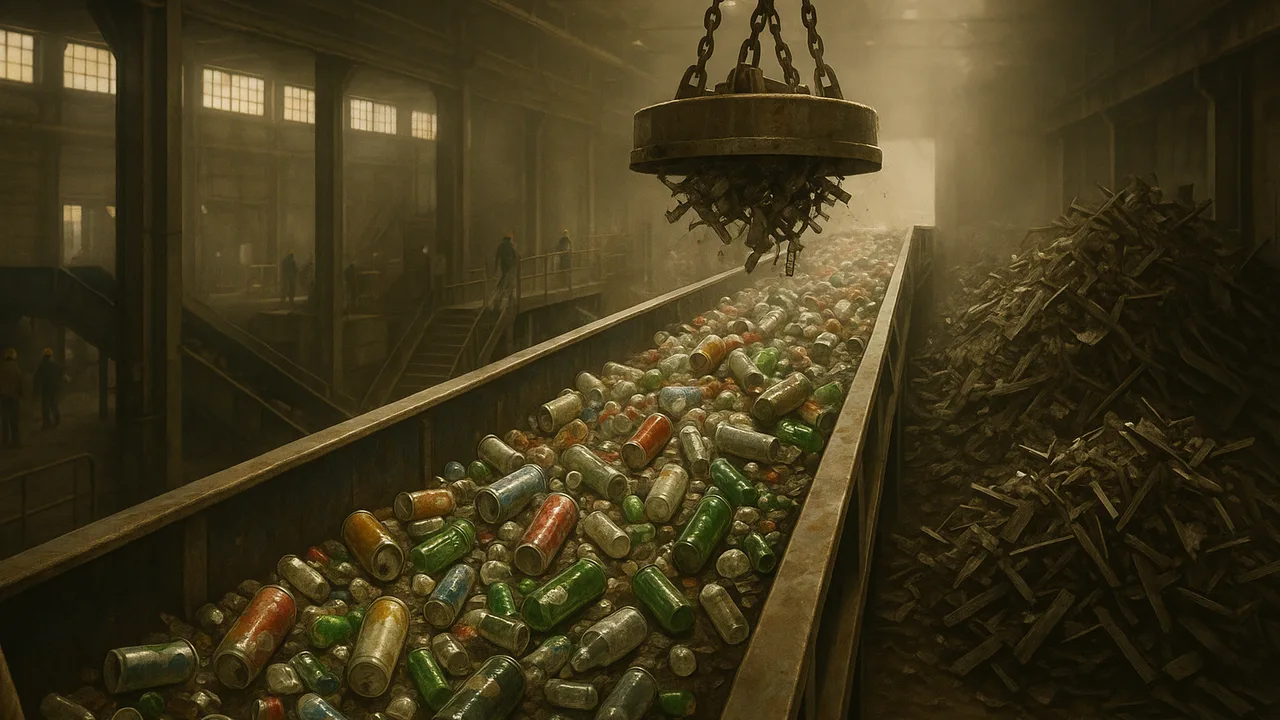
At many recycling centers, mixed recycling rides along conveyor belts through a series of sorting machines. Steel cans are usually pulled out by magnets. One common setup hangs a strong magnet just above the belt. Another uses a magnetic drum or head pulley at the end of a belt. Steel items are pulled toward the magnet and carried off to their own pile, while everything else keeps moving.
Aluminum cans are trickier, because a magnet does not pick them up. Many centers use an eddy current separator. Its rotor holds magnets that spin very fast, so the magnetic field changes over and over. That changing field makes swirling electric currents inside the aluminum. These currents make their own magnetic field, which pushes away from the rotor. The aluminum cans get flung off the end of the belt into a separate bin, while plastic and paper simply drop.
Steel and aluminum can both be melted down and made into new products again and again. Sorting them cleanly is what makes that possible.
Think about it: Our sorter only handles steel. Which idea from the real recycling center could help our design, and what evidence would show it works?
Closure ~5 min
Now you know how the pros do it, sorting engineers. Next class we draw a model of our whole sorting line.
Exit ticket: explain, in two sentences, how a recycling center can separate steel AND aluminum using magnetic fields.
How confident are you that you can I can explain how an investigation shows that fields act between objects that are not touching.
Teacher notes
Materials: a compass per team, iron filings in a sealed bag or clear box, the team sorters, optional: a strong neodymium magnet and a thick aluminum or copper tube for the demo.
Setup: run the falling-magnet demo once for the class. Keep eddy currents descriptive: changing field → currents in the metal → a push. No equations. Strong magnets pinch fingers and harm electronics; teacher handles them.
Listen for: “aluminum is magnetic” (it is pushed only by a changing field); “the field is the wire” (the field fills the space around it).
Support / stretch: give a labeled diagram of the belt, overhead magnet and eddy current separator. Stretch: explain why the eddy current rotor must spin fast to work.