1.15 Three Ways to Warm a Meal: Competing Concepts
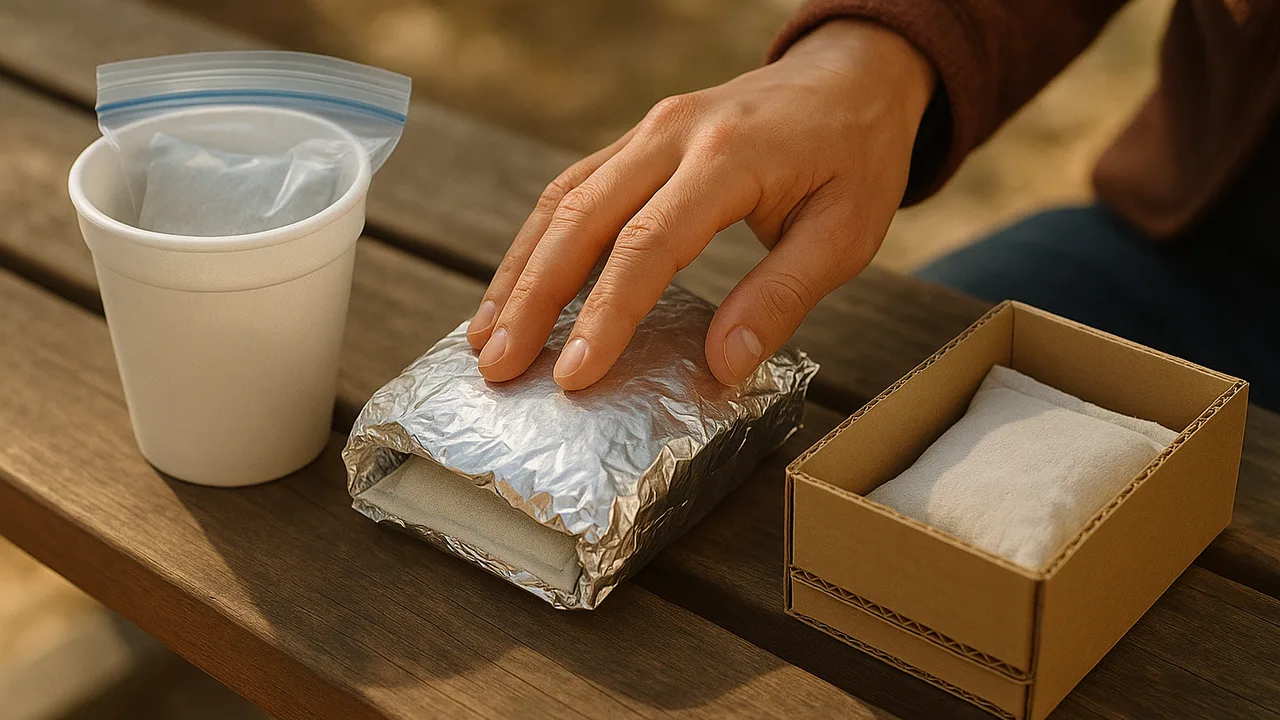
sketch competing meal-warmer concepts and explain how each one could meet the hiking club’s criteria and constraints.
- I can identify scientific ideas that relate to the problem and each possible solution.
- I can explain how each design solution could solve the problem.
- I can define the criteria for a solution that meet the needs of the people or groups affected by the problem.
- I can explain who the solution is meant to help and use criteria to compare different solutions, including using numbers when needed.
Phase 4: Build
Warm-Up ~5 min
Do Now. A hiker stops at a cold trail shelter. Open fires are banned there, and there is no outlet. List three ways the hiker could still get a warm meal, and one problem with each way.
Which heat source fits BOTH of our clients, the hiking club and the emergency-preparedness group?
Instruction ~10 min
Engineers, welcome to the Build phase. In Make Sense you explained where the heat in a self-heating meal comes from. Now you will turn that science into a working warmer for two clients: a hiking club and a community emergency-preparedness group.
Restate the problem. People on a trail, or at home after a storm knocks out power, need a hot meal. They cannot use a flame or electricity. Our job is a light, safe pouch that warms the meal using a process that releases thermal energy.
Our criteria, from 1.09: the test meal (100 g of water in a sealed bag) rises at least 15 °C within 10 minutes, is still at least 10 °C above its start at 20 minutes, and the outside stays comfortable to hold. Our constraints: no more than 20 g of heater material; no flame, no electricity and no leaks; only processes on the approved list, with nothing that releases a flammable gas; goggles for every mix; and two class periods to build. If your class agreed on different numbers, use yours.
The system. Inside the system are the heat pack, the meal bag, any insulation and the outer sleeve. Outside the system are the cold air, the hiker’s hands and the ground. Thermal energy should flow from the pack into the meal, not out into the air.
Worked example 1: Concept A, the Pack Sandwich. Ava’s team splits its 20 g of calcium chloride into two flat 10 g packs, one on each side of the meal bag. Their reasoning: “Two packs touch more of the meal, so thermal energy moves in from both sides.” Their worry: each small pack may cool off fast, so the meal may not stay warm until 20 minutes.
Worked example 2: Concept B, the Wrapped Pocket. Malik’s team uses one pack under the meal and wraps both in a felt sleeve. Their reasoning: “One 20 g pack keeps the energy in one place, and the felt slows energy escaping to the cold air.” Their worry: the meal might not rise 15 °C within 10 minutes. Both teams use the same chemistry. They differ in how they move and keep the energy.
| Concept | Sketch labels | Estimated mass (g) | How energy gets into the meal and stays there | Biggest risk |
|---|---|---|---|---|
| A | ||||
| B | ||||
| C |
Guided Exercises ~15 min
Work with your team. After each block, add a note to your concept table.
Independent Practice ~10 min
Sketch your own concepts.
Sketch at least two warmer concepts. Label the heat pack, the meal bag and any insulation, and estimate each concept's total mass in grams.
For each concept, explain in two or three sentences how thermal energy moves from the pack into the meal, and what stops it from escaping too fast.
Closure ~5 min
Good start, engineers. Next class, you will choose between your concepts with a decision matrix instead of a vote.
Exit ticket: name the people affected if a warmer fails in an emergency, and one criterion that protects them.
How confident are you that you can I can explain how each design solution could solve the problem.
Teacher notes
Materials: notebooks, colored pencils, the class criteria and constraints poster from Part 1, sample materials to handle (zip bags, felt, foam sheet, bubble wrap, cardboard, a kitchen scale).
Setup: if Part 1 set different criteria, change the 15 °C, 10-minute, 20-minute and 20 g targets everywhere in this part. Give 12 minutes for sketching. Weigh one empty zip bag and one felt sleeve so teams can estimate mass.
Listen for: “the pack makes heat out of nothing” (energy is released from the substances, not created); concepts that are the same design twice.
Support / stretch: give a concept template with label lines and a mass box. Stretch: add a third concept that could be reused after a trip.