2.15 Version 1 Sorters: Coils, Cores and Steel
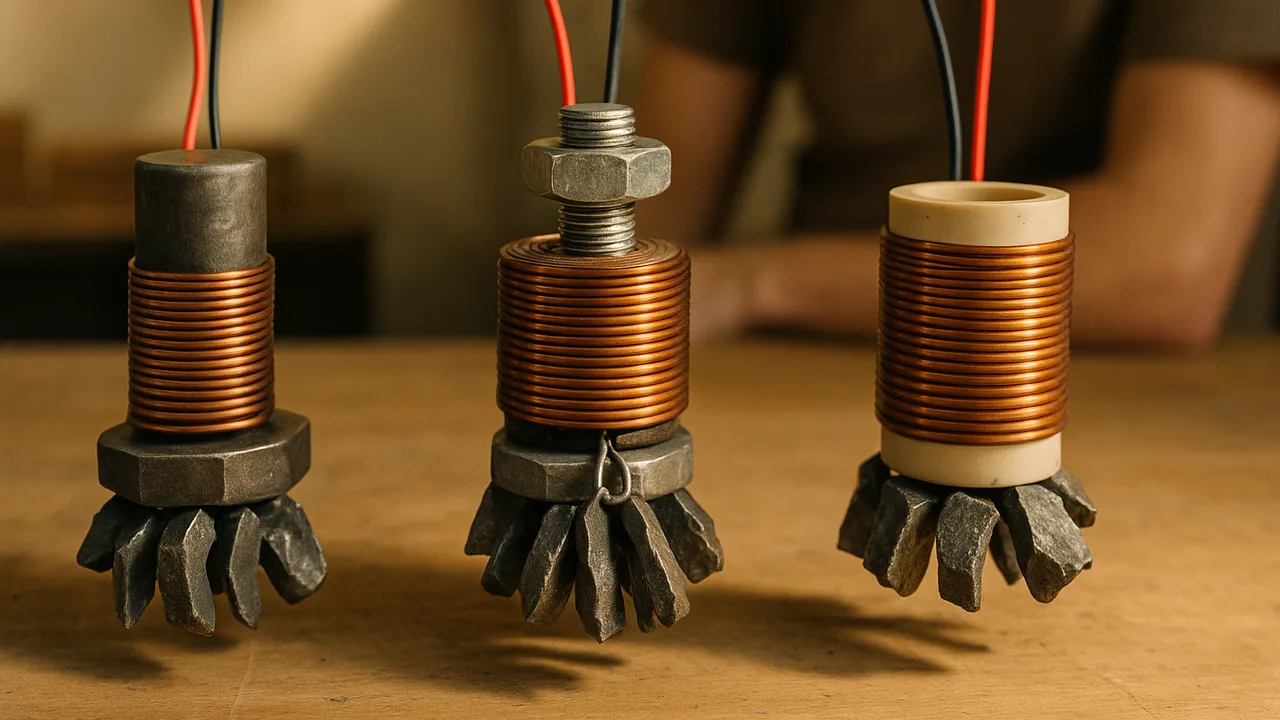
build three electromagnet sorters that differ in one factor and use data to predict which will pull steel the hardest.
- I can ask questions about data to figure out how changing the electric current or the number of wire turns affects the strength of a magnetic force.
- I can ask questions about data to find out how the distance or orientation between objects changes the strength of electric or magnetic forces.
- I can ask questions about data to understand how the amount or type of electric charge, or the strength of magnets, affects electric or magnetic forces.
- I can use data and science ideas to make a hypothesis that predicts how strong electric or magnetic forces will be when I change certain factors.
- I can use my hypothesis to explain how different changes could lead to different outcomes in the strength of electric or magnetic forces.
- I can organize data from tests of three or more design solutions using tables, charts, or graphs.
Phase 4: Build
Warm-Up ~5 min
Do Now. Remember the scrapyard crane from our phenomenon. It lifts a whole car, then drops it when the operator flips a switch. Which part of that magnet must be different from a fridge magnet?
Why can a scrapyard crane drop a car on command?
Instruction ~10 min
Sorting engineers, welcome to the Build phase. Our client, a city recycling center, needs a sorting line that pulls steel cans out of a mixed stream. In class, steel bottle caps or washers stand in for the cans. Aluminum foil pieces and plastic beads stand in for everything else.
Our criteria: sort at least 9 of 10 steel “cans” out of a mixed batch in 60 seconds, pick up no aluminum or plastic, and release the steel when switched off. Our constraint: a safe, low-voltage battery, with short contact only.
An electromagnet is a coil of wire around an iron or steel core. When current flows through the coil, the core becomes a magnet. When the current stops, most of the magnetism goes away. That on-off switch is exactly what a sorter needs.
Three factors you can change. In Part 1 you found that more turns of wire, more current and a smaller distance all make the magnetic force stronger. Today each team builds three versions that change just one factor, so the test is fair.
Worked example 1: turning a pattern into a hypothesis. Jamal’s team tested two coils on one cell (sample data). The 20-turn coil picked up 4 steel caps. The 40-turn coil picked up 8. Their hypothesis: “If we use 60 turns, then the coil will pick up about 12 caps, because more turns made a stronger magnetic force in our data.” Doubling the turns roughly doubled the pickups here, but they will test whether the pattern keeps going.
Worked example 2: distance matters. Mei held the same coil at three heights above a tray of caps (sample data). At 0.5 cm it lifted 6 caps. At 1 cm it lifted 2. At 2 cm it lifted none. Her claim: the magnetic force gets weaker quickly as distance grows. So a sorter must pass close to the stream.
| Version | Turns | Cells (1.5 V each) | Core | Caps lifted at 0.5 cm | Our prediction |
|---|---|---|---|---|---|
| A | |||||
| B | |||||
| C |
Guided Exercises ~15 min
Build Version A first, then change ONE factor for B and C. Record each result in the table before you move on.
Independent Practice ~10 min
Use your team’s table.
Write a hypothesis for your Version C, using If… then… because…. Your because must cite data from Version A or B.
Mei's data showed 6 caps at 0.5 cm and 2 caps at 1 cm. Predict how many caps lift at 1.5 cm, and explain the pattern you used.
Closure ~5 min
Three sorters built, sorting engineers. Next class we run real sorting trials and time them.
Exit ticket: name the two factors that most changed the strength of your electromagnet. Give the evidence for each.
How confident are you that you can I can use data to predict how strong an electromagnet will be when I change one factor.
Teacher notes
Materials (per team): about 3 m of enameled magnet wire (22–26 gauge), three large iron nails or steel bolts, sandpaper, one or two D-cell holders and cells, 20 steel bottle caps or small steel washers, a ruler, goggles. Test every “steel cap” with a magnet first; some caps are aluminum.
Setup: post the class criteria and constraints from 2.09. If your class set different targets, use yours everywhere this part says 9 of 10 or 60 seconds. Sand 2 cm of enamel off each wire end before class for younger groups. Wind turns tightly in one direction. The 0.5 cm test height can be set with a stack of index cards.
Listen for: “the battery is the magnet” (the current in the coil makes the magnetism); changing two factors at once; treating sample patterns as exact laws.
Support / stretch: give a prewritten hypothesis frame. Stretch: test a steel nail core versus a pencil (no core) at the same turns and explain the difference.