2.08 Ramps and Crashes: Energy That Changes Speed
observe how energy transferred to or from a cart changes its speed, and describe the evidence before and after each change.
- I can make a claim that when an object’s kinetic energy changes, energy is transferred to or from that object.
- I can identify and describe changes in observable features, like motion, temperature, or sound, of an object before and after its kinetic energy changes.
- I can identify and describe changes in observable features of other objects or the surroundings in the system when kinetic energy changes.
Phase 2: Investigate
Warm-Up ~5 min
Do Now. A toy cart rolls down a ramp and hits a second, parked cart. Picture the moment of the crash. Predict before the teacher runs it.
After the crash, what happens to the two carts?
Instruction ~10 min
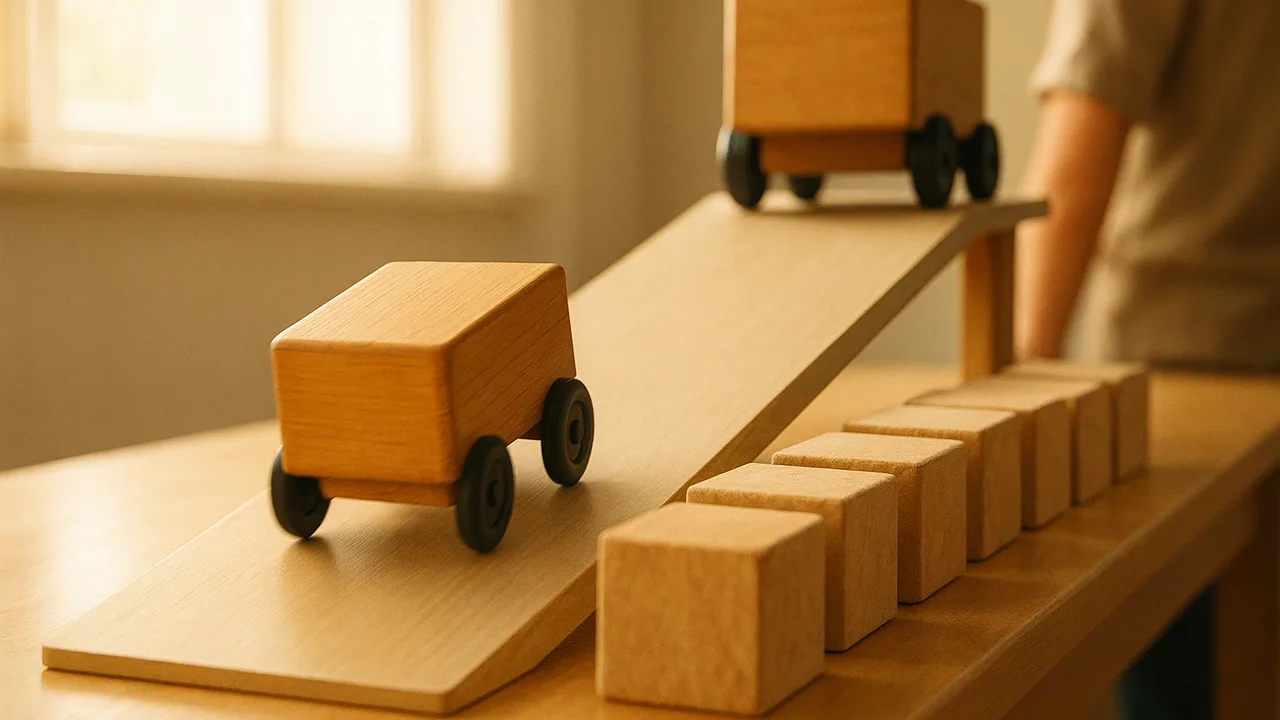
Explore first. Run three setups, three trials each. Setup A: release a cart from low, middle and high spots on a ramp, and judge its speed at the bottom. Setup B: let a rolling cart hit a parked cart. Setup C: let a rolling cart run onto a carpet or towel. Record observations before and after.
| Setup | Before (motion, sound, other) | After (motion, sound, other) | Did the cart’s speed go up, down or stay? | Where did energy go or come from? |
|---|---|---|---|---|
| A: low start | ||||
| A: high start | ||||
| B: cart hits parked cart | ||||
| C: cart rolls onto towel |
Naming the idea. A moving object has kinetic energy; the faster it moves, the more it has. When an object’s kinetic energy changes, energy has been transferred to it or from it. The energy does not vanish or appear from nowhere; it moves between objects and the surroundings.
Worked example 1: the ramp. Jamal released the cart from the highest spot. It reached the bottom fastest. The Earth–cart system stored more energy when the cart was higher, and that stored energy was transferred into the cart’s motion. Higher start, more speed, more kinetic energy.
Worked example 2: the crash. Ava watched the moving cart slow down and the parked cart start moving. The first cart’s kinetic energy went down; the second cart’s went up. She also heard a click and felt the bumpers were very slightly warm after many crashes. Some energy went to sound and thermal energy in the surroundings.
Worked example 3: the towel. On the towel, Diego’s cart slowed and stopped. Its kinetic energy was transferred to the towel and the air as a tiny amount of thermal energy and sound, through friction.
Guided Exercises ~15 min
Use your table to answer. Discuss each card before you lock in.
Independent Practice ~10 min
Connect the carts to the sorting line.
On a sorting line, a steel can slides down a chute and bumps into a stopper. Describe what you would observe before and after, and where the can's kinetic energy goes.
How confident are you that you can I can use observations to show that energy was transferred when a cart's speed changed.
Closure ~5 min
Every change in speed is a sign of an energy transfer. Next time, we turn the client’s needs into criteria and constraints and plan a fair test for our sorting line.
Exit ticket: make a claim about the moving cart in the crash. Did energy move to it or from it? Use two observations as evidence.
Teacher notes
Materials (per team): 2 toy cars or lab carts, a ramp (a board or stiff binder on books), a towel or carpet square, masking tape to mark release points, a meter stick.
Setup: mark low, middle and high start lines with tape so trials are repeatable. Judging speed by eye is fine; a phone slow-motion video helps teams compare.
Listen for: “the cart ran out of energy” or “the energy disappeared.” Push for where it went. The warming is tiny, so treat it as an explanation, not something every team will feel. Stay qualitative; no energy calculations and no kinetic-energy graphs (MS-PS3-5 boundary; MS-PS3-1 graphs are grade 8).
Support / stretch: give before/after picture frames. Stretch: predict what happens when the parked cart carries extra mass, then test.