1.02 Mapping the Meal-Warmer System
The Flameless Meal Warmer
How can we design a pouch that heats a meal with no flame and no electricity, safely and reliably?
The mystery: Some ready-to-eat meals for hikers and soldiers heat themselves: add a little water to a packet and it gets hot enough to warm the food. No fire, no batteries. Where does the heat come from, and where do the atoms go?
identify the parts of the meal-warmer system, the people who need it and the features the solution must have.
- I can identify the system where the problem exists, including its main parts, how they relate, and what is inside or outside the system.
- I can explain who needs the problem solved, what needs must be met, and which scientific issues are important.
- I can analyze how possible solutions might affect people and the environment, and decide which issues and parts of the system matter most.
- I can describe the features of the problem my device needs to solve.
- I can explain how my device will absorb or release thermal energy using a chemical reaction.
Phase 1: Spark
Warm-Up ~5 min
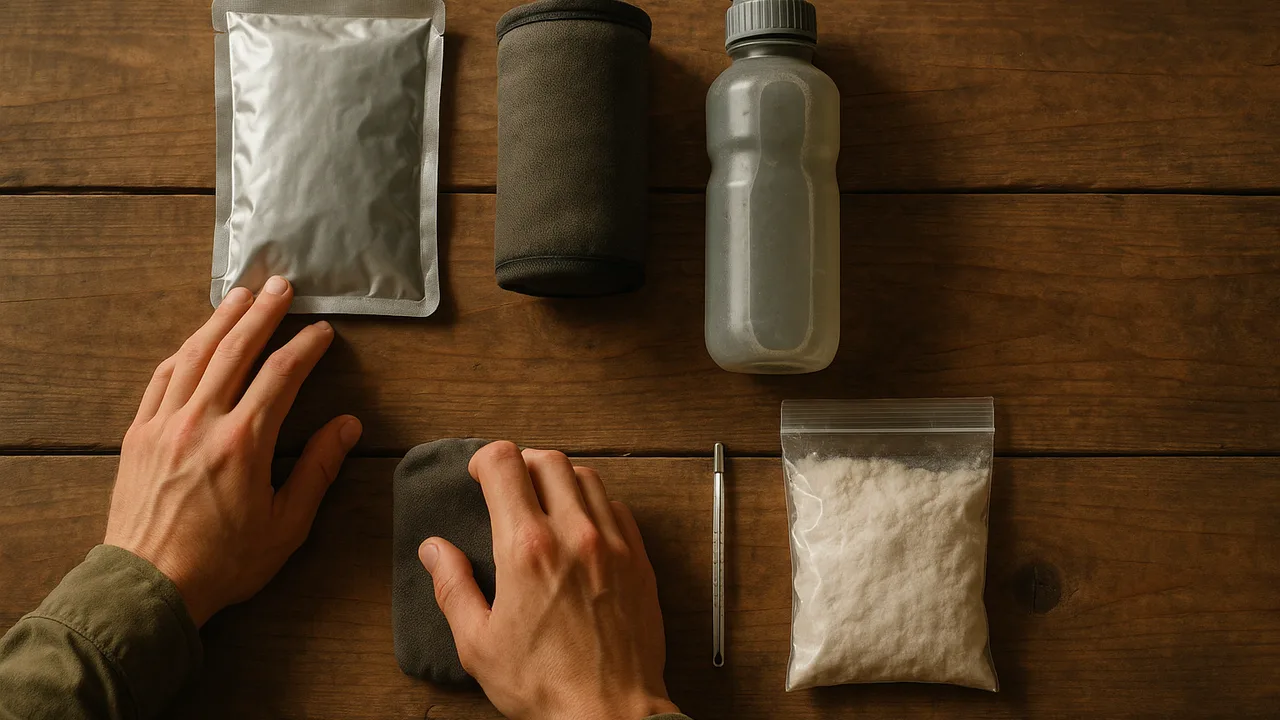
Do Now. Look at the photo of a meal pouch resting on a camp table beside a cup of water and a folded heater packet. List every object you see. Then circle the ones that matter for getting the food warm.
If the heater packet gets hot, where will most of its thermal energy end up in a poorly designed pouch?
Instruction ~10 min
Thinking in systems. A system is a set of parts that interact. Engineers draw a boundary around the parts they are designing and study what crosses that boundary. For our warmer, energy and sometimes gas cross it.
Worked example 1: a system map. Malik drew a box labeled “pouch”. Inside, he listed the heater packet, the activating water, the food pouch and the outer bag. Outside, he listed the air, the ground and the user’s hands. He drew arrows for thermal energy moving from the heater into the food, and smaller arrows leaking into the air. His map shows where energy should go and where it is wasted.
Worked example 2: from needs to features. Ava interviewed a pretend client from the preparedness group. The client said, “Kits sit in a closet for months, and kids may use them.” Ava turned each need into a feature: it must stay safe in storage, start with a simple step, and keep its outside comfortable to hold. Each feature becomes something we can test later.
Two clients, different needs. Hikers care about weight and space in a backpack. Families care about storage time and safety for children. Both care about how hot the food gets and how quickly. When needs differ, engineers must decide which matter most.
Looking beyond the user. A used heater becomes trash. Some commercial heaters give off a gas while they work. A good design thinks about the trail, the trash can and the air in a small room, not just the meal.
Guided Exercises ~15 min
Use your system map and the client notes. Talk with your team first.
Independent Practice ~10 min
Make your own system map in your notebook.
Draw the meal-warmer system. Show the boundary, at least four parts inside, three things outside, and arrows for where thermal energy should go and where it might be wasted.
List three needs from our two clients. Turn each need into a feature the pouch must have.
Closure ~5 min
Our map shows that energy and matter cross the pouch’s boundary. Next phase, we investigate what happens to substances when they react.
Exit ticket: which part of the system matters most for getting the food warm, and why? Name one part that matters for safety.
Teacher notes
Materials: a projected photo or real setup of a meal pouch, heater packet and cup of water (unused, nothing activated); chart paper; markers; a short client “interview” card for each team.
Setup: write two client cards, one for the hiking club and one for the preparedness group, with three or four needs each.
Listen for: energy “used up” or “gone.” Steer students to say where the energy goes. Keep the gas mention general; lesson 1.12 describes commercial heaters more fully.
Support / stretch: provide a pre-drawn boundary box. Stretch: rank the needs from both clients and justify the top choice.