1.19 How Much, How Fast, How Hot: Testing Version 1
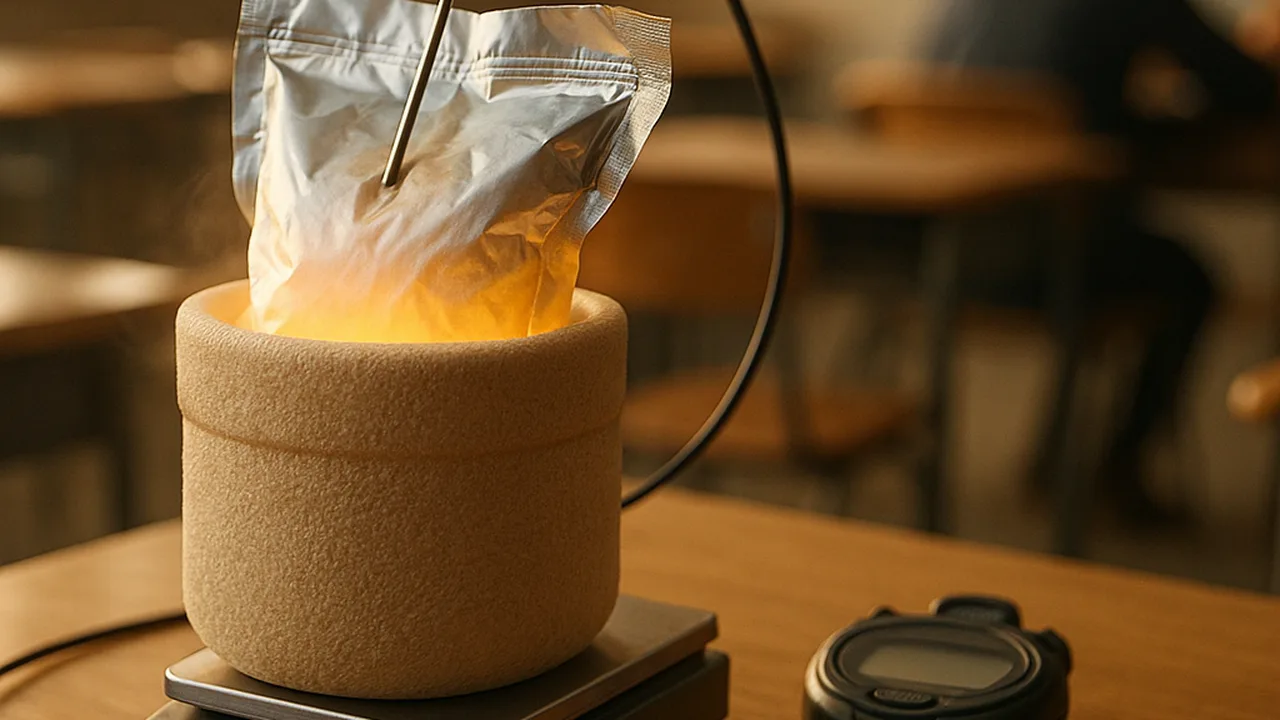
test my warmer for amount, time and temperature, and use a sealed-bag mass check and an atom model to explain why mass stays the same.
- I can test my device to see if it releases or absorbs thermal energy to solve the problem.
- I can use my test results to analyze how well my device meets the criteria and constraints, and identify which parts of my design worked best.
- I can use my model to explain that mass is conserved in a chemical reaction because the number and types of atoms stay the same, and each type of atom always has the same mass.
Phase 4: Build
Warm-Up ~5 min
Do Now. Your sealed warmer weighs 182 g before you mix it. Predict its mass after the calcium chloride dissolves and the pack gets hot.
After mixing inside the sealed bag, the total mass will be…
Instruction ~10 min
Engineers, today you test the three things the hiking club cares about: how much, how fast and how hot. “How much” is the amount of calcium chloride and water. “How fast” is how many degrees the meal rises in the first 10 minutes. “How hot” is how warm the meal still is at 20 minutes, and how the outside feels.
Test procedure. 1. Goggles on. 2. Weigh the sealed warmer and record its mass. 3. Read the meal’s starting temperature. 4. Squeeze the inner pack to burst the water bag into the calcium chloride; the large bag stays sealed. 5. Read the meal temperature every 5 minutes for 20 minutes. 6. Feel the outside sleeve at 10 minutes and score it: cool, warm or hot. 7. Weigh the sealed warmer again.
| Time (min) | 0 | 5 | 10 | 15 | 20 |
|---|---|---|---|---|---|
| Meal temperature (°C) | |||||
| Sleeve: cool, warm or hot |
Mass before: ____ g. Mass after: ____ g.
Worked example 1: reading the data (sample data). Diego’s team used 15 g of calcium chloride and no sleeve. The meal read 20, 28, 33, 31 and 29 °C at 0, 5, 10, 15 and 20 minutes. By 10 minutes it rose 33 − 20 = 13 °C, so it missed the 15 °C criterion. At 20 minutes it was only 9 °C above its start, so it missed the second criterion too. It warmed fastest in the first 5 minutes (8 °C), then cooled as energy escaped to the air. The team’s next question: use the full 20 g, or lose less energy to the air?
Worked example 2: why mass is conserved. Lena models a reaction with beads, using the hand warmer. Before: 4 gray beads for iron atoms and 3 pairs of red beads for oxygen molecules. After: 2 clusters of 2 gray and 3 red beads for iron oxide. She counts: 4 iron and 6 oxygen atoms before, 4 iron and 6 oxygen atoms after. “The atoms just rearranged. Same atoms, and each atom keeps its mass, so the total mass stays the same.” In an open hand warmer, oxygen from the air joins the iron, so the packet itself can get slightly heavier. That is not a break in the rule; atoms came in from outside.
Guided Exercises ~15 min
Use Diego’s sample data and your own data.
Independent Practice ~10 min
Analyze your own test.
Graph your meal temperature against time. Did your warmer meet both temperature criteria? Which part of your design worked best, and which needs to change?
Compare your mass before and after. Use the idea of atoms to explain your result. If the masses differ, give a reason, such as a leak or a reading error.
Closure ~5 min
You now have real data. Next class is the mid-build checkpoint on properties, atoms and energy.
Exit ticket: write one claim about how well version 1 works, with one number from your data as evidence.
How confident are you that you can I can use my test results to analyze how well my device meets the criteria.
Teacher notes
Materials: goggles, built warmers, digital thermometers or probes that fit in the meal bag through a small taped slit, scales reading to 0.1 g or 1 g, timers, beads in two colors for the model, towels.
Setup: keep the large bag sealed for the mass check; slide the thermometer into the meal bag, not the pack. Diego’s numbers are sample data, so share your class results alongside them.
Listen for: “it weighs more because it is hot”; “mass was lost as heat” (thermal energy is not matter).
Support / stretch: give a pre-drawn graph grid. Stretch: calculate the average rise per minute for the first and last 6 minutes and explain the difference.