1.08 More Food, Different Cups: Mass, Material and Temperature Change
plan and run an investigation of how the mass and type of material affect the temperature change when thermal energy moves from warm water.
- I can explain that the purpose of my investigation is to find out how thermal energy transfer relates to the type of matter, the mass of the matter, and the change in temperature (average kinetic energy) of the sample.
- I can plan what data to collect in my investigation, including the initial and final temperatures, the types of matter, and the mass of each sample.
- I can explain how I will use my data to show how changes in temperature relate to the mass and type of matter, and to the change in average kinetic energy of the particles.
- I can describe how I will measure the mass of each material and what units I will use.
- I can describe how and when I will measure the temperature of each material and what units I will use.
- I can explain the details of my experiment, including the variables I will change or keep the same, so I can collect the right data to answer my investigation question.
Phase 2: Investigate
Warm-Up ~5 min
Do Now. Your heater gives off the same amount of energy every time. You use it once on a single cup of soup and once on a big family pot. Predict the result.
The same heater warms a small cup of soup and a large pot. Which gets the bigger temperature rise?
Instruction ~10 min
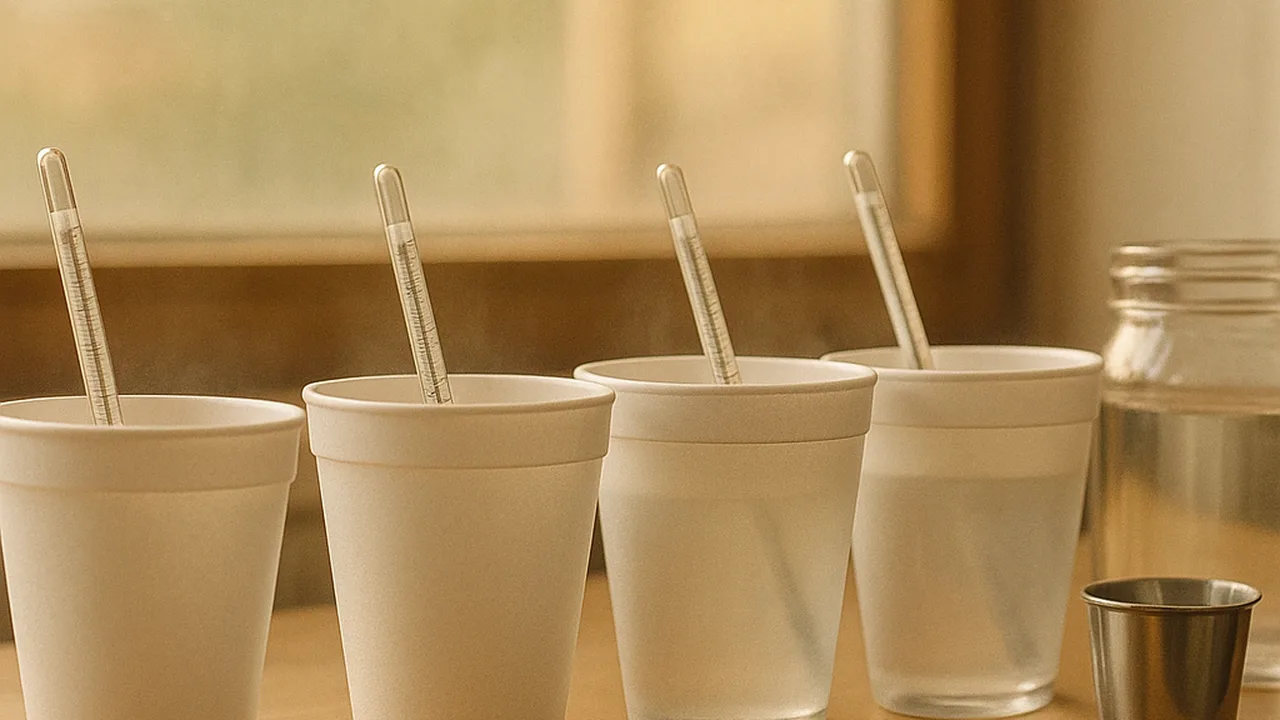
Explore first, Part A: amount of matter. Three foam cups hold 50 g, 100 g and 200 g of cold water. Record each starting temperature. Pour 100 g of warm water into each cup, stir, and record the highest temperature reached. The warm water plays the heater; the cold water plays the food.
| Cup | Mass of cold water (g) | Start temp (°C) | Final temp (°C) | Change (°C) |
|---|---|---|---|---|
| 1 | 50 | |||
| 2 | 100 | |||
| 3 | 200 |
Part B: type of material. Pour 150 mL of warm water into four same-size cups: metal, glass, plastic and foam. Record the water temperature at 0 and 5 minutes, and the outside of each cup at 5 minutes.
| Cup material | Water at 0 min (°C) | Water at 5 min (°C) | Drop (°C) | Outside of cup at 5 min (°C) |
|---|---|---|---|---|
| Metal | ||||
| Glass | ||||
| Plastic | ||||
| Foam |
Name the ideas. Thermal energy always moves from hotter matter to colder matter until they reach the same temperature. Temperature measures the average kinetic energy of the particles. The temperature change depends on how much energy moves, how much matter shares it, and what kind of matter it is. A conductor moves thermal energy quickly; an insulator slows it down.
Worked example 1: mass. These are sample data. Malik’s 50 g cup rose 24°C, his 100 g cup rose 18°C, and his 200 g cup rose 11°C. More mass, smaller temperature change, for the same warm water.
Worked example 2: type of matter. Sample data again. Priya set 100 g of sand and 100 g of water in the same warm bath for five minutes. The sand rose about twice as much as the water. Equal masses of different materials change temperature by different amounts.
A fair test. Change one variable at a time. In Part A, only the mass changes. In Part B, only the cup material changes.
Guided Exercises ~15 min
Use your Part A and Part B data. Talk with your team before you answer.
Independent Practice ~10 min
Plan the next investigation.
Make a line graph of temperature change versus mass for Part A. Describe the pattern as a relationship: as mass doubles, the change …
Plan a test of whether oatmeal or water warms more with the same warm bag. Name the data you will collect, the units, the variable you will change and three you will keep the same.
Closure ~5 min
Mass and material both shape the temperature change. Next time, we turn everything we have learned into the criteria and constraints for our warmer.
Exit ticket: a hiker wants to warm a large meal with a small heater. Use today's data to predict what will happen and explain why.
Teacher notes
Materials (per team): goggles, 3 foam cups, 4 same-size cups (metal, glass, plastic, foam), a balance or graduated cylinder (1 mL of water has a mass of about 1 g), 2 thermometer probes, a pitcher of warm tap water, ice water for the cold cups, a timer.
Setup: chill water ahead of time, then remove the ice so only water is measured. Keep the warm water near 45–50°C.
Listen for: “the bigger cup has more heat so it is hotter”, which mixes up temperature and thermal energy. Do not calculate total energy transferred; stay with temperature changes and comparisons. Sand and water comparisons are sample data; run the sand test only if time allows.
Support / stretch: give the line-graph axes pre-labeled. Stretch: predict the change for a 400 g cup and explain the reasoning as a proportion.