2.24 The Official Sorting Trial
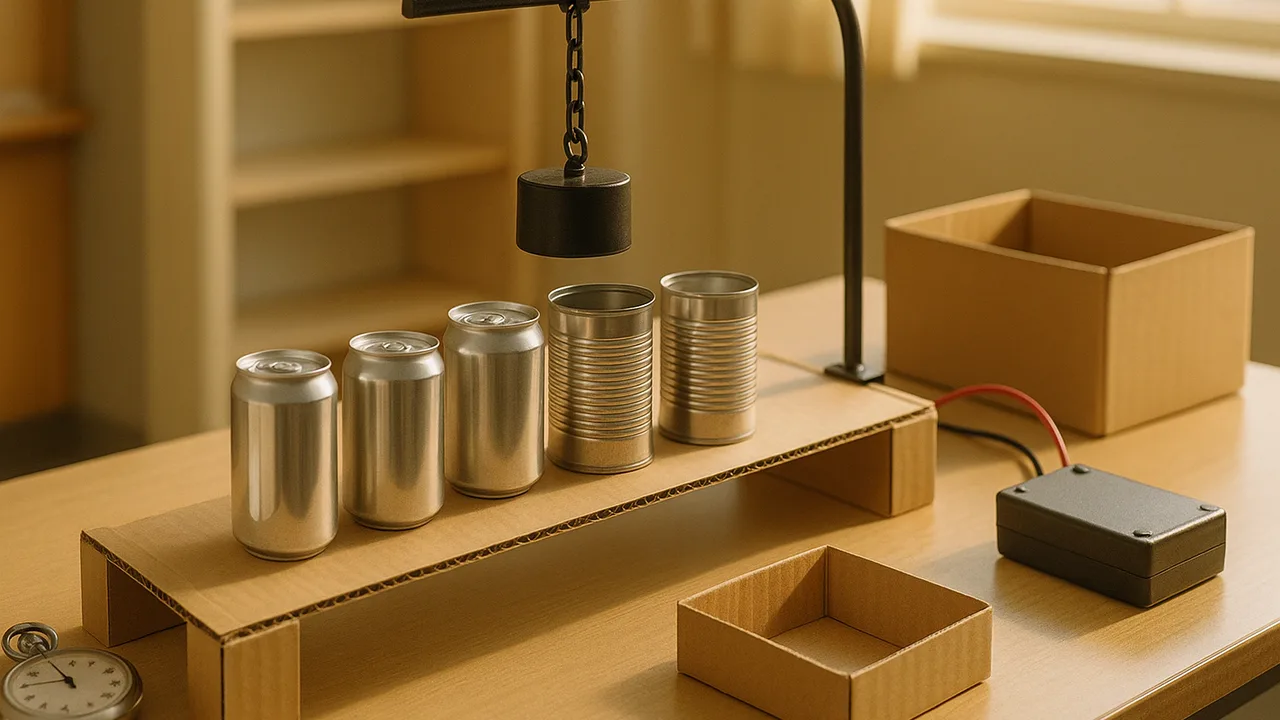
run a fair, timed sorting trial of my final design and judge it against every criterion and constraint with data.
- I can analyze data using methods like comparing numbers or looking for patterns.
- I can identify how each design solution meets the criteria and fits the constraints by examining the data.
- I can make a claim about which characteristics of each design best meet the criteria and constraints, using evidence from the data.
- I can describe how the data from my model, along with the criteria and constraints, can help me improve my design through testing and making changes.
Phase 5: Prove It
Warm-Up ~5 min
Do Now. Today is trial day. Every team uses the same mixed batch, the same timer and the same rules. Why does that matter if we want to compare designs fairly?
What makes the official trial a fair test?
Instruction ~10 min
Sorting engineers, this is the test the recycling center asked for. Each team runs its final design on the model line. A judge from another team runs the timer and counts. You run three trials and report the mean.
Trial rules: standard batch of 10 steel caps, 5 foil pieces and 5 plastic beads; belt at the class “steady” pace; 60 seconds; no more than two 1.5 V cells; switch off between sweeps.
Worked example 1: a results summary. Diego’s team (sample data): trials of 10, 9 and 9 steel caps, mean about 9.3; 0 wrong items; every cap released; one cell. Summary: “Our design met all four criteria. Rate was closest to the edge: one more missed cap would fail it.”
Worked example 2: comparing across teams. The class posted every team’s mean on one bar graph (sample data). The three fastest designs all used 40 or more turns. Two of them used one cell, and both released cleanly. That pattern is evidence for which features to recommend to the recycling center.
| Criterion | Trial 1 | Trial 2 | Trial 3 | Mean or result | Met? |
|---|---|---|---|---|---|
| Steel sorted in 60 s (goal 9+) | |||||
| Aluminum or plastic picked (goal 0) | |||||
| Steel released when off | |||||
| Low-voltage battery (1–2 cells) | |||||
Guided Exercises ~15 min
Run your trials first. Then answer using your table and the class graph.
Independent Practice ~10 min
Write your trial report.
Write a trial report: your mean results, which criteria you met, which was closest to failing, and one change you would make with one more day, based on your data.
Closure ~5 min
Trial complete, sorting engineers. Next class you present to the recycling center.
Exit ticket: in one sentence, tell the recycling center whether your design is ready, and the evidence for your answer.
How confident are you that you can I can judge a design against every criterion using test data.
Teacher notes
Materials: standard batches pre-bagged so every team gets the same mix, timers, judge score sheets, a class bar graph on chart paper.
Setup: pair teams so each judges the other. Agree on the “steady” belt pace before starting. Check every team’s battery setup before trials.
Listen for: teams counting a cap that fell back as “sorted”; reports that skip the criteria that were not met.
Support / stretch: give a fill-in report frame. Stretch: compute each team’s accuracy as a fraction and rank designs by rate and by accuracy.