1.23 Revise and Retest: Warmer Version 2
improve my warmer using test data and critique, then retest it against the criteria.
- I can improve my device by making changes based on my test results so it better meets the criteria and constraints.
- I can test my device and use the rate of temperature change to measure how well it minimizes or maximizes thermal energy transfer.
- I can identify the design solution that is supported by the information given.
Phase 4: Build
Warm-Up ~5 min
Do Now. Write your team’s top fix from critique day and the criterion it should improve.
Why should a team change only one or two things in version 2?
Instruction ~10 min
Engineers, real products go through many versions. Today you make version 2 and test it with the same procedure as version 1, so the results compare fairly.
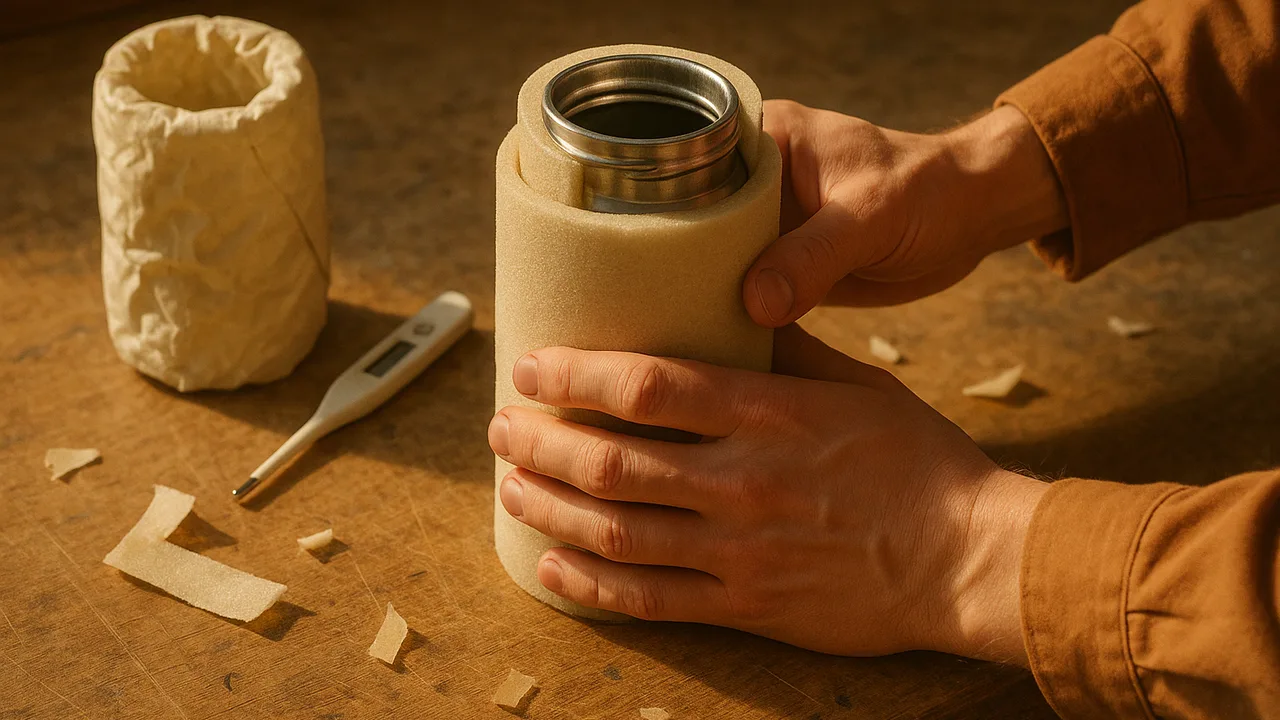
Worked example 1: one change, clear result (sample data). Diego’s team pressed the pack flat against the meal and added a foam sleeve, and used the full 20 g. Version 1 rose 13 °C by 10 minutes and was 9 °C above its start at 20 minutes. Version 2 rose 17 °C by 10 minutes and was still 14 °C above its start at 20 minutes. In the first 5 minutes, version 1 rose 8 °C and version 2 rose 10 °C. “Better contact and less loss to the air sped up the transfer into the meal.”
Worked example 2: a revision that went too far. Ava’s team tried 8 g more calcium chloride, 28 g in all. The meal rose 25 °C, but the pack broke the 20 g limit, the outside felt hot and the bag puffed at one seam. They went back to 20 g and kept the foam sleeve. “More is not always better. Safety is weighted highest.”
| Measure | Version 1 | Version 2 | Change |
|---|---|---|---|
| Rise by 10 min (°C) | |||
| Above start at 20 min (°C) | |||
| Rise in first 5 min (°C) | |||
| Heater material (g) | |||
| Leaks? Sleeve feel? |
Guided Exercises ~15 min
Plan, build and retest. Answer as you go.
Independent Practice ~10 min
Retest and report.
Fill in the version table. Did version 2 meet more criteria? Explain the result using how thermal energy moved through your system.
Make a claim: is version 2 the design your team will take to Trail Test Day? Name its strongest and weakest criterion.
Closure ~5 min
Version 2 is ready. Next phase, Prove It: Trail Test Day.
Exit ticket: what is one question a food scientist might ask about your warmer before selling it?
How confident are you that you can I can improve my device using test results so it better meets the criteria and constraints.
Teacher notes
Materials: goggles, fresh calcium chloride within the class limit, new zip bags, sleeves, thermometers, scales, timers.
Setup: teams get one new pack each; if a seam puffs or leaks, stop the test and bag the pack. Collect version 1 packs in a lined bin.
Listen for: teams changing many things at once; “more chemical is always better.”
Support / stretch: give a one-change planning frame. Stretch: graph version 1 and 2 on the same axes and compare the slopes.