2.22 Peer Critique: Testing Models With What-Ifs
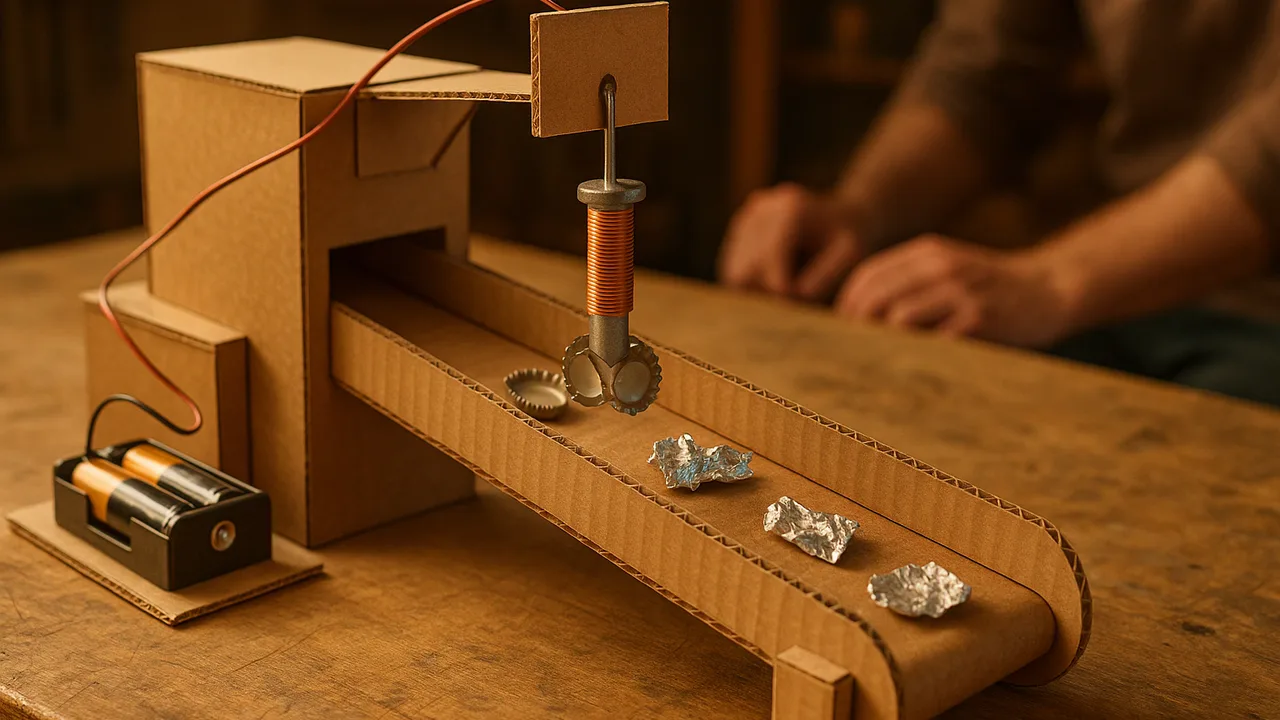
use my sorting line model to generate data for what-if changes, name its limits, and give and take critique.
- I can use my model to generate data that shows how my proposed solution works and how it changes when I modify its parts.
- I can identify and explain the limitations of my model in representing my proposed solution.
- I can use data to identify the best features from each design that could be combined to create a better solution.
Phase 4: Build
Warm-Up ~5 min
Do Now. Our model belt is poster board pulled by hand. The real recycling center belt is long, wide and runs all day. Name one thing our model gets right and one thing it gets wrong.
Which is a LIMITATION of our tabletop model?
Instruction ~10 min
Sorting engineers, a model is a test bench. You can change one part and run it again in minutes. Today each team runs two what-if tests, records the data, then visits another team for critique.
Worked example 1: a what-if test. Kofi’s team asked, “What if the belt moves faster?” (sample data). At a slow pace the line sorted 10 of 10 caps in 60 seconds. At a fast pace it sorted 7. Faster belts give the magnet less time over each cap. Their next what-if: lower the arm from 0.5 cm to 0.3 cm at the fast pace. Result: 9 of 10.
| What-if change | Steel sorted in 60 s | Wrong items | Released? | Meets criteria? |
|---|---|---|---|---|
| Starting model | ||||
| What-if 1: | ||||
| What-if 2: |
Worked example 2: naming limits. Kofi’s team wrote: “Our caps are lighter than real cans, so a real magnet must be much stronger. Our belt is pulled by hand, so the speed is not steady. Our model has no wet or crushed cans.” Naming limits shows which results can be trusted for the real center and which need more testing.
Critique protocol. Visitors watch one run, then say: I like… (a strength backed by data), I wonder… (a question), and What if… (a feature from their own design that might help). Hosts listen, write everything down and only ask questions.
Guided Exercises ~15 min
Run your what-ifs, then switch to critique.
Independent Practice ~10 min
Use your what-if data and critique notes.
Describe your two what-if tests. For each, state the change, the result and whether the line met the criteria.
List two limitations of your model. For each, explain how it might make the real line work better or worse than the model.
Closure ~5 min
Great critique, sorting engineers. Next class you build Version 2 and meet the people who do this for a living.
Exit ticket: which feature from another team's design will you add to Version 2? What data convinced you?
How confident are you that you can I can use my model to generate data and explain its limits.
Teacher notes
Materials: team models and sorters, timers, critique cards with the three sentence stems.
Setup: 15 minutes of what-if testing, 15 minutes of critique (two rounds of 7 minutes), 5 minutes to plan. Define “fast” and “slow” belt pace with a count (one hand-width per second versus two).
Listen for: critique that is only praise or only negative; hosts arguing instead of asking; what-ifs that change several parts.
Support / stretch: give a what-if menu (speed, height, cells, turns, sweep path). Stretch: graph sorting count against arm height.