2.03 Balloons, Hair and the Invisible Push
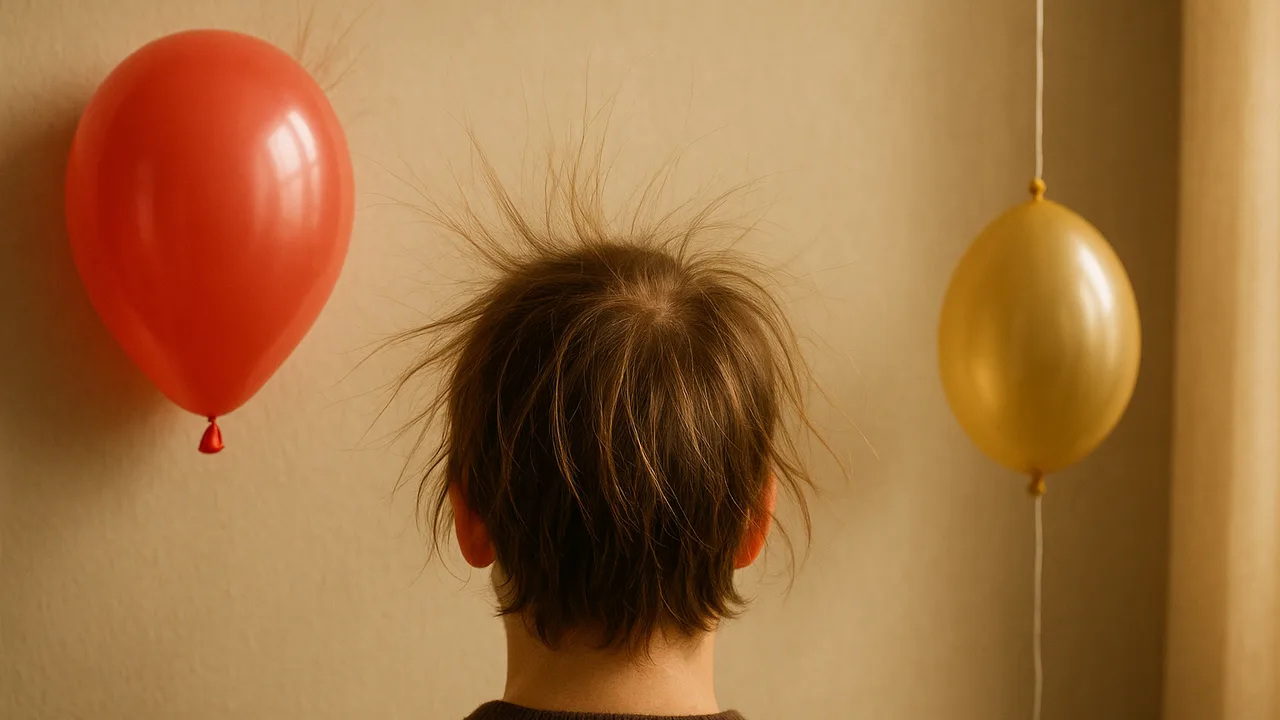
collect data showing how the amount of charge and the distance between objects change the strength of an electric force.
- I can ask questions about data to figure out how changing the electric current or the number of wire turns affects the strength of a magnetic force.
- I can ask questions about data to find out how the distance or orientation between objects changes the strength of electric or magnetic forces.
- I can ask questions about data to understand how the amount or type of electric charge, or the strength of magnets, affects electric or magnetic forces.
- I can make and record observations about how objects move, stay suspended, or interact in simulations when electric or magnetic fields are involved.
- I can make and record observations about feeling a push or pull when holding an object affected by electric or magnetic forces.
Phase 2: Investigate
Warm-Up ~5 min
Do Now. Rub a balloon on your hair or a wool cloth five times. Hold it near a few tiny bits of paper on the table. Predict before you try it with ten rubs.
If you rub the balloon ten times instead of five, what will change?
Instruction ~10 min
Explore first. Run two tests. Test A: rub the balloon 0, 5, 10 and 20 times, then lower it toward paper bits. Record the height where the first bit jumps up. Test B: charge two balloons the same way, hang them on strings and bring them close. Record what they do.
| Number of rubs | Trial 1: jump height (cm) | Trial 2: jump height (cm) | Trial 3: jump height (cm) | Average (cm) |
|---|---|---|---|---|
| 0 | ||||
| 5 | ||||
| 10 | ||||
| 20 |
Naming the idea. Rubbing moves tiny charged particles called electrons from your hair onto the balloon. The balloon gains a negative electric charge. Charged objects push or pull on each other with an electric force. Like charges repel, and opposite charges attract. A charged balloon can also pull on neutral objects like paper and walls.
Worked example 1: reading a pattern. Ava’s team recorded these sample data averages: 0 rubs, 0 cm; 5 rubs, 2 cm; 10 rubs, 4 cm; 20 rubs, 5 cm. More rubs gave a bigger jump height, so more charge gave a stronger force. The increase slowed after 10 rubs, perhaps because the balloon could hold only so much charge.
Worked example 2: distance matters. Diego held a charged balloon at 10 cm, 5 cm and 2 cm from a hanging balloon. The hanging balloon swung only a little at 10 cm, but swung hard at 2 cm. The electric force got stronger as the distance got smaller.
How we know it is the balloon. When Diego moved the charged balloon away, the paper fell and the hanging balloon swung back. The force disappeared when the second object left. That is strong evidence the balloon caused it.
Guided Exercises ~15 min
Run the sim with a partner, then answer. The sim is a model of what you saw on the table.
Independent Practice ~10 min
Use your own team’s data.
Write two questions your data raises about electric forces. For example, does humidity matter? Does the material you rub with matter? Choose one and explain how you would test it.
How confident are you that you can I can describe how charge and distance change an electric force.
Closure ~5 min
Electric forces get stronger with more charge and shorter distances. Next time, we map the space around magnets with iron filings and compasses.
Exit ticket: describe the data that showed the balloon and the paper pushed or pulled each other without touching. Include what happened when the balloon was removed.
Teacher notes
Materials (per team): 2 balloons (latex-free if anyone is allergic), a wool cloth or knit scarf, tissue-paper bits, string, tape, a meter stick. Devices with the Balloons and Static Electricity sim.
Setup: static works best on dry days. On humid days, results shrink; use it as a discussion point rather than a failure. Hang balloons from a desk edge with tape.
Listen for: “the balloon is magnetic.” The balloon lifts paper and plastic, which magnets do not. Stay qualitative; no Coulomb’s law (MS-PS2-3 boundary). The worked-example numbers are sample data.
Support / stretch: pre-draw the data table with distance marks. Stretch: predict and test whether a balloon rubbed on a plastic bag behaves the same as one rubbed on wool.