2.02 What Sticks? Sorting a Sample Recycling Stream
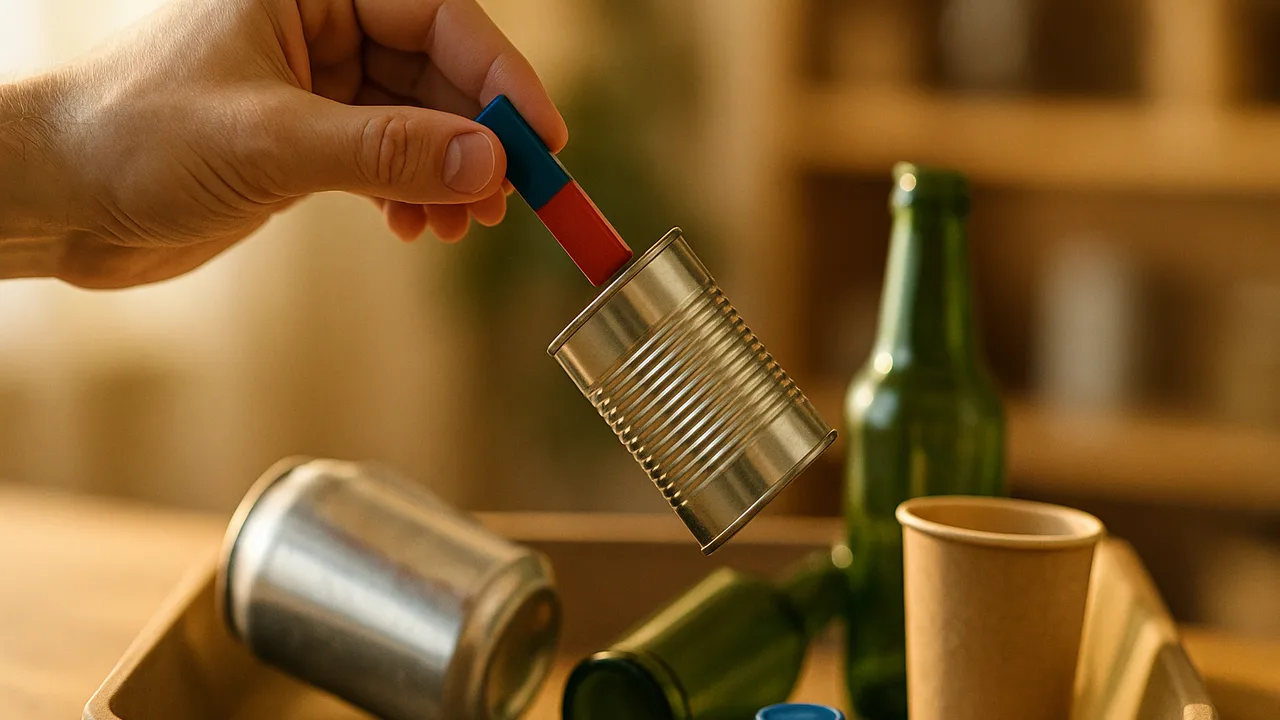
The Recycling Center Sorting Line
How do objects push and pull without touching, and how can we use that to sort steel from everything else in a recycling stream?
The mystery: At a scrapyard, a crane lifts a whole car with a giant magnet, then drops it the moment the operator flips a switch. Maglev trains float above their tracks. A balloon rubbed on hair sticks to the wall.
test which items in a sample recycling stream respond to a magnet and ask testable questions about why.
- I can ask questions about electric and magnetic forces that can be tested with experiments or investigations in places like my classroom or a museum.
- I can describe the data that will show two objects can exert forces on each other without touching.
- I can describe the data that will help me tell the difference between electric and magnetic forces.
- I can describe the data that will show the force on one object is caused by its interaction with a second object, such as when the force disappears if the second object is removed.
Phase 1: Spark
Warm-Up ~5 min
Do Now. Look at the sample bin: a steel food can, an aluminum soda can, a plastic bottle, a foil pie tin, a paper carton, a steel bottle cap and a coin. Sort them into two piles before you touch a magnet.
Which statement will our magnet test support?
Instruction ~10 min
Explore first. Test each item with your magnet. Hold the magnet about 1 cm away first, then touch it. Record what happens before you read on.
| Item | Material (best guess) | Pulled at 1 cm? (yes / weak / no) | Pulled when touching? (yes / weak / no) | Bin it belongs in |
|---|---|---|---|---|
| Food can | ||||
| Soda can | ||||
| Plastic bottle | ||||
| Foil pie tin | ||||
| Paper carton | ||||
| Bottle cap | ||||
| Coin |
Naming the pattern. Materials that a magnet pulls strongly are called magnetic materials. The common ones are iron, steel, nickel and cobalt. Most food cans are steel with a thin coating, so they respond. Soda cans and foil are aluminum, which does not respond in a way you can feel.
Worked example 1: reading the data. Jamal’s team found the food can was pulled at 1 cm, but the bottle cap was pulled only when touching. Both are steel, so why the difference? The magnet pulls harder when it is closer. The cap may also be thinner or coated. One table can raise several new questions.
Worked example 2: from a surprise to a testable question. Mei noticed a steel can stuck to the magnet through a paper label. She asked, “How many sheets of paper can the magnet pull a can through?” She can change the number of sheets and record whether the can sticks. That question matters for our sorting line, because real cans are dirty and wrapped.
Watch out. Some stainless steel barely responds to a magnet, and different coins are made of different metals. Test; don’t assume.
Guided Exercises ~15 min
Use your data table to answer. Discuss each card with your team.
Independent Practice ~10 min
Think like a sorting engineer.
Write three testable questions our sorting line team should investigate. For each, name the variable you would change and the result you would measure.
How confident are you that you can I can ask questions about magnetic forces that we can test in class.
Closure ~5 min
Our sorting line can only pull out materials that respond to a magnet. Next time, we explore a different force at a distance: static electricity.
Exit ticket: write one testable question about how distance changes a magnet's pull on a steel can. Then describe how you would test it.
Teacher notes
Materials (per team): one ceramic or bar magnet, a rinsed steel food can, an aluminum soda can, a plastic bottle, a foil pie tin, a small carton, a steel bottle cap, a few coins, a ruler. Tape over sharp rims ahead of time.
Setup: test each item yourself first; some cans and caps differ by brand. Check with a magnet before claiming any item is steel or aluminum.
Listen for: “all metals are magnetic” and “shiny means magnetic.” Coins vary: most common coins respond weakly or not at all, so treat them as an open question. Many recycling centers really do use magnets to remove steel; keep claims about specific facilities general.
Support / stretch: give a question frame: “Does changing ___ change ___?” Stretch: research why some stainless steel is barely magnetic and report back in one paragraph.