2.09 Defining the Sorting Problem and Planning a Fair Test
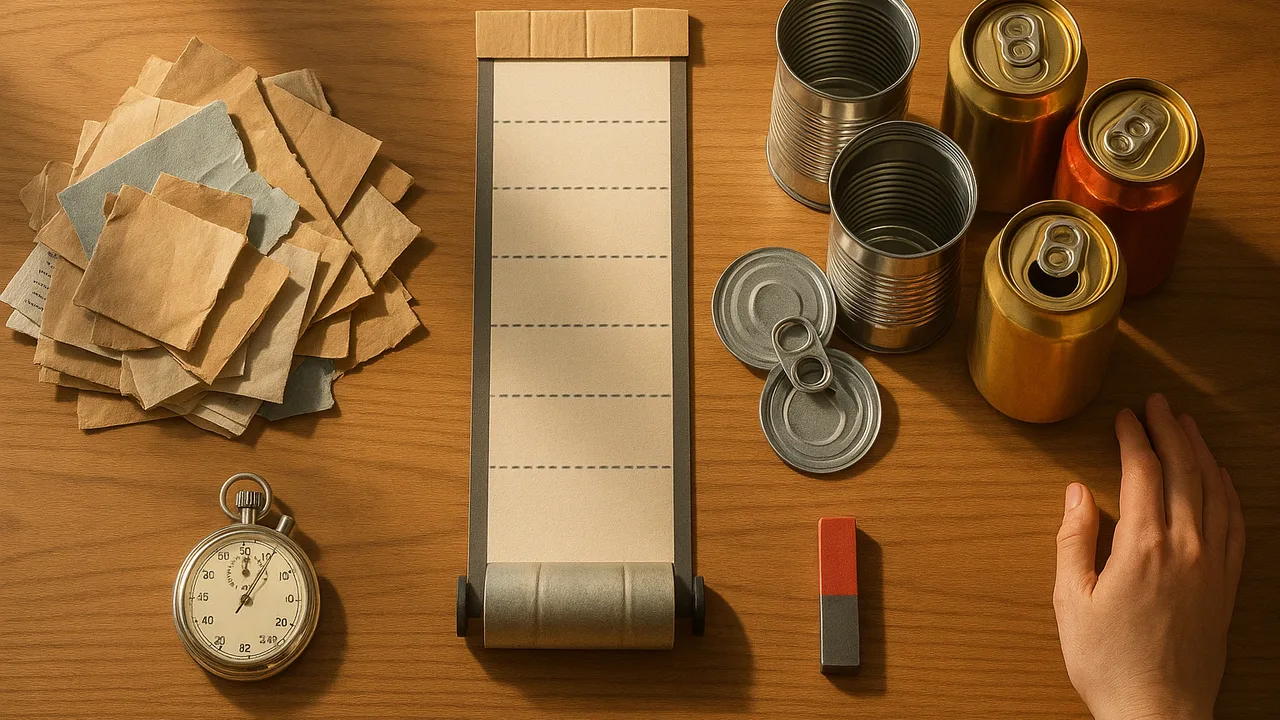
turn the client’s needs into criteria and constraints and plan an investigation that can show a field acting on cans without contact.
- I can explain why the investigation plan includes changing the distance between objects.
- I can explain why the plan includes changing the charge or magnetic orientation of objects, and changing the amount of charge or strength of the magnetic field.
- I can explain why the plan includes a way to show or measure if electric or magnetic forces are present.
- I can evaluate if the investigation’s design and data can show that fields exist between objects that act on each other without touching.
Phase 2: Investigate
Warm-Up ~5 min
Do Now. Read the client’s note: “Steel cans must come out, and aluminum must stay on the belt. Keep it simple and safe for our workers.” List every need you can find in those sentences.
Which is a constraint rather than a criterion?
Instruction ~10 min
Criteria and constraints. Criteria describe what a successful design must do. Constraints are limits, such as cost, size, time, materials or safety. Engineers write both before they design.
| Need from the client | Criterion or constraint? | How we will measure it | Target |
|---|---|---|---|
| Pull steel cans out of the stream | |||
| Leave aluminum and plastic on the belt | |||
| Drop the steel into the right bin | |||
| Safe, low-voltage power only | |||
| Fits on a desk; built from class materials |
Worked example 1: making a criterion measurable. Mei wrote, “It should work well.” That can’t be tested. Malik wrote, “Out of 10 steel cans, the line removes at least 8, and removes 0 of 10 aluminum cans.” Now the class can count and decide whether a design passes.
Worked example 2: planning a fair test of distance. Priya’s team wants to know how high the magnet can sit above the belt. They plan to change only the gap: 1, 2, 3 and 4 cm. They keep the same magnet, the same cans and the same belt speed. They count cans lifted at each gap.
Worked example 3: is the design able to show a field? Jamal asked, “How do we know the magnet, not a bump, moved the can?” His team added a check: run the belt with the magnet removed. If no cans lift, the force came from the magnet. A good plan includes a way to show the force is present and a way to show it is absent.
Guided Exercises ~15 min
Build your team’s plan step by step. Discuss each card before you answer.
Independent Practice ~10 min
Evaluate a plan.
Diego plans to test one can at one gap, one time. Evaluate his plan: could it show that a field acts on the can without touching? List two improvements.
How confident are you that you can I can plan an investigation that shows a field acts on objects without contact.
Closure ~5 min
We now have criteria, constraints and a fair-test plan. Next, in Make Sense, we turn our data into models and arguments.
Exit ticket: explain why your plan changes the distance between the magnet and the can, and why it includes a way to show the force is present or absent.
Teacher notes
Materials: printed client note, criteria and constraints table, planning template, one magnet and a few cans per team for quick checks.
Setup: post the class criteria and constraints after discussion; they guide the Build phase. Agree on a common sample stream (e.g. 10 steel and 10 aluminum items) for later tests.
Listen for: confusing criteria with constraints, and plans that change several variables at once. The 8-of-10 target is an example; let the class set its own with the client’s needs in mind.
Support / stretch: give a variables organizer with three boxes. Stretch: add a criterion about energy use and explain how to measure it without calculations (for example, time the circuit is closed).