1.16 The Decision Matrix: Choosing a Warmer With Evidence
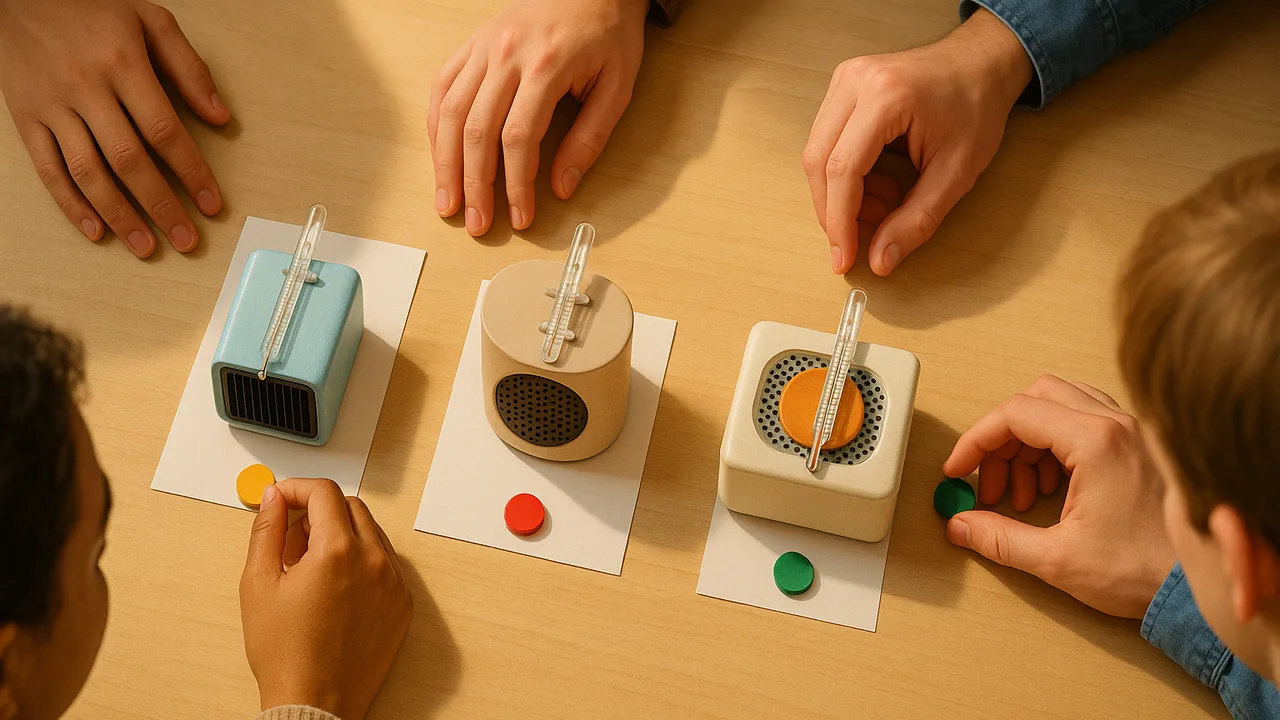
use a weighted decision matrix to compare warmer concepts and make a claim about which one to build.
- I can use a systematic method, like a decision matrix, to find the strengths and weaknesses of each solution.
- I can evaluate each solution using the criteria and constraints we defined.
- I can compare the solutions based on how well they meet the criteria and constraints.
- I can use evidence and reasoning to make a claim about which solution works best, based on their strengths and weaknesses.
- I can identify the design solution that is supported by the information given.
Phase 4: Build
Warm-Up ~5 min
Do Now. Diego says, “Let’s build the Pack Sandwich because two packs sounds hotter.” What evidence would you want before you agree?
What should a team's choice of design be based on?
Instruction ~10 min
Engineers, a decision matrix is a scoring table. Each row is a criterion or constraint. Each column is a concept. You score every concept on every row, multiply by the row’s weight, and add up the totals. Everyone uses the same rules, so the method is systematic.
Step 1: agree on rows and weights as a team. Safety matters most for both clients, so “Safe: no leaks, safe to hold” gets a weight of 3. “Rises 15 °C in 10 minutes” also gets 3. “Still 10 °C above start at 20 minutes” gets 2, and “Low waste” gets 1. Every concept must also stay within 20 g of heater material, or it is out. Agree before you score, so nobody bends the weights later.
Step 2: score from 1 (weak) to 3 (strong), using evidence. Use your Investigate data on how much calcium chloride warmed the water, and what you know about insulation.
Worked example 1: scoring two concepts. Here is how Ava’s team scored them (sample scores).
| Row (weight) | Pack Sandwich score × weight | Wrapped Pocket score × weight |
|---|---|---|
| Safe: no leaks, safe to hold (×3) | 2 × 3 = 6 | 3 × 3 = 9 |
| Rises 15 °C in 10 min (×3) | 3 × 3 = 9 | 2 × 3 = 6 |
| Still warm at 20 min (×2) | 1 × 2 = 2 | 3 × 2 = 6 |
| Low waste (×1) | 1 × 1 = 1 | 2 × 1 = 2 |
| Total | 18 | 23 |
Worked example 2: the claim. Ava wrote: “We claim the Wrapped Pocket is the better design. It scored 23 to 18. It stays warm longer and is safer to hold because the felt sleeve sits between the pack and your hands. Its weakness is speed: one pack may not raise the meal 15 °C in 10 minutes. We will press the pack flat against the meal.” She named strengths, a weakness and evidence. The matrix supports a decision; it does not end the thinking.
| Row (weight) | Concept A | Concept B | Concept C |
|---|---|---|---|
| Safe: no leaks, safe to hold (×3) | |||
| Rises 15 °C in 10 min (×3) | |||
| Still warm at 20 min (×2) | |||
| Low waste (×1) | |||
| Total |
Guided Exercises ~15 min
Use the worked example, then score your own concepts.
Independent Practice ~10 min
Make your claim.
Complete your team's matrix. Then write a claim: which concept will you build? Give the totals as evidence and name one strength and one weakness of your choice.
Name one idea from a losing concept that you could add to your winner. Explain which row it would improve.
Closure ~5 min
Your team has a plan backed by evidence. Next class, we look at how companies and the military already heat meals without flames.
Exit ticket: why is a decision matrix fairer than voting on the best-looking sketch?
How confident are you that you can I can use a decision matrix to compare designs against criteria and constraints.
Teacher notes
Materials: concept sketches from 1.15, calculators, Investigate data on temperature change with different amounts of calcium chloride.
Setup: model the weighted math once on the board. Teams may change weights, but they must agree before scoring and explain why.
Listen for: teams changing scores after seeing totals; adding scores without multiplying by weights; “hottest is best” (hotter is not safer).
Support / stretch: give a matrix with weights filled in. Stretch: score on a 1–5 scale and see whether the winner changes.