2.13 Stored Energy, Moving Energy: Modeling the Sorting Line
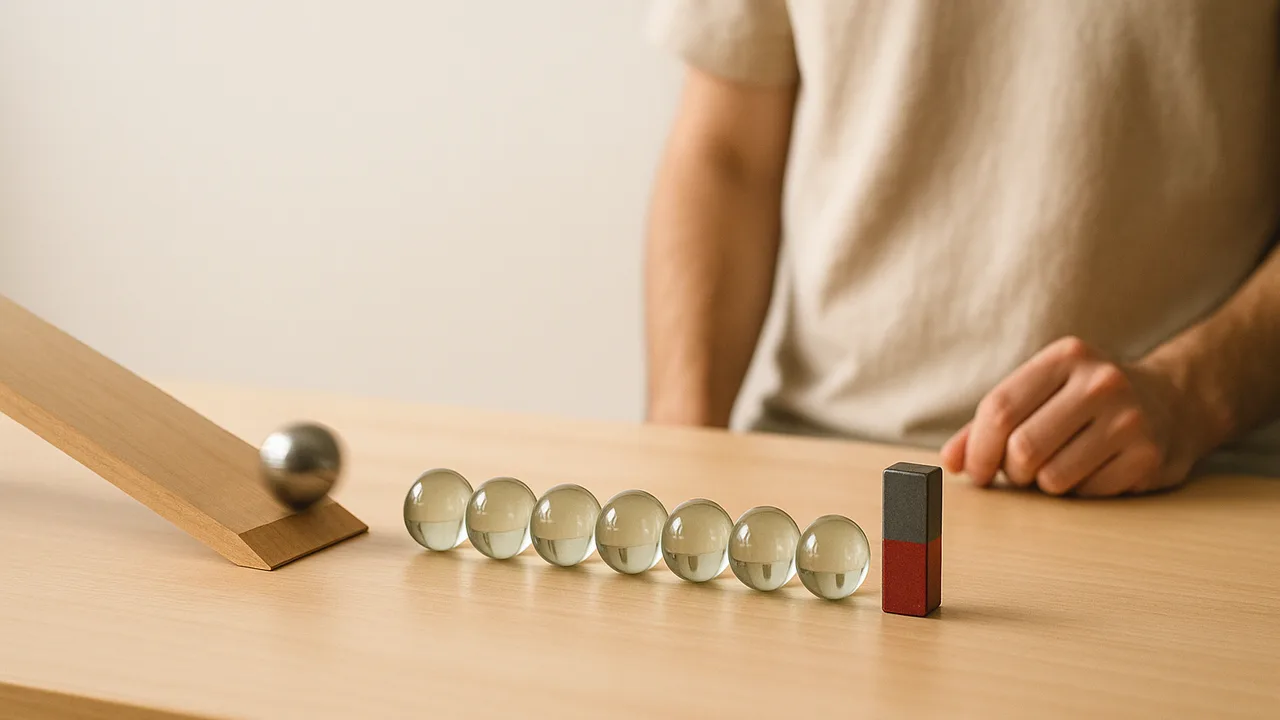
model how energy is stored between interacting objects and argue from evidence that energy transfers change an object’s kinetic energy.
- I can use my model to explain that moving two objects that attract each other farther apart requires a force and adds energy to the system.
- I can use my model to explain that moving two objects that repel each other closer together requires a force and adds energy to the system.
- I can evaluate the types of sources and the reliability of the evidence that supports my claim.
- I can decide if the evidence is strong enough to support my claim and explain why.
- I can identify other possible explanations and explain why the evidence best supports my claim.
- I can present an argument, in writing or speaking, to support or refute an explanation or model for a phenomenon.
Phase 3: Make Sense
Warm-Up ~5 min
Do Now. A steel can rides a belt toward a magnet hanging above. Suddenly it leaps up and clanks against the magnet. Sketch the can just before and just after the leap.
Where did the energy for the can's leap come from?
Instruction ~10 min
Putting the pieces together. In 2.06 we found that changing the arrangement of interacting objects changes stored energy. In 2.08 we found that a change in speed shows energy was transferred. Today we combine them into one model.
Worked example 1: a model of the leap. Ava drew three frames. Frame 1: can far below the magnet, large gap, most stored energy, can not moving up. Frame 2: can rising, gap shrinking, stored energy falling, kinetic energy rising. Frame 3: can stuck to magnet, no gap, sound and a little warming. Each object pulls on the other, which transfers energy between them.
Worked example 2: putting energy back in. To drop the can in the bin, a worker could pull it off the magnet. Pulling attracting objects apart takes a force and adds energy to the system. An electromagnet avoids this: switching off the current removes the strong field, and gravity takes over.
Worked example 3: an argument about kinetic energy. Jamal claimed the cart in 2.08 lost kinetic energy in the crash. His evidence: it slowed, the parked cart sped up, and there was a click. He considered another explanation, “the cart just got tired,” and rejected it. Objects do not slow without a force from something else, and the other cart’s motion shows where the energy went. His evidence came from repeated trials, which makes it more reliable.
| Frame | Gap | Stored energy (more / less) | Can’s motion | Energy transferred to or from |
|---|---|---|---|---|
| 1. Can on belt | ||||
| 2. Can rising | ||||
| 3. Can hits magnet | ||||
| 4. Current off, can falls |
Guided Exercises ~15 min
Build your model frame by frame, then argue from it.
Independent Practice ~10 min
Write an argument.
Claim: “When a cart rolls down a higher ramp, more energy is transferred to it.” Support or refute it in writing using observations from 2.08. Name one other explanation and why your evidence fits better.
How confident are you that you can I can model stored energy and argue that energy transfers change kinetic energy.
Closure ~5 min
Forces at a distance store energy, and that stored energy can become motion. Next time, we use everything we’ve learned to brainstorm sorting-line designs.
Exit ticket: two magnets repel. Explain, using a model, why pushing them closer requires a force and what happens to the system's energy.
Teacher notes
Materials: four-frame model template, a magnet and steel can for a live demo, 2.06 and 2.08 notebooks, argument organizer.
Setup: run the can leap slowly; hold the magnet with both hands and keep fingers clear of the gap.
Listen for: “the energy is in the magnet” (it is in the system) and “closer always means more energy” (true only for repelling pairs). Keep energy qualitative: more or less, to or from (MS-PS3-2 and MS-PS3-5 boundaries); no calculations.
Support / stretch: give frames with the gap already drawn. Stretch: add a fifth frame for gravity pulling the dropped can into the bin and describe the Earth–can system.