1.06 Building Blocks: Modeling Atoms Rearranging
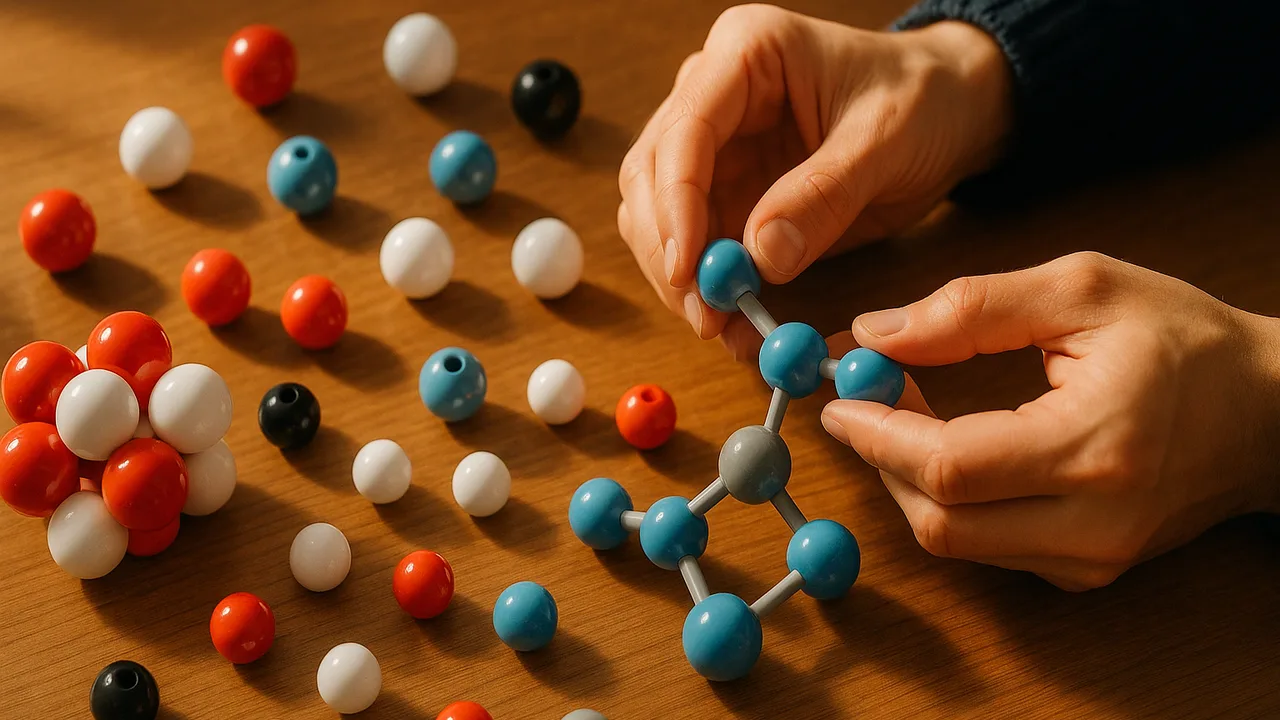
build physical models of reactant and product molecules and use them to show that atoms rearrange but are never lost or gained.
- I can develop a model that shows the types and number of molecules in the reactants of a chemical reaction.
- I can develop a model that shows the types and number of molecules in the products of a chemical reaction.
- I can describe how each molecule in the reactants is made of specific types and numbers of atoms.
- I can explain that during a chemical reaction, atoms in the reactants rearrange to form new molecules in the products.
- I can show that the number and types of atoms in the products are equal to those in the reactants, and that each type of atom always has the same mass.
- I can use my model to explain how atoms from the reactants rearrange to form different products in a chemical reaction.
Phase 2: Investigate
Warm-Up ~5 min
Do Now. In grade 6 you modeled molecules with clay and beads. Use 4 red bricks and 2 white bricks to build one shape. Now take it apart and build a different shape with the same bricks.
You rebuilt your bricks into a new shape. How many bricks of each color do you have now?
Instruction ~10 min
Explore first: a model reaction. Use the key on the card. Each color of brick or bead stands for one type of atom. Build the reactant molecules shown, then take them apart and rebuild them into the product molecules. Count every atom before and after.
| Reaction model | Atom type | Number in reactants | Number in products | Same? |
|---|---|---|---|---|
| A: hydrogen + oxygen → water | Hydrogen (white) | |||
| A: hydrogen + oxygen → water | Oxygen (red) | |||
| B: methane + oxygen → carbon dioxide + water | Carbon (black) | |||
| B: methane + oxygen → carbon dioxide + water | Hydrogen (white) | |||
| B: methane + oxygen → carbon dioxide + water | Oxygen (red) |
Name the ideas. Every substance is made of atoms. In a molecule, a specific set of atoms is linked together. Water is always 2 hydrogen atoms linked to 1 oxygen atom. In a chemical reaction, the links between atoms break, and the same atoms link up in new ways. That is why products have new properties: different arrangements make different substances.
Worked example 1: making water. Start with 2 hydrogen molecules (each 2 white bricks) and 1 oxygen molecule (2 red bricks). That is 4 white and 2 red. Rebuild them into 2 water molecules (each 2 white + 1 red). Count again: 4 white and 2 red. Same atoms, new molecules.
Worked example 2: why mass stays the same. Each type of atom always has the same mass, like each red brick weighing the same. If the number of each type of atom stays the same, the total mass must stay the same too. That explains our sealed-bag data from 1.05.
Check with a simulation. The PhET sim below shows molecules breaking apart and atoms forming new products. Use it as a counting model.
Guided Exercises ~15 min
Build each model first, then answer. Talk it through with your team.
Independent Practice ~10 min
Show what your model can explain.
Use your brick model to explain why the sealed bag in 1.05 kept the same mass. Mention atom types, atom numbers and mass.
Name one way your brick model is like real atoms and one way it is not.
Closure ~5 min
Atoms rearrange; they are never lost or gained. Next time, we measure whether reactions and processes give off energy or take it in.
Exit ticket: draw a simple model of any reaction from today. Show the reactant molecules, the product molecules and an atom count.
Teacher notes
Materials (per team): about 20 interlocking bricks or pop beads in black, white and red; a color key card; devices for the PhET sim.
Setup: test the sim on student devices before class.
Listen for: “the atoms got used up” and “the atoms became new atoms.” Keep to physical models and drawings. Do not introduce atomic masses or ask students to balance symbolic equations; the sim is a counting tool only. Model B is shown already balanced on the card (1 methane + 2 oxygen → 1 carbon dioxide + 2 water).
Support / stretch: give pre-built reactant molecules to students who need them. Stretch: on the sim’s Game screen, predict the products and leftovers before checking.