2.10 Modeling Fields: Electric, Magnetic and Gravitational
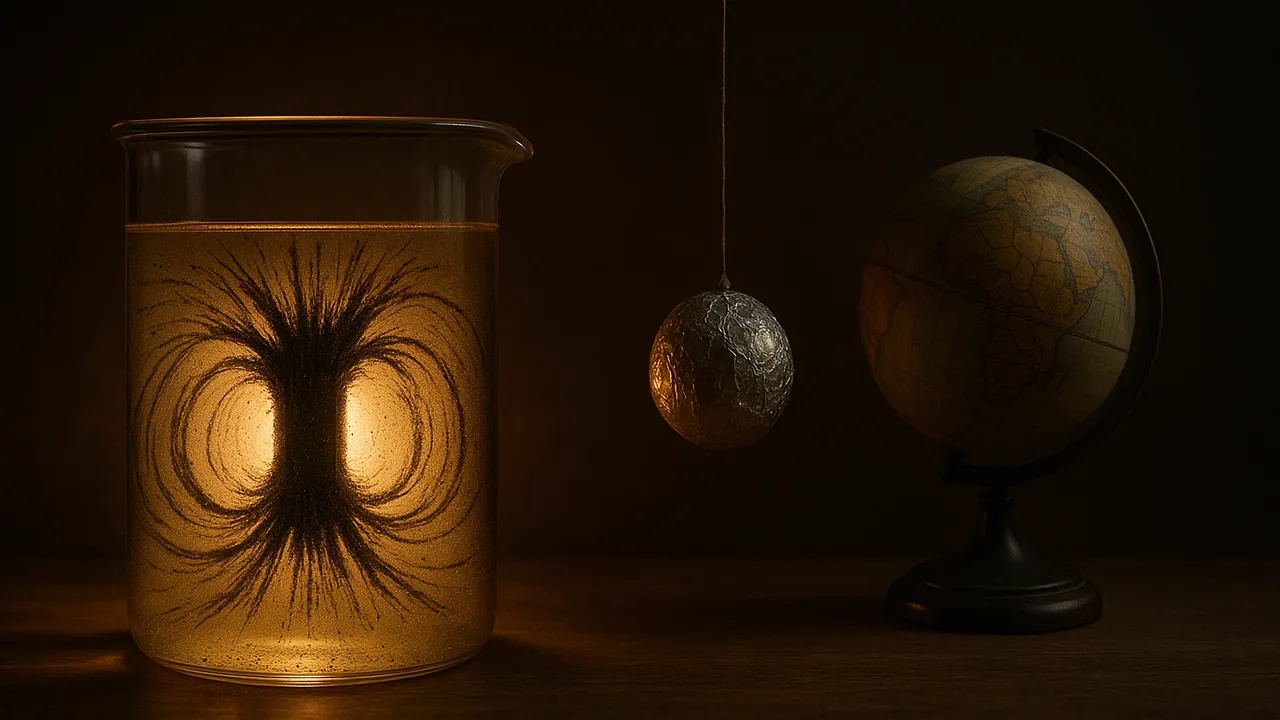
model the fields around charged, magnetic and massive objects and use evidence to tell electric and magnetic forces apart.
- I can explain the purpose of the investigation, which is to show that fields exist between objects that exert forces on each other without being in contact.
- I can describe the data that will show two objects can exert forces on each other without touching.
- I can describe the data that will help me tell the difference between electric and magnetic forces.
- I can describe the data that will show the force on one object is caused by its interaction with a second object, such as when the force disappears if the second object is removed.
- I can evaluate if the investigation’s design and data can show that fields exist between objects that act on each other without touching.
Phase 3: Make Sense
Warm-Up ~5 min
Do Now. Look back at your filing sketches and balloon data. A mystery object pulls paper bits but not a steel clip. Decide what kind of force it uses.
What kind of force does the mystery object use?
Instruction ~10 min
One big idea, three forces. Each force at a distance acts through a field, a region of space where an object can feel a push or pull. Electric fields surround charged objects. Magnetic fields surround magnets and wires carrying current. Gravitational fields surround everything with mass.
| Field | Made by | Acts on | Push, pull or both? | Evidence from our labs |
|---|---|---|---|---|
| Electric | ||||
| Magnetic | ||||
| Gravitational |
Worked example 1: a field model of the balloon. Ava drew a charged balloon with arrows pointing toward it from all sides. She drew the arrows closer together near the balloon to show a stronger field. She added paper bits only in the close zone, because her data showed they jumped only within a few centimeters.
Worked example 2: telling forces apart. Jamal built a three-test check. Test 1: does it pull a steel clip? Test 2: does it pull paper bits? Test 3: does a compass needle turn? A magnet passes 1 and 3. A charged balloon passes 2, and its pull fades as the charge leaks away. That is clear evidence for two different kinds of field.
Worked example 3: evaluating a design. Mei asked whether our investigations really showed fields. The filings showed a pattern with no contact. The force disappeared when the source was removed. It changed with distance and orientation. Together, these make the field model strong.
Limits of the model. Field lines are a drawing tool. No real strings stretch through space, but the model predicts what we observe.
Guided Exercises ~15 min
Check your models with your team before you answer each card.
Independent Practice ~10 min
Judge the evidence.
Evaluate our unit's investigations. Which one gave the strongest evidence that fields exist between objects that are not touching? Which was weakest? Explain each choice.
How confident are you that you can I can model fields and use evidence to tell electric and magnetic forces apart.
Closure ~5 min
Three forces, one idea: fields. Next time, we argue from data about how to make the strongest electromagnet for the recycling center.
Exit ticket: a student says, “The balloon sticks to the wall because it is magnetic.” Use data from two labs to explain whether you agree.
Teacher notes
Materials: students’ lab notebooks, chart paper, colored pencils, a demo magnet, balloon and compass for the three-test check.
Setup: run the three-test check live with a magnet and a balloon. Note: a strongly charged balloon can nudge a light compass needle a little; if it happens, discuss it as a reason to use several tests, not one.
Listen for: “magnetism and static are the same.” They are related in physics, but the evidence here shows different behaviors. Keep fields qualitative (MS-PS2-5 boundary).
Support / stretch: provide a partly completed comparison table. Stretch: explain why a compass points north using the idea of Earth’s magnetic field.