2.11 The Strongest Electromagnet: A Data-Driven CER
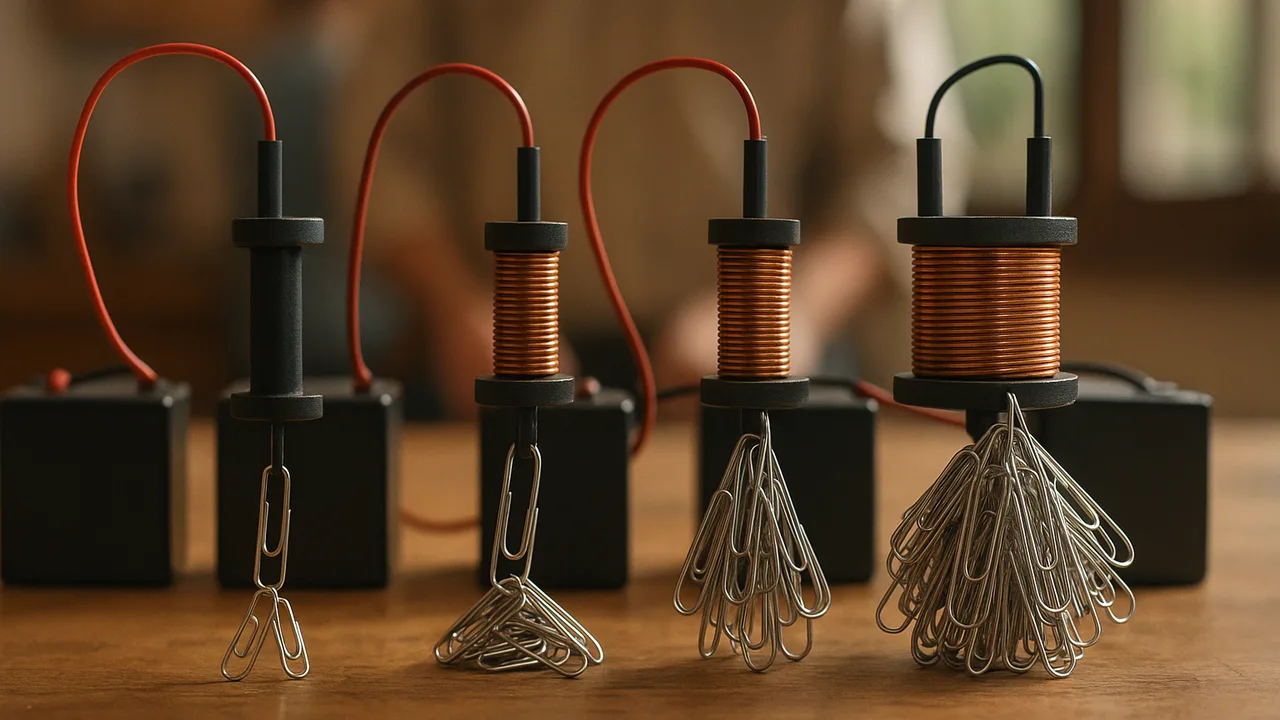
use electromagnet data to write a hypothesis and a claim about how coil turns and current change magnetic force.
- I can use data and science ideas to make a hypothesis that predicts how strong electric or magnetic forces will be when I change certain factors.
- I can use my hypothesis to explain how different changes could lead to different outcomes in the strength of electric or magnetic forces.
- I can ask questions about data to figure out how changing the electric current or the number of wire turns affects the strength of a magnetic force.
- I can ask questions about data to find out how the distance or orientation between objects changes the strength of electric or magnetic forces.
- I can ask questions about data to understand how the amount or type of electric charge, or the strength of magnets, affects electric or magnetic forces.
Phase 3: Make Sense
Warm-Up ~5 min
Do Now. Look at this sample class data for a 30-turn electromagnet: 1 cell lifted 8 clips; 2 cells lifted 15 clips. Write one thing you notice and one thing you wonder.
Using the sample pattern, what would 60 turns with 2 cells most likely do?
Instruction ~10 min
Pooling the class data. Each team adds its averages to the class table. Pooled data from many teams is more reliable than one team’s results.
| Turns | Cells | Team averages (clips) | Class average (clips) | Pattern you notice |
|---|---|---|---|---|
| 10 | 1 | |||
| 20 | 1 | |||
| 40 | 1 | |||
| 30 | 1 | |||
| 30 | 2 |
Worked example 1: proportional reasoning. In the 2.05 sample data, 10 turns lifted 3 clips and 20 turns lifted 6. Twice the turns, about twice the clips. From 20 to 40 turns the clips went from 6 to 11, a little less than double. The pattern is roughly proportional at first and may level off.
Worked example 2: a model CER. Question: “How does the number of turns affect an electromagnet’s strength?”
- Claim: more turns make a stronger electromagnet.
- Evidence: in the sample data, clips rose from 3 at 10 turns to 11 at 40 turns, with the same nail and battery.
- Reasoning: each turn of wire carrying current adds to the magnetic field. More turns means a stronger field around the core, so it pulls harder on steel.
Sentence starters. Claim: “Increasing ___ makes the electromagnet ___.” Evidence: “When we changed ___ from ___ to ___, the clips changed from ___ to ___.” Reasoning: “This happens because ___.”
Why it matters for the client. A scrapyard crane is an electromagnet that operators switch on and off. Our sorting line can work the same way: on to grab steel, off to drop it in the bin.
Guided Exercises ~15 min
Use the class table. Discuss each card before you write your CER.
Independent Practice ~10 min
Predict outcomes from your hypothesis.
Using your hypothesis, predict three outcomes: (a) more turns, same current; (b) same turns, less current; (c) the current switched off. Explain how each change leads to a different outcome.
How confident are you that you can I can use data to make a hypothesis about electromagnet strength.
Closure ~5 min
Our data supports a clear rule of thumb: more turns and more current, stronger magnet. Next time, we build an argument about gravity.
Exit ticket: write one testable question the class data has not yet answered about electromagnets. Name what you would change and measure.
Teacher notes
Materials: class data table on the board or a shared sheet, teams’ 2.05 data, graph paper, CER organizer.
Setup: collect team averages at the start. If teams’ data conflict, use that to talk about reliability and repeat trials.
Listen for: claims with no numbers, or evidence that changes two variables at once. All worked-example numbers are sample data. Proportional reasoning is fine; no formulas for magnetic force (MS-PS2-3 boundary).
Support / stretch: give a CER with the claim filled in. Stretch: explain why the class average may level off at high turns, using what they know about batteries running down.