2.24 Drop Day: The Final Test Against the Criteria
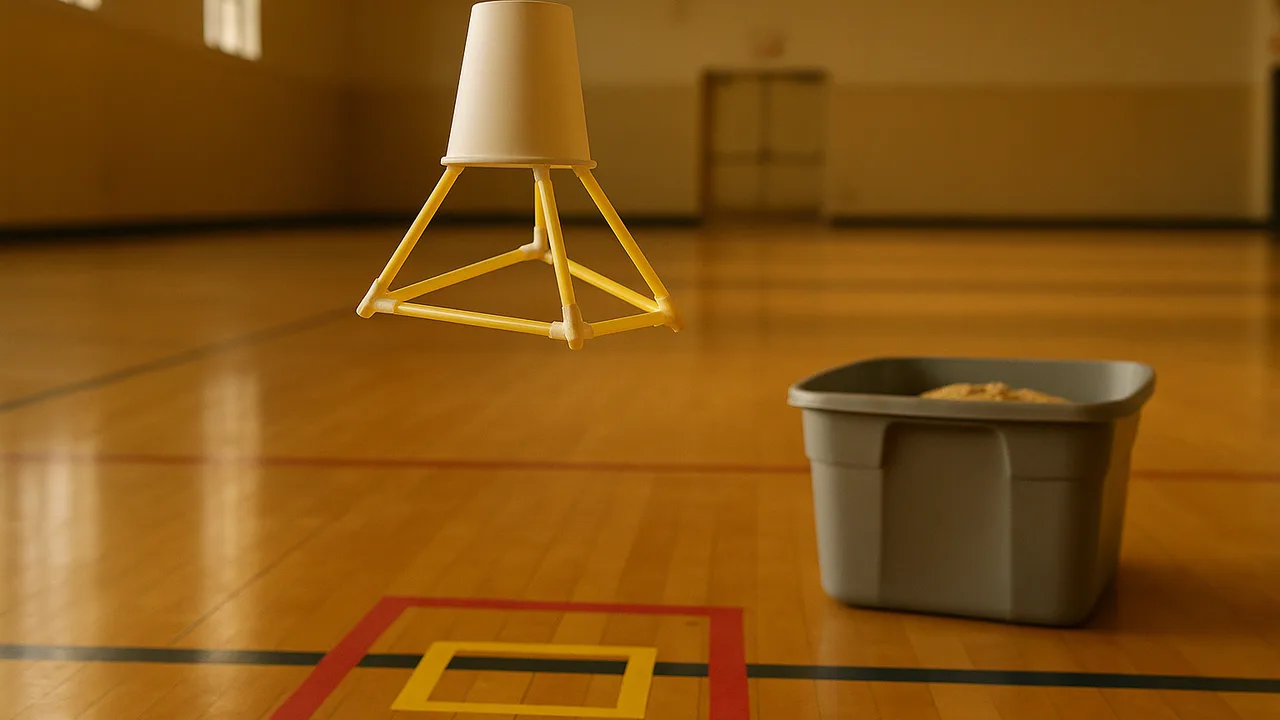
test my final lander against every criterion and constraint, analyze the class data, and explain the results with Newton’s third law.
- I can analyze data using methods like comparing numbers or looking for patterns.
- I can identify how each design solution meets the criteria and fits the constraints by examining the data.
- I can make a claim about which characteristics of each design best meet the criteria and constraints, using evidence from the data.
- I can use my understanding of Newton’s Third Law to analyze how well my design meets the criteria and constraints.
Phase 5: Prove It
Warm-Up ~5 min
Do Now. Weigh your final lander and measure it against the 20 cm cube. Record both. If it breaks a constraint, you have 5 minutes to fix it.
Your final lander weighs 156 g. What should you do?
Instruction ~10 min
Mission engineers, it is Drop Day. The science center wants proof that your lander works. Each lander gets three official drops from 2.0 m. A judge from another team checks the payload, the landing position and the time to open.
Judging rules. A trial passes only if the payload has no crack or leak, the lander ends upright, and the payload is out in under one minute. Mass and size are checked before the first drop.
Worked example 1: scoring a lander (sample numbers). Team Orion’s lander is 128 g and fits the cube. Trial 1 passes. Trial 2: payload OK, but it tips. Trial 3 passes. Score: 2 of 3 full passes, 3 of 3 for payload protection.
Worked example 2: explaining with Newton’s third law. Priya writes: “At impact, the floor pushed up on our crumple base as hard as the base pushed down. The base crushed about 3 cm. So the cotton nest and egg slowed down over a longer distance. The push between nest and egg stayed small, and the egg survived.”
| Team | Mass (g) | Fits cube? | Trial 1 | Trial 2 | Trial 3 | Full passes | Key feature |
|---|---|---|---|---|---|---|---|
Guided Exercises ~15 min
After all drops, analyze the class table together.
Independent Practice ~10 min
Write your Drop Day conclusion.
Claim: our lander (did / did not) meet the criteria. Evidence: give your trial data, mass and size. Reasoning: use Newton's third law to explain why the payload survived or failed.
Look back at your iteration log from V1 to the final version. How did the data from testing guide your changes?
Closure ~5 min
The data are in. Next: you present the exhibit to the science center.
Exit ticket: if you had one more round, what one change would you make? Name the data that support it.
How confident are you that you can I can judge a design against criteria and explain the results with data and forces.
Teacher notes
Materials: final landers, scale, 20 cm cube gauge (a box with one side open), timer, tarp, zip bags, eggs or water balloons, judge cards, class data sheet.
Setup: assign each team a judge from another team. Run drops in order and post results live on the board. Allow about 20 minutes for drops and 20 for analysis.
Listen for: teams blaming luck; redirect to features and data. Listen for force pairs described as unequal.
Support / stretch: give a conclusion frame. Stretch: calculate class success rates as percentages and rank the features.