2.03 The Crash Lab: Collisions and Balloon Rockets
collect evidence that when two objects collide or push apart, each one pushes on the other with an equal force in the opposite direction.
- I can design a solution to a collision problem by identifying and describing the parts of the system that are involved in the collision.
- I can describe the force that one object will exert on another during a collision.
- I can explain how Newton’s Third Law is used in my design and describe the technologies I will use to solve the problem.
Phase 2: Investigate
Warm-Up ~5 min
Do Now. Today you explore first, and we name the ideas later. Two students on rolling chairs face each other, feet off the floor. One student gently pushes the other’s hands.
Who will roll when one student pushes?
Instruction ~10 min
Mission engineers, welcome to the Crash Lab. A landing is a collision. Before we design, we need to see what forces do when objects hit or push apart. Run all three stations and record what you see.
- Station 1, the head-on crash: roll two equal carts (or two equal balls) toward each other. Then roll one cart into a cart at rest.
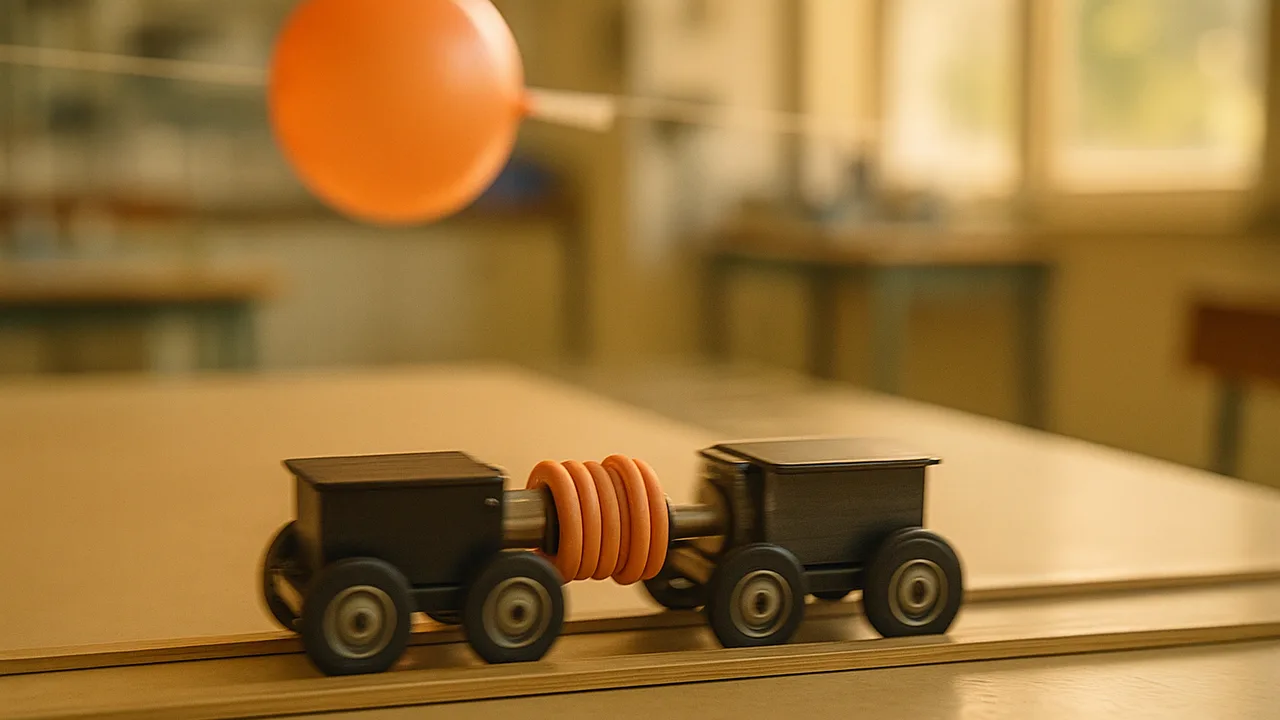
- Station 2, the spring push: press two carts together with a rubber band or spring between them. Let go. Measure how far each one rolls.
- Station 3, the balloon rocket: thread a string through a straw and tie it across the room. Tape a blown-up balloon to the straw and let the air out. Measure how far the balloon travels.
| Station and trial | What pushed on what? | Which way did each object move? | Distance moved (cm) | Notes |
|---|---|---|---|---|
| 1. Head-on crash | ||||
| 1. Cart into still cart | ||||
| 2. Spring push, equal carts | ||||
| 2. Spring push, one cart loaded | ||||
| 3. Balloon rocket, trial 1 | ||||
| 3. Balloon rocket, trial 2 |
Worked example 1: naming the system. A system is the group of objects we are studying. In Station 2, Ava named her system: “cart A, cart B and the spring.” She drew an arrow on each cart pointing the way it moved. The arrows pointed in opposite directions. These are sample notes; your data will be your own.
Worked example 2: the balloon puzzle. Jamal noticed the air rushed out the back while the balloon zoomed forward. He wrote, “The balloon pushed the air backward, and the air pushed the balloon forward.” Rockets work this way too. They do not need anything outside to push against.
A pattern to look for. In every station, did one object push alone, or did both objects push on each other? We will name the rule in Make Sense.
Guided Exercises ~15 min
Use your team’s data table to answer these. The Recorder reads out the numbers.
Independent Practice ~10 min
Connect the Crash Lab to our lander.
When a lander hits the ground, name the two objects in the collision system. Describe the push each one gives the other.
How confident are you that you can I can describe the pushes between two objects in a collision.
Closure ~5 min
In every station, the push went both ways. Next time, we keep the push the same and change the mass to see how motion changes.
Exit ticket: describe one observation from today showing that BOTH objects in an interaction feel a push.
Teacher notes
Materials (per team): 2 dynamics carts or 2 equal toy trucks (equal balls work too), a rubber band or spring launcher, 2–4 masses or washers, masking tape, a meter stick. Class: 2 balloon-rocket lines (string, straws, balloons, tape). Two rolling chairs for the demo.
Setup: tape a start line for the spring push. Release the spring by pulling a pencil out from between the carts. Mark balloon start points so trials match.
Listen for: “the bigger thing pushes harder.” In every interaction the two forces are equal in size; the lighter object just moves more. Hold “Newton’s third law” as a name until 2.10. Keep everything in one dimension (back and forth along one line).
Support / stretch: give pre-drawn system diagrams to label. Stretch: predict the result of a spring push with one loaded cart before testing.