1.03 Building Blocks: Modeling Atoms and Molecules
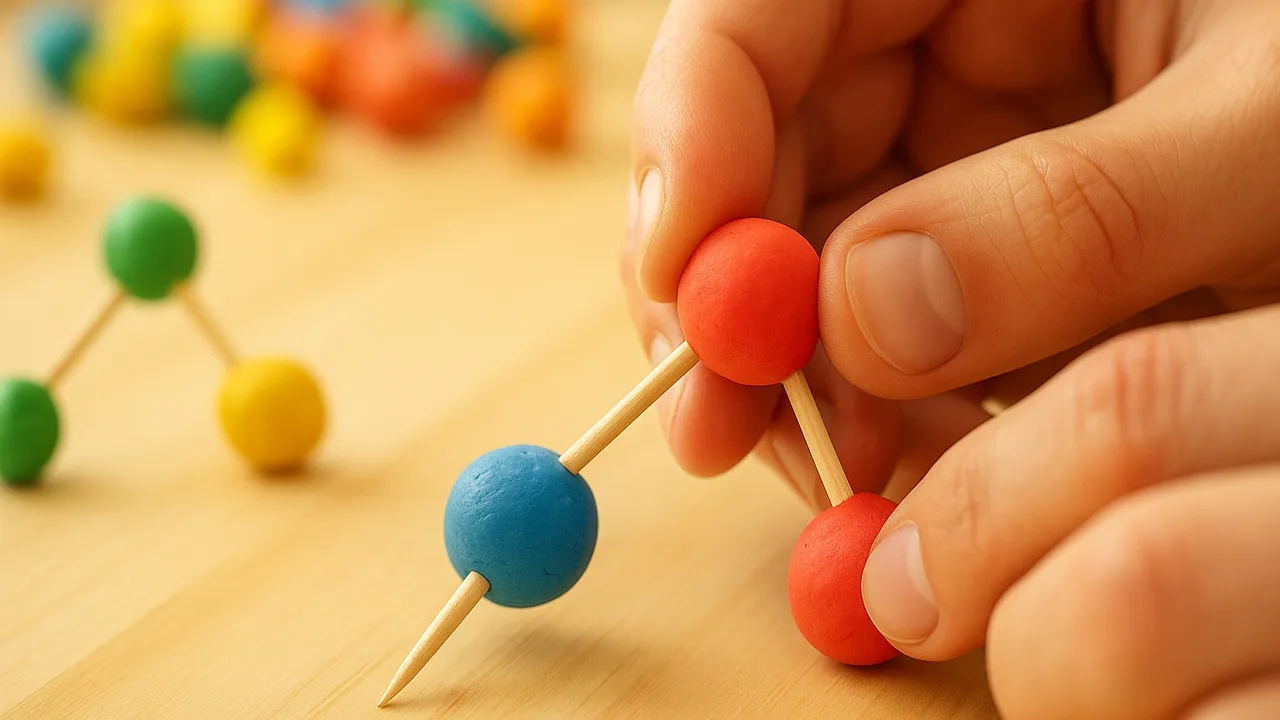
build simple models of atoms and molecules and explain how molecules can be made of the same or different kinds of atoms.
- I can create models that show individual atoms, molecules, and extended structures with repeating parts.
- I can identify and label substances as solids, liquids, or gases in my models.
- I can use models to explain how atoms combine to form molecules, and how molecules can be made of the same or different types of atoms.
- I can show in my models that some molecules can connect to each other, and that in some structures, the same atoms or groups of atoms repeat.
Phase 2: Investigate
Warm-Up ~5 min
Do Now. Today you build first and we name ideas later. Each team gets clay in three colors, toothpicks and a set of recipe cards. A card says, for example, “2 white + 1 red.” Before building, answer the question below.
If you could zoom in on a drop of water a billion times, what would you see?
Instruction ~10 min
Cooler engineers, today you build tiny things big. Use one clay ball for each atom. Color shows the type: white for hydrogen, red for oxygen, black for carbon, and blue for nitrogen. A toothpick joins two atoms that are connected. Build each recipe card, then fill in the table.
| Recipe card | Substance | Atoms in one molecule (types and number) | Same type or different types? | Solid, liquid or gas at room temperature? | Sketch of my model |
|---|---|---|---|---|---|
| 2 white + 1 red | water | ||||
| 2 red | oxygen gas | ||||
| 1 black + 2 red | carbon dioxide | ||||
| 2 blue | nitrogen gas | ||||
| 1 black + 4 white | methane (natural gas) |
Naming what you built. An atom is the smallest piece of an element, like oxygen or carbon. When two or more atoms are joined, they form a molecule. A substance is one kind of matter, and in a pure substance every molecule is the same.
Worked example 1: water. Ava joined two white balls to one red ball. Her model shows one water molecule: two hydrogen atoms and one oxygen atom. Chemists write it as H2O. A single raindrop holds an enormous number of these molecules, each built the same way.
Worked example 2: same type or different types? Malik built oxygen gas with two red balls. Both atoms are oxygen, so it is a molecule made of one type of atom. His carbon dioxide model, CO2, joins one carbon to two oxygens. That molecule is made of different types of atoms.
Not every substance comes in molecules. Helium, the gas in party balloons, exists as single atoms that are not joined to anything. Next time you will meet a third kind of structure, one with no separate molecules at all.
Guided Exercises ~15 min
Use your models and table to answer. The Recorder reads your table out loud before each answer.
Independent Practice ~10 min
Model a new molecule on your own.
Hydrogen peroxide, the bubbly first-aid liquid, has the formula H2O2. Sketch a model of one molecule. Label each atom, and compare it to your water model.
How confident are you that you can I can model molecules made of the same or different types of atoms.
Closure ~5 min
We built atoms into molecules and saw that atoms can combine in different ways. Next time, we use hand lenses on salt and find a pattern that repeats.
Exit ticket: explain the difference between an atom and a molecule, using water as your example.
Teacher notes
Materials (per team): modeling clay in four colors (or colored paper circles and tape), about 20 toothpicks, recipe cards, the data table. Keep a color key posted.
Setup: hand out recipe cards without the substance names for the first five minutes, so students build before naming. Then reveal the names.
Listen for: “a water molecule is a tiny drop of water” (a molecule has no wetness; that is a property of many molecules together). Stay inside the MS-PS1-1 boundary: no electrons, no bond types, no bond energy. Toothpicks just mean “joined.” Real molecules have shapes; water is bent, but do not test on angles.
Support / stretch: pre-build one water model as a reference. Stretch: build ethanol (2 carbon, 6 hydrogen, 1 oxygen) from a provided sketch.