2.06 Shadow Play: Solar and Lunar Eclipses
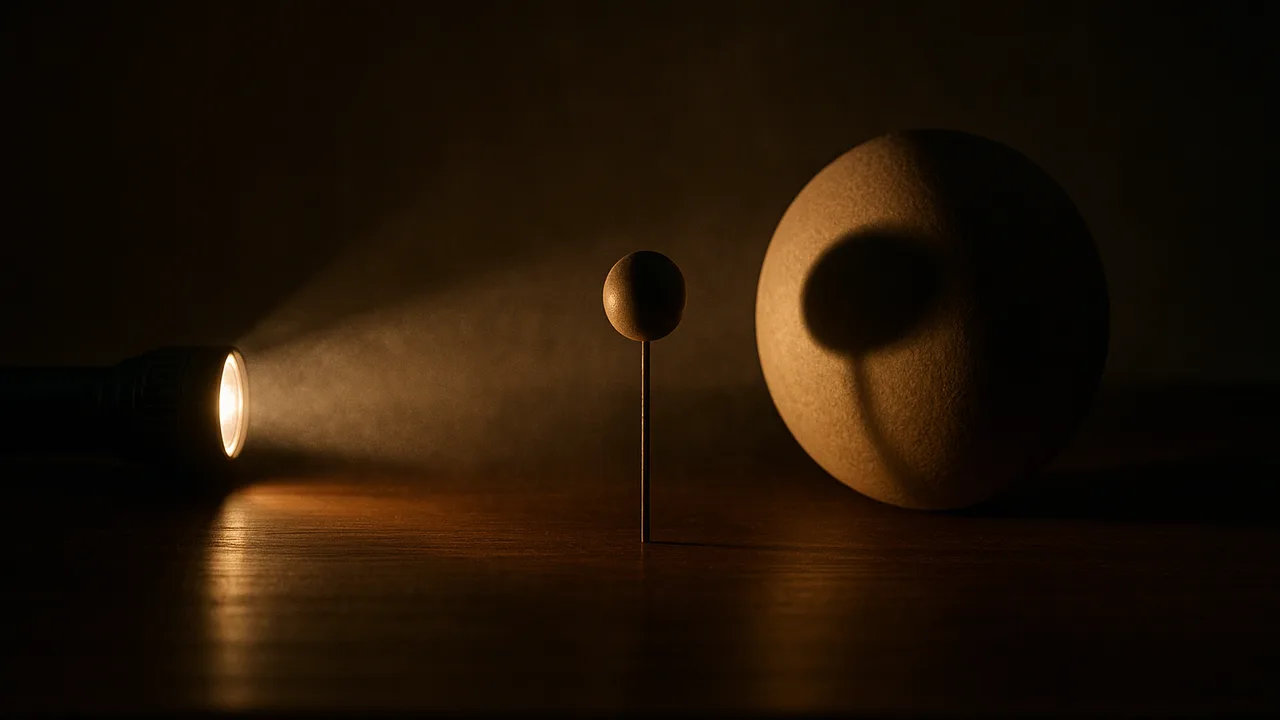
use the lamp-and-ball model to show how solar and lunar eclipses happen and explain why they do not happen every month.
- I can use my model to explain how the changing positions of the Earth, sun, and moon cause the phases of the moon we see from Earth.
- I can use my model to explain how solar and lunar eclipses happen, and why they do not occur every month.
- I can use my model to explain how Earth’s tilted axis and its orbit around the sun cause the seasons, and why summer and winter happen at different times in the Northern and Southern Hemispheres.
- I can use my model to predict the phase of the moon or the positions of Earth, sun, and moon when given information about one of them.
- I can use my model to predict when and where an eclipse will happen, based on the positions of Earth, sun, and moon.
- I can use my model to predict the season on Earth or the positions of Earth and the sun, given information about the season and location on Earth.
Phase 2: Investigate
Warm-Up ~5 min
Do Now. Hold your hand between the lamp and the wall. A shadow appears. Move your hand closer to the lamp, then closer to the wall.
In which phase of the Moon could a SOLAR eclipse happen?
Instruction ~10 min
Mission engineers, today we make eclipses. Use the same lamp and ball. Run the two lineups and then the puzzle.
- Lineup 1, solar eclipse: hold the Moon ball between the lamp and your eyes so it blocks the bulb. Look at a partner’s face to see the small shadow the ball casts.
- Lineup 2, lunar eclipse: hold the ball behind your head, exactly opposite the lamp, and lower it into your head’s shadow.
- The tilt puzzle: tilt your Moon’s circle so the ball passes a little above the lamp on one side and a little below your head’s shadow on the other. Count how many times you get an eclipse in 4 orbits.
| Lineup | Order (Sun, Earth, Moon) | Moon phase at that position | What is blocked, and whose shadow falls where? | Eclipses in 4 tilted orbits |
|---|---|---|---|---|
| Solar eclipse | ||||
| Lunar eclipse | ||||
| Tilted orbit |
Worked example 1: solar eclipse. In a solar eclipse, the order is Sun, Moon, Earth. The Moon blocks sunlight, and its shadow falls on a small part of Earth. Only people inside that shadow see a total eclipse. On April 8, 2024, the path of a total solar eclipse crossed North America, from Mexico through the United States to Canada.
Worked example 2: lunar eclipse. In a lunar eclipse, the order is Sun, Earth, Moon. Earth blocks sunlight from reaching the Moon, so Earth’s shadow falls on the Moon. It can only happen at full moon. Anyone on the night side of Earth can see it, so far more people see a lunar eclipse.
Why not every month? The Moon’s orbit is tilted about 5 degrees compared with Earth’s orbit around the Sun. Most months, the Moon passes a little above or below the lineup, so there is no eclipse. Eclipses only happen when a new or full moon falls right where the two orbits cross.
Guided Exercises ~15 min
Check each answer against your model.
Independent Practice ~10 min
Make a prediction with the model.
A news report says a total lunar eclipse will happen next week. What phase will the Moon be in? Draw the positions of the Sun, Earth and Moon.
How confident are you that you can I can use a model to explain and predict eclipses.
Closure ~5 min
Eclipses are lineups, and the tilted orbit makes them rare. Next time, we tilt Earth and find out what causes the seasons.
Exit ticket: explain why there is not a solar eclipse every month, using the word “tilted.”
Teacher notes
Materials: the lamp and balls from 2.05, a hula hoop or wire ring to show the tilted Moon orbit, index cards for pinhole viewers.
Setup: tilt the hoop slightly around a student’s head so the Moon ball passes above and below the shadow most of the way around.
Listen for: confusing the lunar eclipse with the phases, and “a solar eclipse happens at night.” Address eye safety firmly; never suggest sunglasses. Exact eclipse dates beyond 2024 are not needed.
Support / stretch: provide labeled lineup cards. Stretch: why does the Moon look reddish during a total lunar eclipse? (Some sunlight bends through Earth’s atmosphere; accept qualitative answers.)