2.09 Walking the Solar System: A Toilet-Paper Scale Model
organize planet data and use a scale to build a model that shows true distances in the solar system and its scale limits.
- I can organize data about solar system objects, such as their surface features, layers, and distances from the sun, using graphs, diagrams, or models to help me analyze their scale.
- I can organize data in a way that helps me find and explain patterns in the scale properties of solar system objects, even when those properties are too big or too small to see directly.
- I can show and explain the size and distance relationships between Earth, the sun, and the moon in my model, and describe any scale limitations.
Phase 2: Investigate
Warm-Up ~5 min
Do Now. Most textbook pictures show the planets lined up close together, about the same size as the Sun’s edge. Is that picture true?
If the Sun-to-Neptune distance were the length of a football field, how big would Earth be?
Instruction ~10 min
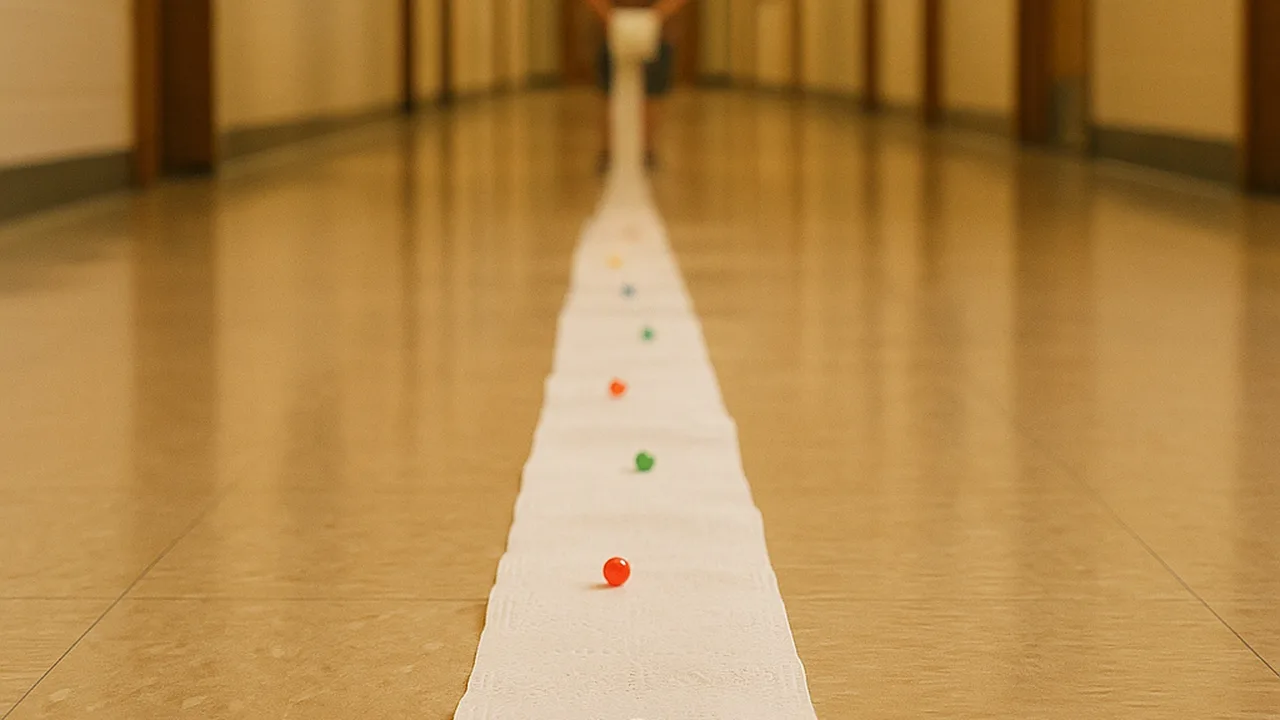
Mission engineers, today we unroll the solar system. One astronomical unit (AU) is the average distance from Earth to the Sun, about 150 million km. Our scale: 1 AU = 3 toilet-paper sheets. Multiply each distance by 3, then lay out the roll in the hallway.
| Object | Diameter (km) | Average distance from Sun (AU) | Sheets from Sun (AU × 3) | Rocky or gas/ice giant? |
|---|---|---|---|---|
| Sun | 1,391,000 | 0 | 0 | — |
| Mercury | 4,879 | 0.39 | ||
| Venus | 12,104 | 0.72 | ||
| Earth | 12,756 | 1.00 | ||
| Mars | 6,792 | 1.52 | ||
| Jupiter | 142,984 | 5.20 | ||
| Saturn | 120,536 | 9.5 | ||
| Uranus | 51,118 | 19.2 | ||
| Neptune | 49,528 | 30.1 |
Worked example 1: using the scale. Jupiter is 5.20 AU from the Sun. Malik multiplied 5.20 × 3 = 15.6, so Jupiter goes about 15 and a half sheets from the Sun. Mars is 1.52 × 3 = about 4.6 sheets. Notice the big gap between Mars and Jupiter. That is where the asteroid belt is.
Worked example 2: Earth and Moon to scale. The Moon’s diameter (3,475 km) is about one quarter of Earth’s. The Moon is about 384,000 km away, roughly 30 Earth diameters. If Earth were a basketball, the Moon would be a bit bigger than a tennis ball, about 7 meters away. Our lamp-and-ball model put them less than one meter apart, so it was not to scale.
Scale limitations. On our toilet-paper roll, every planet would be far too tiny to see. Any single model can show true distances OR visible sizes, but usually not both. That is a scale limitation.
Guided Exercises ~15 min
Use your completed table and the hallway model.
Independent Practice ~10 min
Plan the exhibit version.
The science center has a 100-meter hallway. Neptune is at the far end. Choose a scale and calculate where Earth and Jupiter go. Show your work.
How confident are you that you can I can use data and a scale to model distances in the solar system.
Closure ~5 min
Our solar system is huge and mostly empty space, and scale models must choose what to show. Next, we make sense of the Crash Lab and push cart data. First, take the 3DX field trip.
Exit ticket: explain why it is hard to show both the sizes and the distances of planets in the same model.
Teacher notes
Materials (per team): a roll of toilet paper (or adding-machine tape marked in 10 cm units), markers, sticky labels, calculators, a printed data table.
Setup: 90 sheets is roughly 10 m; check your hallway first. Distances are averages; values are standard rounded data from NASA fact sheets.
Listen for: “the planets are lined up” and “the Moon is just above the clouds.” Stay with scale from data; no Kepler’s laws or orbital equations (MS-ESS1-3 boundary).
Support / stretch: give a partly completed calculation column. Stretch: at the same scale, how big would the Sun be? (About 2.8 cm across on a 100 m field.)