1.25 Showcase: Presenting the Cooler to the Field Trip Team
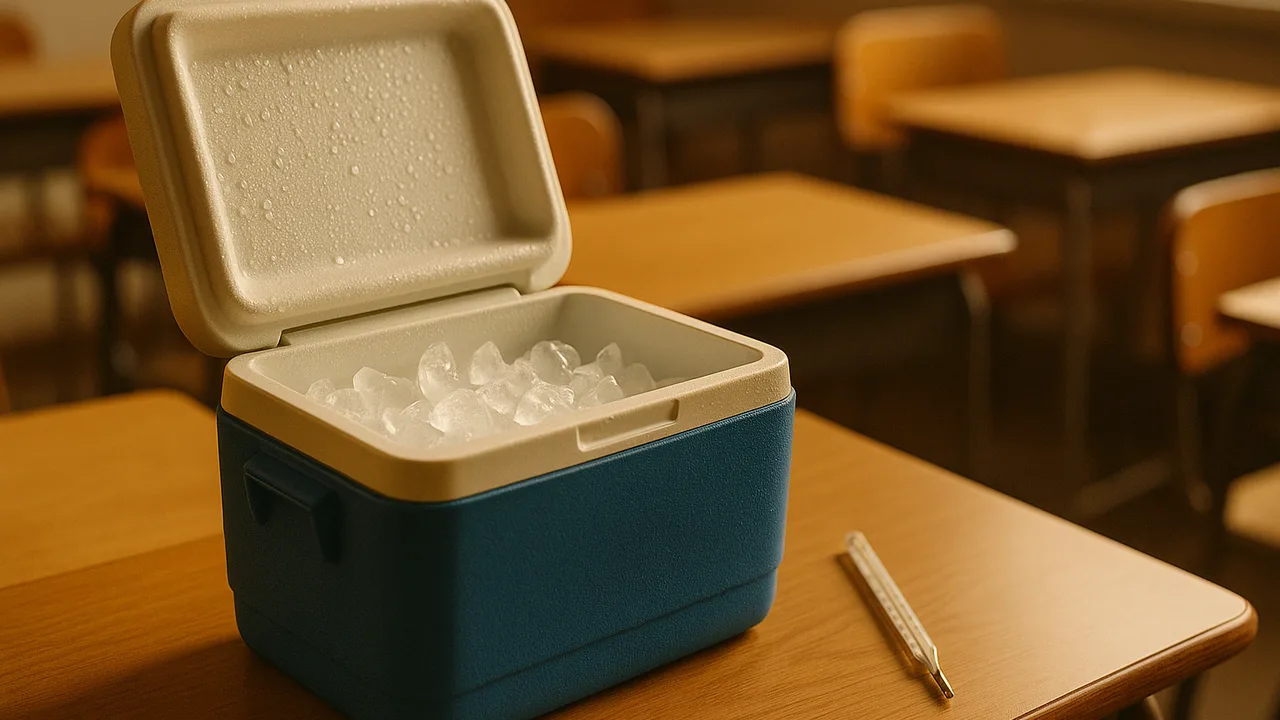
present our cooler to the field trip team and defend it with test data, particle science and a decision matrix.
- I can use evidence and reasoning to make a claim about which solution works best, based on their strengths and weaknesses.
- I can identify the system where the problem exists, including its main parts, how they relate, and what is inside or outside the system.
- I can explain who needs the problem solved, what needs must be met, and which scientific issues are important.
- I can analyze how possible solutions might affect people and the environment, and decide which issues and parts of the system matter most.
- I can use my model to explain how the motion of particles is related to their kinetic energy and the temperature of the system.
- I can describe how adding or removing thermal energy changes the kinetic energy of particles and can cause a change in state.
- I can use my model to show how the state of matter (solid, liquid, gas) is connected to how particles move and interact.
Phase 5: Prove It
Warm-Up ~5 min
Do Now. The field trip team has five minutes per team. What three things do they most need to hear?
Which opening best fits our client?
Instruction ~10 min
Design engineers, today the client is here. Members of the 6th-grade field trip team, such as teachers, chaperones and a front office helper, visit in person or by video. They will choose which designs to copy for the next trip.
Your five-minute showcase. 1. The problem and who it affects. 2. Your concepts and decision matrix. 3. Your final cooler and how it works, with a particle model. 4. Your test data from field trip day. 5. Materials: where they come from and their effect on the environment.
Worked example 1: explaining the science simply. Mei said: “Warm air outside has fast-moving particles. Our foam walls are full of trapped air, so energy passes through slowly. The ice absorbs what gets in and melts slowly, which keeps the lunch at 3.5 °C.” Short, accurate and tied to the design.
Worked example 2: being honest about trade-offs. Diego said: “Our wool cooler kept lunch at 4.0 °C, just meeting the criterion. It costs $4.50, more than foam. But wool is a natural, reusable material, and foam is hard to recycle. If you want the coldest cooler, pick foam. If you want less waste, pick wool.” Clients trust honest data.
Guided Exercises ~15 min
Rehearse with your team before the client arrives.
Independent Practice ~10 min
After all presentations, reflect.
What did the client ask or suggest? Name one idea from another team that you would borrow, and explain why.
Write a one-paragraph recommendation to the field trip team: which design should they copy, and why? Use evidence from at least two teams.
Project task: The Field Trip Lunch Cooler
Design, build, test and present a cooler that keeps a packed lunch at 4 °C or colder from 7:30 until 12:30, with no electricity, for the 6th-grade field trip team. Defend your design with a decision matrix, a particle model and field-trip-day data, and explain where your materials come from.
Submission workflow
- Define the problem: who needs it, the system, the criteria and the constraints, including effects on the environment.
- Sketch at least two concepts and choose one with a weighted decision matrix.
- Build version 1, run the heat test, take critique and build version 2.
- Run the field-trip-day heat test and compare results to every criterion and constraint.
- Present to the client: problem, design choice, particle science, data, materials and an honest recommendation.
How it is scored
| Criterion | What proficient looks like |
|---|---|
| Defining the problem | The problem, the people affected, the system, measurable criteria and constraints (cost, time, safety, environment) are stated clearly. |
| Evaluating designs | Two or more concepts are scored in a weighted decision matrix; the claim about the best design names strengths, weaknesses and evidence, and uses ideas from how others solved similar problems. |
| Science of matter and energy | A particle model shows the cooler system and explains how slowing thermal energy keeps the ice solid and the lunch cold; temperature and thermal energy are used correctly; materials are traced to natural or synthetic sources. |
| Testing and communication | Field-trip-day data is graphed and compared with every criterion; one limitation is named; every member speaks; the recommendation to the client is honest and clear. |
Closure ~5 min
You solved a real problem for real people, design engineers. Next: the unit checkpoint, then two catch-up and stretch days.
Exit ticket: which question from our Wonder Board can you now answer? Write the question and your answer.
How confident are you that you can I can defend a design to a client with data and science.
Teacher notes
Materials: final coolers, graphs and matrices on posters or slides, rubric copies for visitors, a timer.
Setup: invite the teachers and chaperones planning a grade-level trip; a video call works if they cannot attend. Visitors can score the “Testing and communication” row. Score the rubric during talks.
Listen for: talks that skip the data; “keeps the cold in” language; one student doing all the talking.
Support / stretch: give a five-box presentation frame and allow note cards. Stretch: ask teams to estimate how their cooler would do on a much hotter day and why.