2.05 Lamp, Ball and Moon: Modeling the Phases
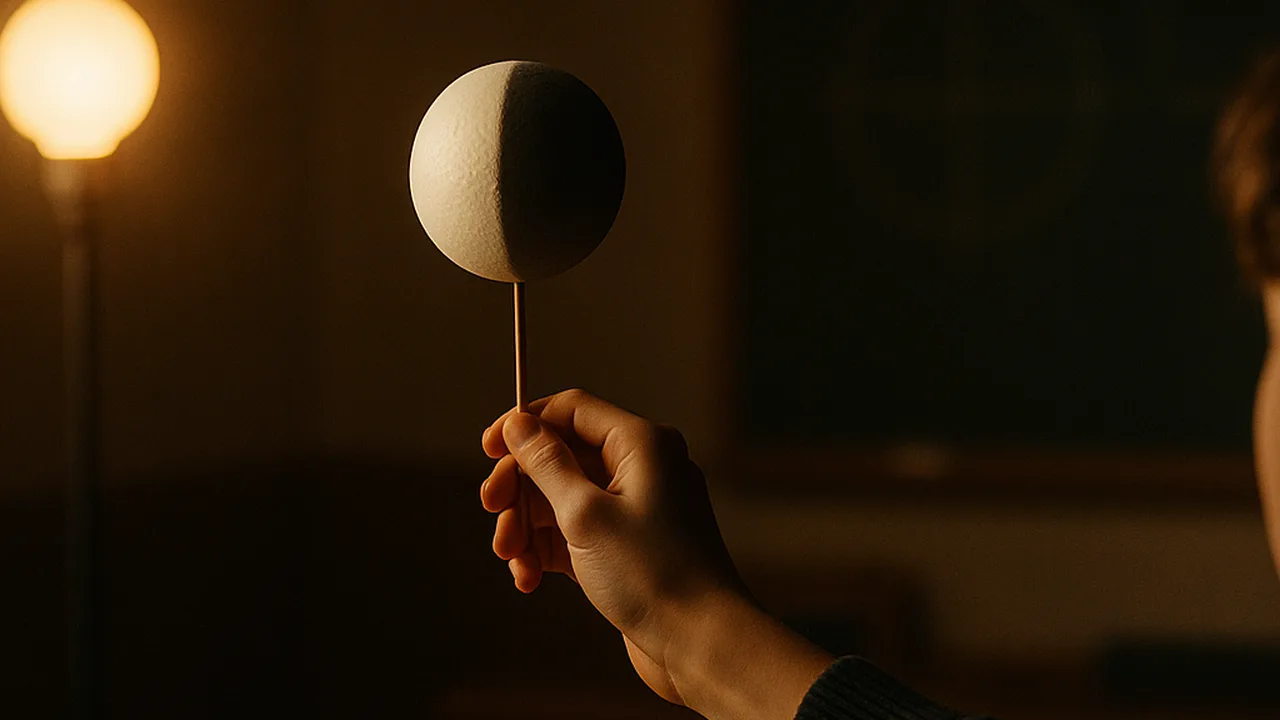
use a lamp-and-ball model to show how the changing positions of the Sun, Earth and Moon cause the phases we see from Earth.
- I can develop a model of the Earth, sun, and moon system that includes Earth (showing its tilted axis), the sun, the moon, and solar energy.
- I can use my model to describe how Earth rotates on its tilted axis once a day and how the moon rotates on its axis about once a month.
- I can explain how the moon orbits Earth about once a month, always showing the same side to Earth, and how the moon’s orbit is tilted compared to Earth’s orbit around the sun.
- I can describe how the Earth-moon system orbits the sun once a year, how solar energy travels in straight lines to Earth and the moon, how sunlight reflects off the moon, how the distance between Earth and the sun stays nearly the same, how sunlight hits Earth at different angles, and how Earth’s axis stays pointed in the same direction as it orbits the sun.
- I can use my model to explain how the changing positions of the Earth, sun, and moon cause the phases of the moon we see from Earth.
- I can use my model to explain how solar and lunar eclipses happen, and why they do not occur every month.
- I can use my model to explain how Earth’s tilted axis and its orbit around the sun cause the seasons, and why summer and winter happen at different times in the Northern and Southern Hemispheres.
Phase 2: Investigate
Warm-Up ~5 min
Do Now. Over a month, the Moon seems to grow from a thin sliver to a full circle and shrink back again. Many people have a guess about why. Choose yours before the lights go off.
What causes the Moon's phases?
Instruction ~10 min
Mission engineers, the room is now the solar system. A bare lamp in the center is the Sun. Your head is Earth. A foam ball on a pencil is the Moon. Hold the ball at arm’s length, a little above your head, and turn slowly to your left in a full circle. Stop at each of the 8 positions taped on the floor and sketch what you see.
| Position | Where the Moon is (toward the lamp, side, away) | Sketch of the lit part I see | Phase name |
|---|---|---|---|
| 1 | |||
| 2 | |||
| 3 | |||
| 4 | |||
| 5 | |||
| 6 | |||
| 7 | |||
| 8 |
Worked example 1: two key positions. When Priya held the ball between her face and the lamp, she saw only its dark side. That is a new moon. When the ball was behind her head, opposite the lamp, she saw the whole lit face. That is a full moon. Halfway between, she saw half of the face lit, called a quarter moon. These are sample notes; your sketches will be your own.
Worked example 2: what the model shows about motion. Earth rotates, or spins, on its tilted axis once a day. The Moon orbits Earth in about a month, and the full cycle of phases takes about 29.5 days. The Moon also rotates once for each orbit, so the same side always faces Earth. Malik kept a sticker on the ball facing his nose the whole way around, and the ball turned once as he circled.
Light travels in straight lines. Sunlight travels straight to the Moon and reflects off its surface to our eyes. The Moon makes no light of its own.
Guided Exercises ~15 min
Use your sketches. The Reporter checks answers with the model.
Independent Practice ~10 min
Use the model to predict.
Tonight the Moon is full. About how many days until the next new moon? Explain where the Moon will be in its orbit and why.
How confident are you that you can I can use a model to explain the phases of the Moon.
Closure ~5 min
The phases come from where the Moon is in its orbit, not from Earth’s shadow. Next time, we line the Sun, Earth and Moon up exactly and make eclipses.
Exit ticket: explain to a friend who believes Earth's shadow causes the phases why that idea does not match our model.
Teacher notes
Materials: one bare-bulb lamp with no shade (LED, so it runs cooler), foam or polystyrene balls on pencils (one per student), tape to mark 8 positions, a room that can be darkened.
Setup: students stand in a ring around the lamp. Have them hold the ball slightly above head height so their head does not block the light (that would make an eclipse, saved for 2.06).
Listen for: “Earth’s shadow makes the phases.” Also “the Moon doesn’t spin.” Use the sticker to show one rotation per orbit. Note the model’s limits: sizes and distances are far off, a point students fix in 2.09.
Support / stretch: give a phase card set to sequence. Stretch: explain why a full moon rises around sunset.