1.07 Hand Warmers and Cold Packs: Energy In, Energy Out
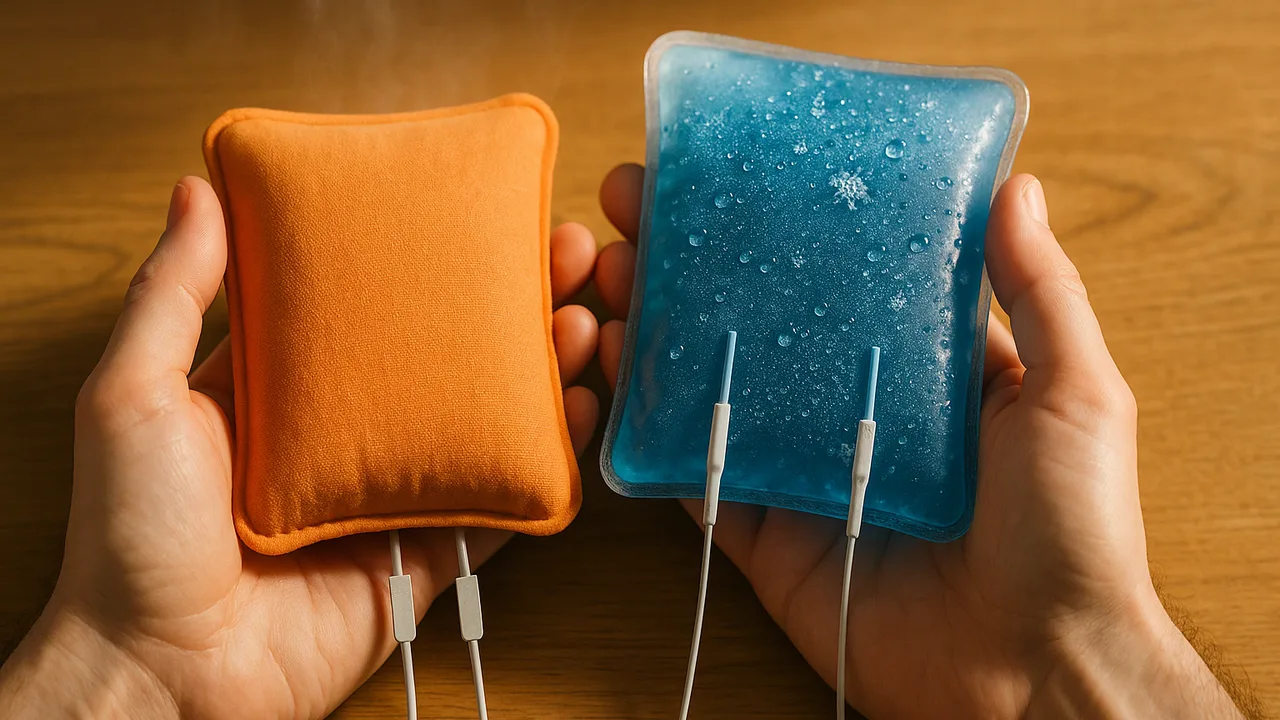
measure how hand warmers and instant cold packs change temperature and explain what happens to particle motion in each.
- I can use my model to explain how the motion of particles is related to their kinetic energy and the temperature of the system.
- I can describe how adding or removing thermal energy changes the kinetic energy of particles and can cause a change in state.
- I can use my model to show how the state of matter (solid, liquid, gas) is connected to how particles move and interact.
- I can use my model to explain how adding or removing thermal energy changes the average kinetic energy of the particles in a substance.
Phase 2: Investigate
Warm-Up ~5 min
Do Now. Your teacher holds up two sealed packets: an air-activated hand warmer and an instant cold pack. Neither one has a battery or a plug. Make a prediction.
Where does the hand warmer's warmth come from?
Instruction ~10 min
The test. Tape a thermometer probe to each pack. Record the starting temperature. Then open the hand warmer’s outer wrapper, and squeeze the cold pack until the inner pouch pops. Record every two minutes.
| Time (min) | Hand warmer (°C) | Cold pack (°C) | What I notice |
|---|---|---|---|
| 0 | |||
| 2 | |||
| 4 | |||
| 6 | |||
| 8 | |||
| 10 | |||
| 12 | |||
| 14 | |||
| 16 |
Thinking in particles. Particles in matter are always moving. The faster they move on average, the higher the temperature. When the hand warmer releases thermal energy, particles in the pack, the probe and your hand speed up. When the cold pack takes in thermal energy, particles around it slow down.
Worked example 1: the hand warmer. These are sample numbers. Jamal’s warmer started at 22°C and reached 50°C after ten minutes. Energy was added to the probe, so the probe’s particles moved faster on average. That is why the reading rose.
Worked example 2: the cold pack. Priya’s sample cold pack fell from 22°C to 5°C in four minutes. Then it slowly warmed back up. The pack took thermal energy from the probe and the air, so their particles slowed. Later, energy from the room flowed back in.
Cooler connection. An instant cold pack gets cold fast, but warms within an hour or so and can only be used once. A frozen ice pack starts colder and melts slowly at 0°C, like our 1.05 graph. Which fits a full field trip day better?
Guided Exercises ~15 min
Use your data and the particle idea. Talk with your team before each answer.
Independent Practice ~10 min
Graph and explain your results.
Graph both packs on one set of axes with two colors. Explain each curve using the words thermal energy, particles and temperature.
Would an instant cold pack or a frozen ice pack work better for a five-hour field trip? Use data from 1.05 and today.
Closure ~5 min
Energy in made particles speed up; energy out made them slow down. Next time, we look at the materials coolers are made from and where they come from.
Exit ticket: use a particle model to explain why the probe reading dropped when it touched the activated cold pack.
Teacher notes
Materials (per team): one air-activated hand warmer, one instant cold pack (sold in first-aid sections), 2 thermometer probes, tape, a cloth, goggles. Teacher: a frozen reusable ice pack for comparison.
Setup: check packs for leaks before class. Read the package warnings with students. Dispose of used packs in regular trash per package directions.
Listen for: “the cold pack gives off cold.” Insist on energy language: energy moves out of the surroundings into the pack. Keep the chemistry light. The warmer’s iron reacting with oxygen and the cold pack’s solid dissolving are named only as the source of the energy change; reaction energy belongs to MS-PS1-6 and is outside this course. Temperatures vary by brand; trust your data.
Support / stretch: pair readers with a graphing partner. Stretch: predict the cold pack curve if it were wrapped in foam.