2.10 Equal and Opposite: Making Sense of the Crash Lab
use Newton’s third law and balanced and unbalanced forces to explain our Crash Lab and push cart data in a claim-evidence-reasoning.
- I can use my understanding of Newton’s Third Law to analyze how well my design meets the criteria and constraints.
- I can design a solution to a collision problem by identifying and describing the parts of the system that are involved in the collision.
- I can describe the force that one object will exert on another during a collision.
- I can explain how Newton’s Third Law is used in my design and describe the technologies I will use to solve the problem.
- I can explain that the purpose of my investigation is to show how an object’s motion changes because of balanced or unbalanced forces acting on it.
- I can explain that the purpose of my investigation is to show how the mass of an object affects its change in motion.
Phase 3: Make Sense
Warm-Up ~5 min
Do Now. A loaded truck and a small car bump into each other at low speed in a parking lot. Think about the forces during the bump.
During the bump, which vehicle pushes on the other with more force?
Instruction ~10 min
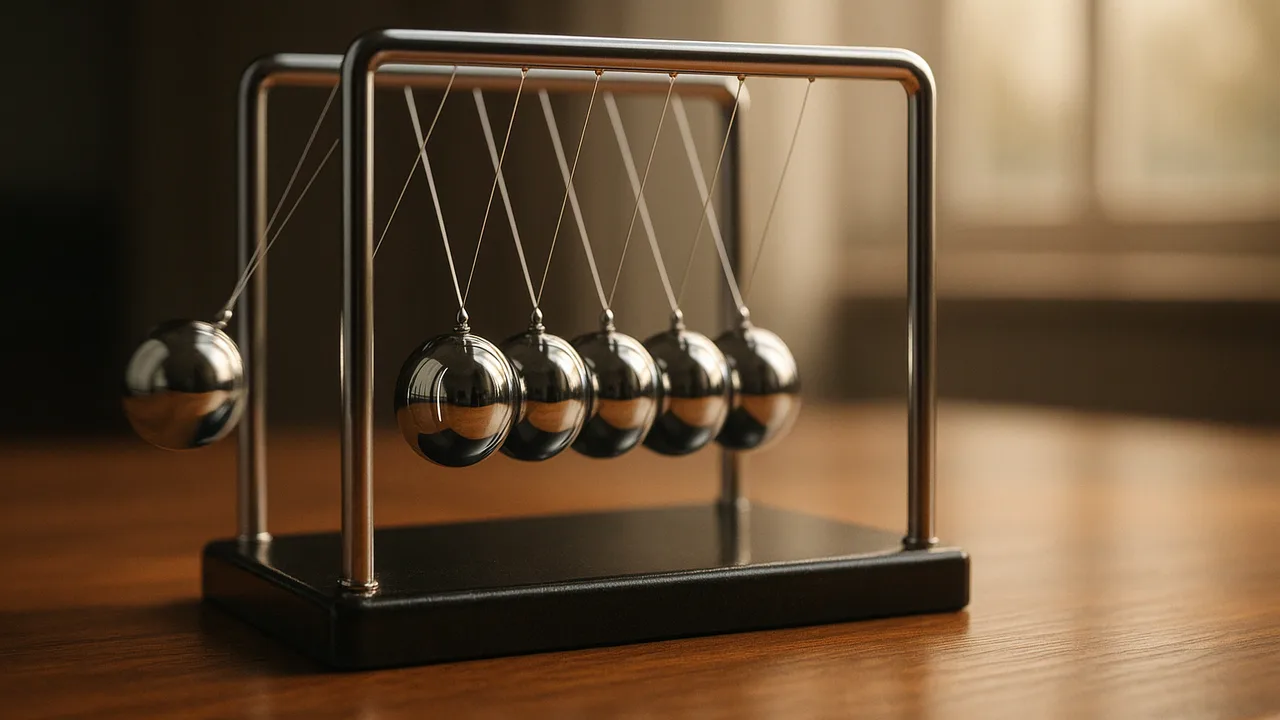
Mission engineers, now we name the pattern. In every Crash Lab station, both objects felt a push. The pushes were equal in size and opposite in direction. This is Newton’s third law: when object A pushes on object B, object B pushes back on object A with an equal force in the opposite direction. The two forces act on DIFFERENT objects, so they do not cancel each other out.
Connecting to mass. In the push cart lab, the same push moved a lighter cart farther and faster. Equal forces can cause different changes in motion when the masses are different. More mass means a smaller change in motion for the same force.
Worked example 1: a third-law model. Priya drew a lander touching the ground. One arrow on the lander points up: “ground pushes lander.” One arrow on the ground points down: “lander pushes ground.” Both arrows are the same length. She labeled the system “lander + ground.”
Worked example 2: a CER from push cart data. Claim: adding mass to a cart makes its motion change less for the same push. Evidence: our empty cart averaged 121 cm in 2.0 s, but with three masses it averaged 64 cm. Reasoning: the launcher gave the same unbalanced push each time; a larger mass resists a change in motion more, so the cart sped up less. These are sample numbers; use your own.
Back to landers. When a lander hits the ground, the ground pushes back just as hard as the lander hits. Padding, crushable legs and airbags make the stop take longer, which makes that push gentler at any moment. Some landers also fire rockets downward: the rocket pushes gas down, the gas pushes the lander up, and the lander slows before touching down.
CER sentence starters. Claim: “I claim that …” Evidence: “Our data showed …” Reasoning: “This happens because …, and Newton’s third law says …”
Guided Exercises ~15 min
Use our data and the third-law model. Check with your team.
Independent Practice ~10 min
Write your own CER using your team’s data.
CER: When a lander touches down, what forces act between the lander and the ground, and how could our design protect the egg? Use one piece of Crash Lab or push cart data as evidence and Newton's third law in your reasoning.
How confident are you that you can I can use Newton's third law to explain a collision.
Closure ~5 min
Forces come in equal and opposite pairs, and mass decides how much the motion changes. Next, we pull our Sun, Earth and Moon investigations into one model.
Exit ticket: a rocket has nothing to push against in space. Use Newton's third law to explain how it still speeds up.
Teacher notes
Materials: team data tables from 2.03 and 2.04, chart paper for a class force-pair model, CER template with sentence starters.
Setup: collect class averages from 2.04 on one chart so every team can cite shared evidence. This lesson formatively checks MS-PS2-1 and MS-PS2-2; part 2 assesses them summatively.
Listen for: “the forces cancel, so nothing moves.” The pair acts on different objects, so they cannot cancel. Keep to one dimension and qualitative reasoning; the stopping-time idea stays descriptive, with no momentum equations.
Support / stretch: give a CER frame with the claim already written. Stretch: identify force pairs in walking (foot pushes floor back, floor pushes foot forward).