2.23 Spreading the Force: Airbags, Landing Legs and Aerospace Engineers
explain how real technologies spread out collision forces, why they matter to society, and how new technology helps us explore the solar system.
- I can explain how my device or solution could be valuable or helpful to society.
- I can explain how the constraints of the problem and current technology limits affect the technologies I choose for my design.
- I can identify examples of how new technology has helped us learn more about the solar system, and how scientific discoveries have led to new engineering designs, like better telescopes or space probes.
Phase 4: Build
Warm-Up ~5 min
Do Now. List three things in daily life that are built to make a crash or a fall gentler. Think about cars, sports and playgrounds.
A bike helmet has a foam liner that crushes in a crash. How does that help?
Instruction ~10 min
Mission engineers, your lander uses the same idea as real safety technology. In any collision, the two objects push on each other with equal and opposite forces. Engineers cannot change that law. What they can change is how suddenly the stop happens. A slower, longer stop means smaller forces on the people or cargo inside.
Worked example 1: comparing two stops. Diego compares a phone dropped on tile with one dropped on carpet. Both phones fall the same height and stop. On carpet, the fibers squish, so the phone stops more gradually. The floor and phone still push equally on each other, but the push is smaller on carpet.
Worked example 2: matching technology to constraints. Ava lists three ways to slow a falling spacecraft. A parachute needs air. Rocket engines need fuel, which adds mass. Airbags and crushable legs need no air. On the Moon, with no air, landers have relied on rocket engines plus landing legs. On Mars, which has thin air, missions have combined parachutes with other tools. The constraints of each world shape the technology.
Guided Exercises ~15 min
Read the case study and career spotlight. Then check your understanding.
Independent Practice ~10 min
Connect to society and to your lander.
Explain how a crash-safe design, like yours or a car's, is valuable to society. Give two examples of who benefits.
Give one example of how a discovery about another world (such as “the Moon has no air”) changed how engineers designed a spacecraft.
🔎 Mini case study: Mini case study: spreading out a collision, from cars to spacecraft ~8 min
Modern cars have crumple zones at the front and back. In a crash, these parts fold and crush on purpose. The cabin in the middle is built to stay strong. Because the front crushes over a longer distance, the car and the people inside stop less suddenly. Airbags add a soft cushion so a person’s head and chest stop gradually instead of hitting something hard.
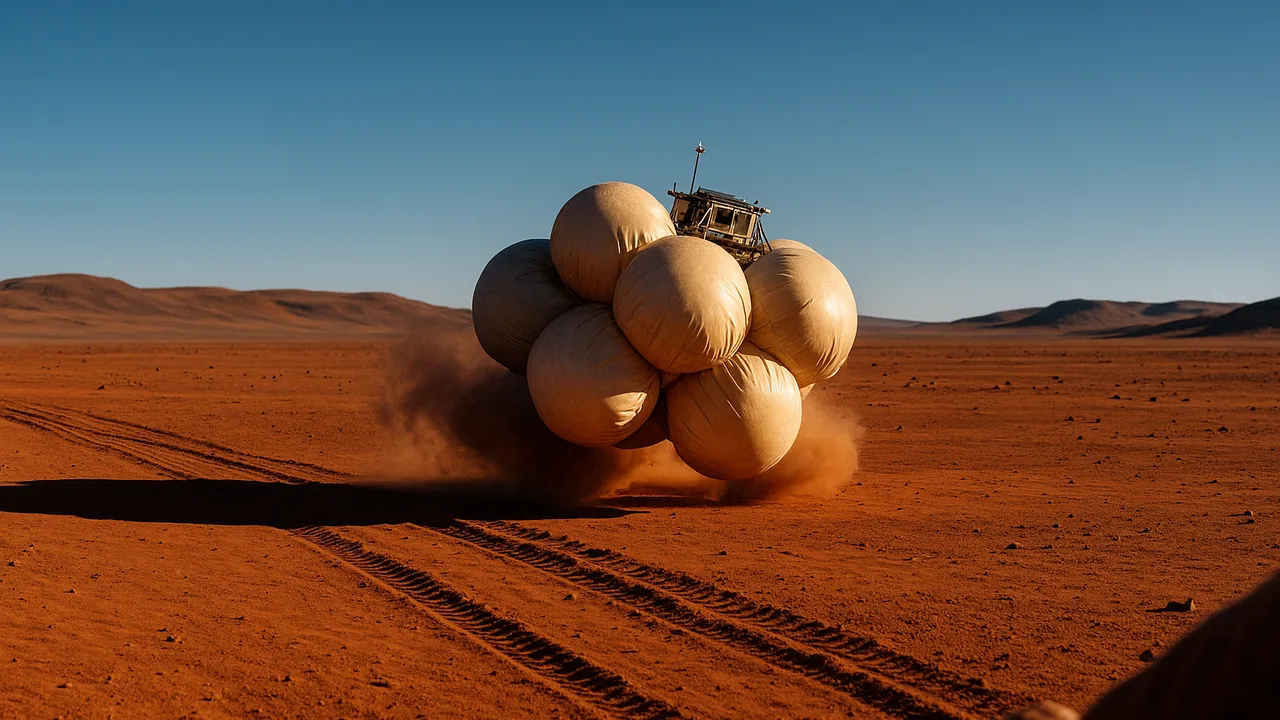
Spacecraft engineers use the same idea. When Mars Pathfinder landed in 1997, it was wrapped in large airbags. It hit the ground, bounced many times, then rolled to a stop before the airbags deflated. The Apollo lunar landers had legs with crushable material inside, built to absorb the shock of touchdown on the Moon.
In every case, the collision forces are still equal and opposite. The design just makes the stop longer and gentler, so the forces on the passengers or payload stay small enough to be safe.
Think about it: Pick one of these technologies. Which feature of your lander does the same job? How could it make your design better?
Closure ~5 min
Your lander joins a long line of force-spreading inventions. Next: Drop Day, the final test against our criteria.
Exit ticket: would you rather be an aerospace engineer or a planetary scientist on a Moon mission? Name one task you would do.
Teacher notes
Materials: case study and career pages, a bike helmet to pass around, short NASA video of an airbag landing test if available.
Setup: jigsaw the case study in three paragraphs, then regroup. Give 8 minutes for the case question.
Listen for: “the airbag absorbs all the force” (it reduces the force by lengthening the stop). Avoid impulse and momentum equations; keep reasoning qualitative.
Support / stretch: provide a paragraph summary with pictures. Stretch: research how a different spacecraft landed and compare its technology to the case study.