2.01 Mission Briefing: The Egg That Has to Land
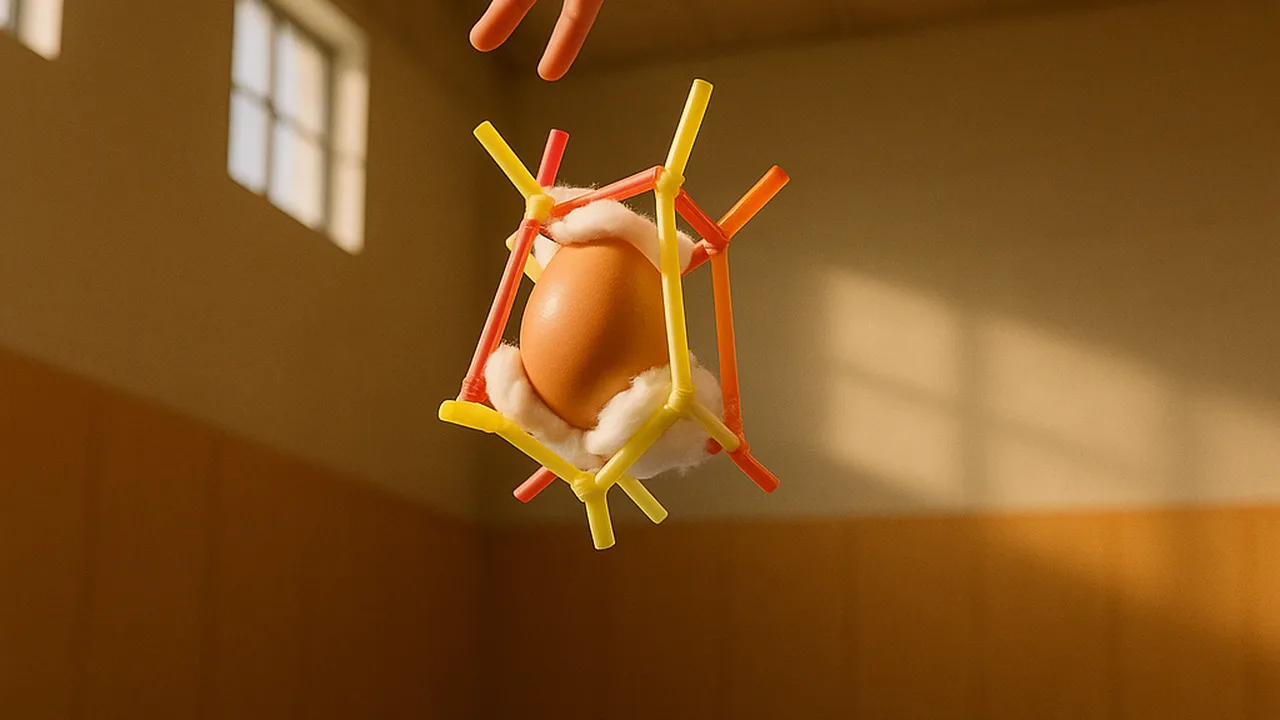
Moon Mission: A Crash-Safe Lander and a Solar System to Scale
How do forces and gravity control motion, from a bumper car to the planets, and how can we land safely on the Moon?
The mystery: The Moon changes shape over a month, but it never falls into Earth. A dropped egg breaks, yet engineers land spacecraft gently on other worlds.
Questions we will figure out together in this unit:
- Why does padding help an egg survive a fall?
- Why does the Moon look like a different shape each week?
- Why doesn’t the Moon fall down onto Earth?
- How far away are the planets, really?
- Why is it hot in summer and cold in winter?
- What happens when two things crash into each other?
- How do rockets push themselves up with nothing to push against?
- Why do eclipses not happen every month?
describe the Moon Mission exhibit our science center client needs, and explain why a lander’s change in motion is worth investigating.
- I can identify a situation where an object’s motion changes, and explain why it is important to investigate.
- I can explain how my device or solution could be valuable or helpful to society.
Phase 1: Spark
Warm-Up ~5 min
Do Now. Your teacher holds a raw egg in a zip bag about one meter above a tray. A second egg sits inside a small cup stuffed with paper. Both will be dropped from the same height. Predict before anything falls.
Which egg is more likely to survive the drop?
Instruction ~10 min
A message from our client. A science center is building a new exhibit called Moon Mission. Visitors will walk through the story of how people explore the Moon and the planets. The exhibit team has asked our class for two things. First, a crash-safe lander demo that visitors can drop and watch land gently. Second, a to-scale solar system model that shows how big and how far apart things in space really are.
Why does it matter? Spacecraft are expensive, and many carry instruments that took years to build. A hard landing can end a mission in one second. Landers that work help scientists study other worlds, test new technology and inspire future engineers. A good exhibit helps visitors understand that work. Today, private companies as well as space agencies design lunar landers and space robots, so this is a real kind of job.
Mission engineers, here is your challenge. Over this unit you will investigate forces, collisions, gravity and the motions of Earth, the Moon and the Sun. Then you will design, test and improve a lander that protects an egg “astronaut,” and build a scale model for the exhibit.
Worked example 1: spotting a change in motion. A lander falls faster and faster as it drops. When it touches the ground, it stops in a tiny moment. Mei described it this way: “Its motion changes twice: it speeds up while falling, then it slows down suddenly when it hits.” Any speeding up, slowing down or change in direction is a change in motion, and a force always causes it.
Worked example 2: why investigate it? Jamal asked, “Why not just add a lot of padding?” Diego answered, “Padding adds mass, and real rockets can only carry so much. We need to know exactly how the forces work so we use the right amount.” Investigating the cause lets engineers design on purpose instead of guessing.
Our teams. You will work in teams of four, and roles rotate every lesson. The Materials Manager gets and returns supplies. The Recorder keeps the data table. The Tester runs each trial. The Reporter shares the team’s findings and keeps everyone on task.
Guided Exercises ~15 min
Work through these with your team. Use the arrows to move between them. Talk it over before you answer.
Independent Practice ~10 min
On your own, start our class Wonder Board.
Write two questions you wonder about: one about landing safely and one about the Moon, planets or space. Put each on a sticky note.
How confident are you that you can I can describe our client's need and name a change in motion worth investigating.
Closure ~5 min
We met our client and our two-part mission. A landing is a sudden change in motion, and forces cause it. Next time, we sort our Wonder Board and set the rules for a good lander.
Exit ticket: describe one change in motion that happens during a landing, and explain why engineers need to investigate it.
Teacher notes
Materials: 2 raw eggs in sealed zip bags, a paper cup and crumpled paper, a tray or plastic sheet, sticky notes, chart paper for the Wonder Board, a roles rotation chart. Optional: a short letter or video request “from” the science center exhibit team.
Setup: post the driving question and the two deliverables (lander demo, scale model). Check for egg allergies before the demo; plastic eggs filled with a little clay can stand in.
Listen for: “the padded egg fell slower.” Both fall at about the same rate from this height; the padding changes the stop, not the fall. Hold the formal idea of force and stopping time for 2.03 and 2.10.
Support / stretch: give a frame: “The exhibit needs ___ so that visitors ___.” Stretch: ask why landing on the Moon is harder than landing with a parachute on Earth (there is no air on the Moon).