2.04 Push Carts: How Force and Mass Change Motion
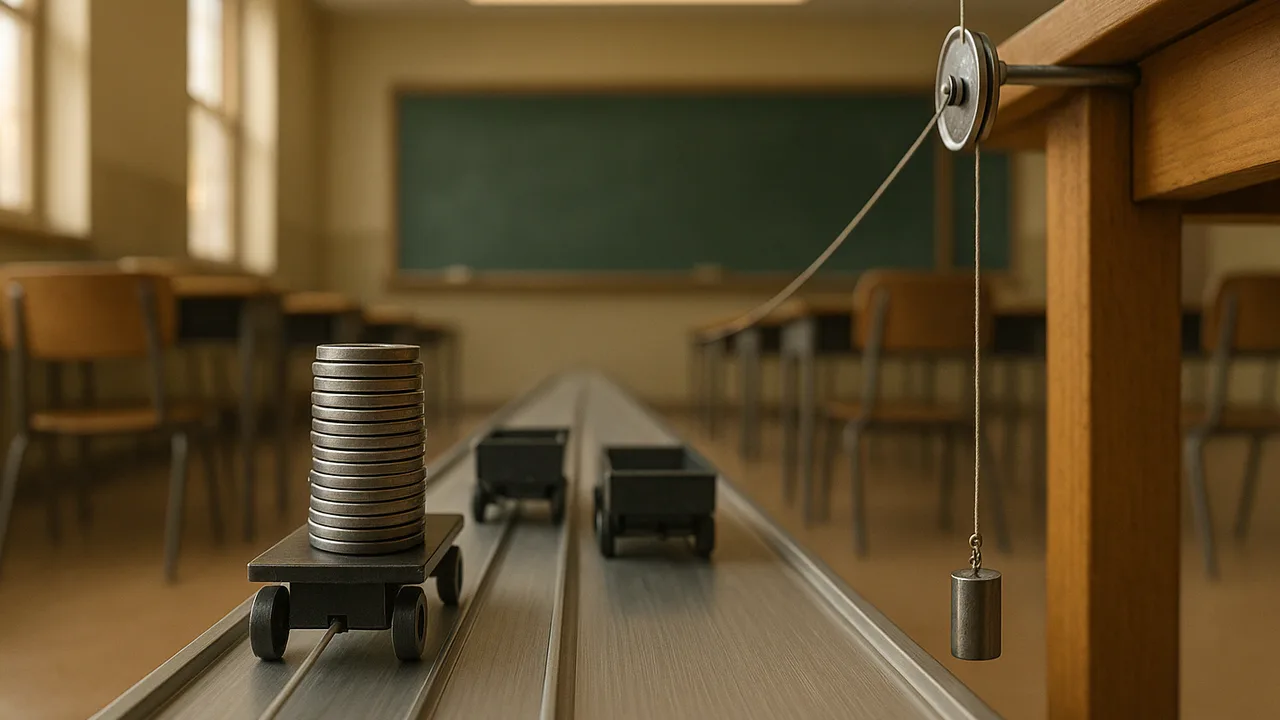
plan and run a fair test showing how balanced and unbalanced forces, and the mass of a cart, affect its change in motion.
- I can explain that the purpose of my investigation is to show how an object’s motion changes because of balanced or unbalanced forces acting on it.
- I can explain that the purpose of my investigation is to show how the mass of an object affects its change in motion.
- I can plan an investigation that includes collecting data about an object’s motion, the total forces acting on it, and its mass.
- I can decide which data I need to show that an object with balanced forces does not change its motion, and that an object with unbalanced forces does change its motion.
- I can plan how to collect data to show that the change in motion of an object with unbalanced forces depends on its mass.
- I can describe how I will measure the motion of an object using a reference frame and units for distance and time, measure its mass with appropriate units, and measure the forces acting on it, including balanced and unbalanced forces.
- I can identify which factors in my investigation are independent variables, dependent variables, and which ones I will keep controlled.
- I can decide how many trials I will do for each condition in my experiment.
Phase 2: Investigate
Warm-Up ~5 min
Do Now. An empty cart and a cart loaded with books sit side by side. Your teacher will give each one the same push with a rubber-band launcher.
With the same push, which cart will roll farther in 2 seconds?
Instruction ~10 min
Mission engineers, today you plan the test. Our question: how does the mass of a cart affect how its motion changes when it gets the same push? A fair test changes only ONE thing at a time.
- Independent variable (what we change): the mass on the cart. Try 0, 1, 2 and 3 masses.
- Dependent variable (what we measure): the distance the cart rolls in 2.0 seconds, timed with a stopwatch.
- Controlled variables (what we keep the same): the launcher stretch, the start line, the floor and the cart.
- Reference frame: distance is measured from the taped start line, in centimeters. Time is in seconds.
| Masses added | Total cart mass (g) | Distance in 2.0 s, trial 1 (cm) | Trial 2 (cm) | Trial 3 (cm) | Average (cm) | Average speed (cm/s) |
|---|---|---|---|---|---|---|
| 0 | ||||||
| 1 | ||||||
| 2 | ||||||
| 3 |
Worked example 1: averaging trials. Diego’s empty cart rolled 118 cm, 124 cm and 121 cm. He added them (363 cm) and divided by 3 to get an average of 121 cm. Then he divided by the time: 121 cm ÷ 2.0 s = about 60 cm/s. Three trials help us trust a result. These are sample numbers; your data will be your own.
Worked example 2: balanced or unbalanced? Before the push, the cart sat still. Gravity pulled down and the floor pushed up just as hard. Those forces were balanced, so its motion did not change. The launcher’s push made the forces unbalanced, so the cart started moving. Later, friction with the floor was an unbalanced force that slowed the cart down.
Try the sim. After the lab, use the simulation to test the same idea with no friction at all.
Guided Exercises ~15 min
Use your team’s data table. The Recorder calculates the averages.
Independent Practice ~10 min
Look for the pattern in your class data.
Describe the pattern between cart mass and average distance in your table. Use at least two numbers from your data.
How confident are you that you can I can plan a fair test of how mass affects a change in motion.
Closure ~5 min
Same push, more mass, smaller change in motion. Next, we turn from carts to the sky and model the Moon’s changing shape.
Exit ticket: a lander gets heavier. If the same braking force acts on it, will it slow down more or less? Use today's data to explain.
Teacher notes
Materials (per team): a cart or toy truck, a rubber-band launcher (two chair legs and a band, or a commercial launcher), 3 equal masses (washers or 100 g masses), a kitchen scale, stopwatch, meter stick or tape measure, masking tape.
Setup: mark the launcher stretch with tape so every team pulls to the same point. The Tester calls “go” and the timer stops at 2.0 s while a spotter marks where the cart is. Check the PhET sim loads on student devices before class.
Listen for: “a moving object needs a force to keep moving.” It keeps moving unless an unbalanced force (here, friction) changes it; the sim shows this with friction off. Stay qualitative plus simple averages; no vector math or F = ma calculations (MS-PS2-2 boundary).
Support / stretch: provide a partly filled table and a calculator. Stretch: graph mass (x) against average distance (y) and describe the trend.