2.22 The Solar System to Scale: Building the Exhibit Wall
organize solar system data and use scale to build an exhibit model that shows sizes and distances, and explain its limits.
- I can organize data about solar system objects, such as their surface features, layers, and distances from the sun, using graphs, diagrams, or models to help me analyze their scale.
- I can organize data in a way that helps me find and explain patterns in the scale properties of solar system objects, even when those properties are too big or too small to see directly.
- I can show and explain the size and distance relationships between Earth, the sun, and the moon in my model, and describe any scale limitations.
Phase 4: Build
Warm-Up ~5 min
Do Now. Many classroom posters show the planets lined up close together, with a Sun not much bigger than Jupiter. What do you think is wrong with that picture?
If Earth were a small marble about 1.3 cm wide, how far away would the Sun be at the same scale?
Instruction ~10 min
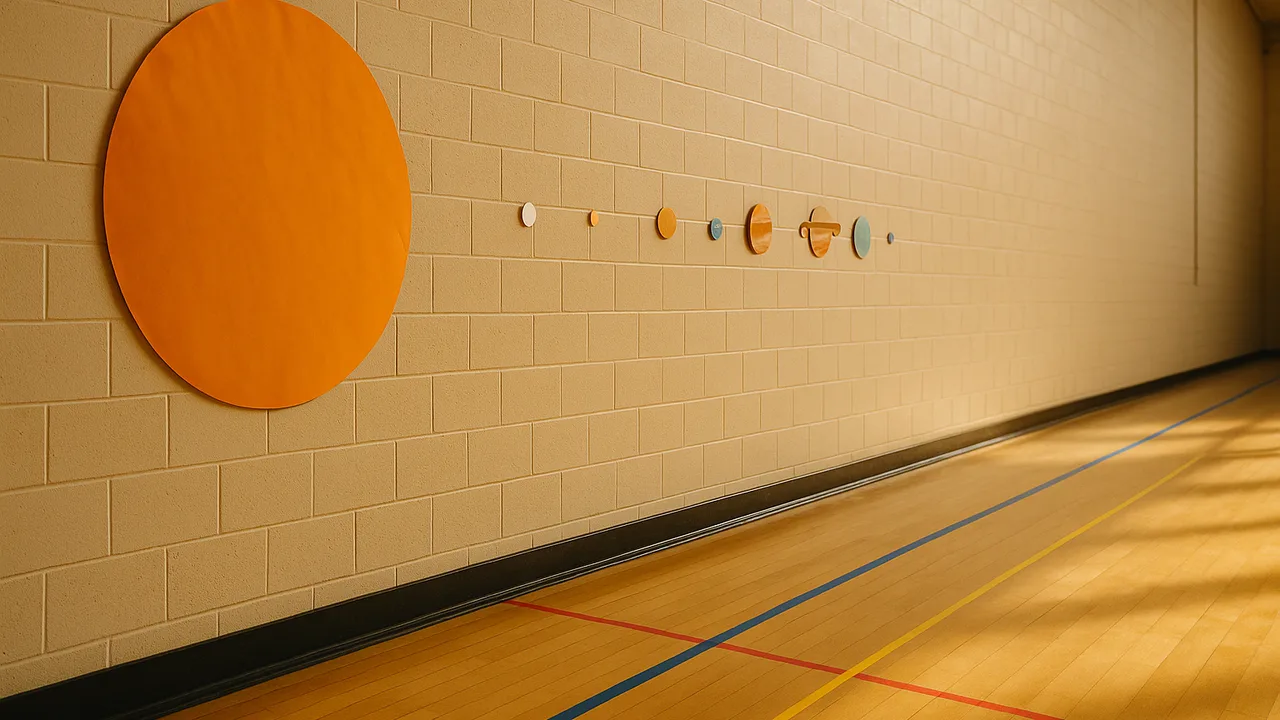
Mission engineers, the exhibit needs a solar system wall. Visitors should see how big and how far apart things really are. To do that, we use a scale. A scale is a rule that shrinks every real measurement by the same amount.
Rounded solar system data. Distances are in astronomical units (AU). One AU is Earth’s average distance from the Sun, about 150 million km.
| Object | Diameter (km) | Distance from Sun (AU) | Main type |
|---|---|---|---|
| Sun | 1,391,000 | 0 | star |
| Mercury | 4,900 | 0.39 | rocky |
| Venus | 12,100 | 0.72 | rocky |
| Earth | 12,800 | 1.0 | rocky |
| Mars | 6,800 | 1.5 | rocky |
| Jupiter | 143,000 | 5.2 | gas giant |
| Saturn | 120,500 | 9.6 | gas giant |
| Uranus | 51,100 | 19.2 | ice giant |
| Neptune | 49,500 | 30.1 | ice giant |
Worked example 1: a size card set. Jamal uses the scale 1 cm = 10,000 km. Earth’s diameter is 12,800 km, so its card circle is 1.28 cm. Jupiter is 14.3 cm. The Sun is 139 cm, taller than many first graders. The Moon, 3,475 km wide, is a 0.35 cm dot. At this scale the Moon sits about 38 cm from Earth.
Worked example 2: a distance hallway. Mei uses a different scale for distance: 1 AU = 1 meter. Mercury is 39 cm from the Sun, and Neptune is 30.1 m down the hallway. But at this scale, Earth would be less than a tenth of a millimeter wide, too small to see. Mei’s conclusion: one convenient scale cannot show both sizes and distances. So the exhibit needs two models, and a sign that says so.
Beyond the planets. On Mei’s hallway scale, the nearest star past the Sun would be roughly 270 km away. The Milky Way, our galaxy of billions of stars, is about 100,000 light-years across. It would not fit on Earth at this scale.
| Object | Scaled diameter (cm) | Scaled distance (m) | Check |
|---|---|---|---|
| Mars | |||
| Jupiter | |||
| Saturn | |||
| Neptune |
Guided Exercises ~15 min
Fill in your scale table as you go. Use a calculator.
Independent Practice ~10 min
Write the exhibit caption.
Write a 4-sentence caption for visitors. Compare the sizes and distances of Earth, the Moon and the Sun. Name one limit of your model.
Explain why a model of the Milky Way would need a third, much smaller scale. Use the light-year in your answer.
Closure ~5 min
The exhibit now has a lander and a solar system wall. Next, we look at how real engineers spread out collision forces.
Exit ticket: what surprised you most about the real scale of the solar system? Use one number.
How confident are you that you can I can use data and scale to compare sizes and distances in the solar system.
Teacher notes
Materials: calculators, card stock, compasses or circle templates, meter sticks, adding-machine tape or string for the distance strip, a 139 cm paper Sun circle (optional).
Setup: split teams: half build size cards, half build the distance strip. Swap and check each other’s math. Data are rounded; check that students keep three digits at most.
Listen for: “the planets are lined up in a row” (they orbit at different places, so a straight line is only a display choice). Also “the Moon is close to Earth”; it is about 30 Earth-diameters away.
Support / stretch: give pre-converted values for two planets. Stretch: add Pluto and the asteroid belt (about 2 to 3.3 AU) to the distance strip.