1.12 Structure Explains Properties: Molecules, Crystals and Foam
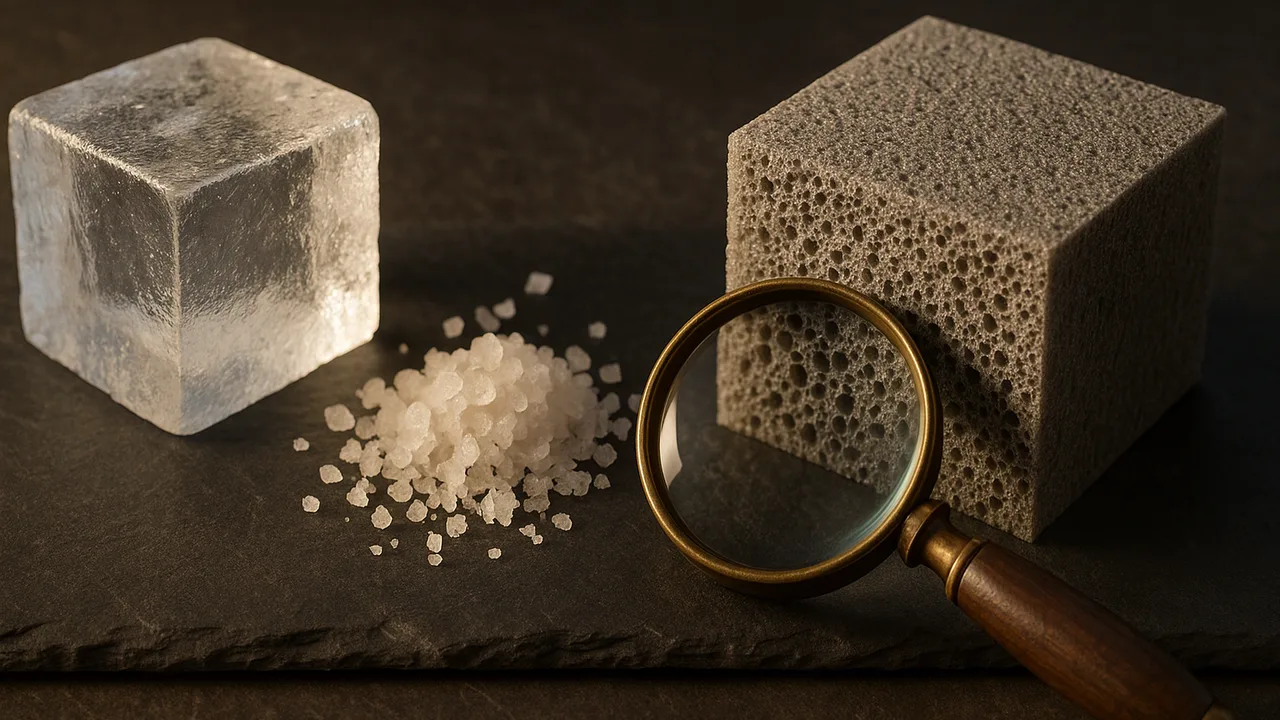
use models of atomic arrangement to explain properties of salt, ice and foam, and explain how foam’s properties differ from the oil and gas it came from.
- I can use models to describe how pure substances are made of atoms or molecules, and how these can be arranged in different ways, like repeating patterns or single atoms.
- I can explain, using my models, how the way atoms and molecules are arranged affects what a substance is like, even though we cannot see them.
- I can combine information from different types of sources, like graphs, diagrams, and text, to describe how synthetic materials are made from natural resources using chemical processes.
- I can explain how the properties of a synthetic material are different from the properties of the natural resource it was made from, and how these properties help the synthetic material do its job.
- I can describe how making and using synthetic materials affects natural resources and society, and how their structure and function meet a societal need or desire.
Phase 3: Make Sense
Warm-Up ~5 min
Do Now. Pencil “lead” is graphite, which is made only of carbon atoms. Diamond is also made only of carbon atoms. One is soft enough to write with; the other is one of the hardest materials known.
How can two materials made of the same atoms be so different?
Instruction ~10 min
Structure decides properties. The properties we observe come from how atoms and molecules are arranged, even though we cannot see them.
Worked example 1: salt and ice. Salt’s sodium and chlorine atoms repeat in a cube-shaped pattern. That is why salt grains break into flat-faced pieces. Ice is also a crystal, but its building blocks are whole water molecules locked in a repeating pattern. When ice melts, the pattern breaks apart, but every water molecule stays whole.
Worked example 2: from gas to foam. Mei compared a natural resource with the synthetic material made from it. Natural gas is made of small, light molecules. It is an invisible gas that burns easily. In a factory, chemical processes build very long chain molecules called polymers. The chains tangle together into a solid plastic. Puffing that plastic with tiny gas bubbles makes foam.
| Property | Natural gas or oil (natural resource) | Foam (synthetic material) | How the structure explains it |
|---|---|---|---|
| State at room temperature | |||
| Size of molecules | |||
| Holds its shape? | |||
| Slows thermal energy? |
Why foam insulates. Foam is mostly trapped gas. Particles in a gas are far apart, so they pass energy along slowly. The plastic walls keep the gas from flowing and carrying energy away. That structure gives foam its job: slowing the flow of thermal energy.
Guided Exercises ~15 min
Connect structures to properties with your team.
Independent Practice ~10 min
Finish the comparison table on your own.
Complete the natural gas and foam table. Then write three sentences: how foam's structure differs, which property changed most, and how that property helps a cooler.
How confident are you that you can I can use models of structure to explain properties.
Closure ~5 min
Arrangement explains properties, from salt grains to foam walls. Next time, we weigh what our sources say about making and using synthetic materials.
Exit ticket: use a model to explain one property of salt OR ice that comes from its repeating pattern.
Teacher notes
Materials: a pencil and a photo of a diamond, bead or clay models from 1.03–1.04, a broken piece of foam, hand lenses, the comparison table.
Setup: let teams examine foam with hand lenses before the foam worked example.
Listen for: “foam is cold.” Foam is at room temperature; it slows energy flow. Keep polymers simple (MS-PS1-1 and MS-PS1-3): long chains of repeating units, no bonding details or named reactions. Foam is described only as “mostly trapped gas”; do not quote a percentage.
Support / stretch: provide paper-clip chains to model polymers. Stretch: explain why a wool sweater keeps you warm using the same idea.