1.09 Criteria and Constraints: Defining the Cooler Problem
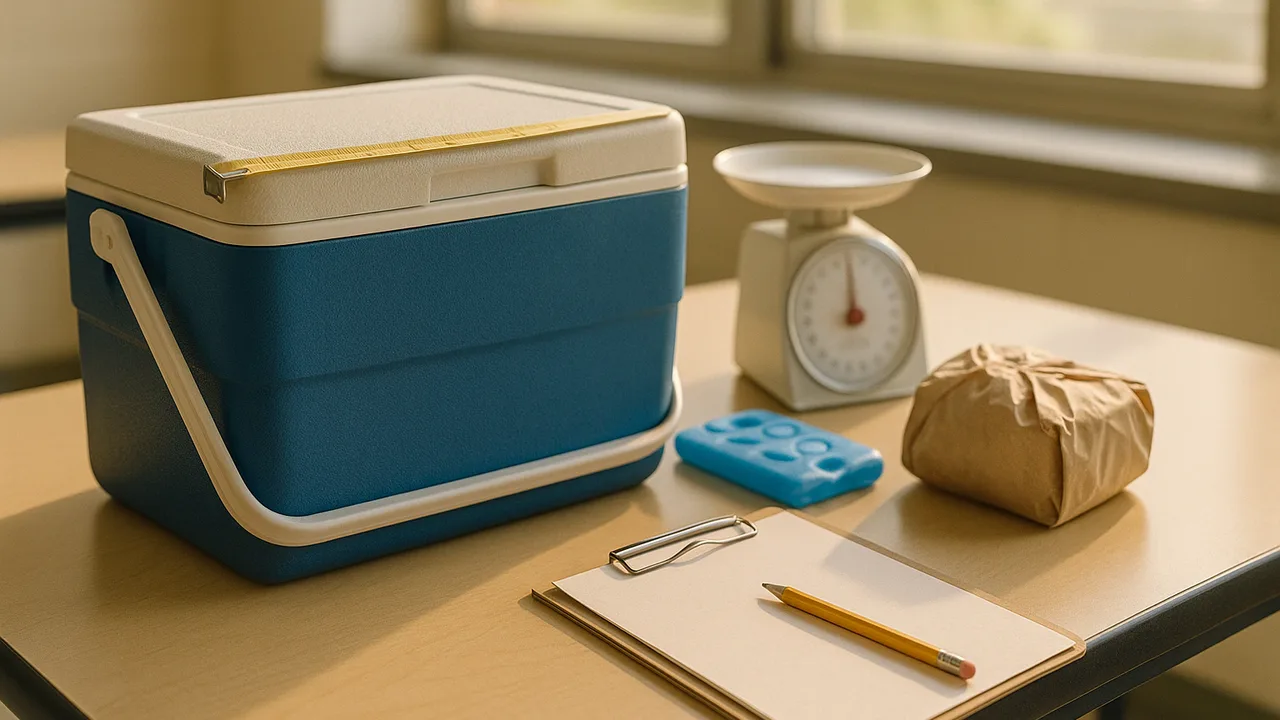
define precise, measurable criteria and constraints for the field trip cooler, including effects on people and the environment.
- I can define the criteria for a solution that meet the needs of the people or groups affected by the problem.
- I can explain who the solution is meant to help and use criteria to compare different solutions, including using numbers when needed.
- I can define the constraints for a solution, including time, materials, costs, and scientific or other important issues.
- I can explain how the needs and wants of people involved, safety, and effects on others limit possible solutions.
- I can analyze how solutions or not solving the problem could negatively affect the environment.
Phase 2: Investigate
Warm-Up ~5 min
Do Now. Read two possible goals for our cooler: “It should keep food cold” and “It keeps food at 4°C or colder for at least 5 hours.” Decide which one is easier to test.
Why do engineers prefer the second goal?
Instruction ~10 min
Interviewing the client. Your teacher plays the field trip coordinator. Teams ask questions such as: how long is the trip, how many lunches go in each cooler, who carries it, and what does the park allow? Record every answer. Then sort what you learned.
Criteria describe what a successful design must do. Constraints are limits on the design, such as time, money, materials and safety rules. Good criteria and constraints are precise, often with numbers.
| Criterion or constraint | Type | Target number or rule | How we will measure it | Whose need it meets |
|---|---|---|---|---|
| Keeps food cold | Criterion | |||
| Holds lunches | Criterion | |||
| Easy to carry | Criterion | |||
| No electricity | Constraint | |||
| Materials and cost | Constraint | |||
| Build time | Constraint | |||
| Safety | Constraint | |||
| Environment | Constraint |
Worked example 1: sharpening a criterion. Mei’s first draft said “keeps food cold.” Using the food safety rule and the trip schedule, she rewrote it: “The food zone stays at 4°C or colder for at least 5 hours with the lid closed.” Now it names a temperature, a time and a test condition.
Worked example 2: a constraint about safety and the environment. Malik suggested dry ice. Dry ice is frozen carbon dioxide; it can burn skin and release a lot of gas in a closed space. The team ruled it out as unsafe. They also added an environmental constraint: the cooler must be reusable for at least ten trips, to avoid one-trip trash.
What if we do nothing? Without a working cooler, lunches could spoil, students could get sick, and a lot of food could be thrown away. Naming that cost reminds us why the criteria matter.
Guided Exercises ~15 min
Test your team’s thinking with these cards. Then finish your table.
Independent Practice ~10 min
Write your own design brief.
Write a design brief: one problem statement, three precise criteria and three constraints. For each, name whose need it meets.
Describe one way a cooler design, or having no cooler, could harm the environment. Turn it into a constraint.
Closure ~5 min
Our design brief is ready. Next, in Make Sense, we build particle models that explain all of our data.
Exit ticket: write the problem statement for our cooler, then add the one criterion you think is most important. Explain why.
Teacher notes
Materials: a role card for the field trip coordinator (fill in your real trip schedule if you have one), chart paper, data from 1.05–1.07.
Setup: decide class-wide constraints in advance: a supply bin and recycled materials only, a simple class budget if you use one, and a set number of build periods. Post the final class design brief; part 2 tests against it.
Listen for: criteria without numbers; mixing criteria and constraints. Dry ice appears in student ideas every year; rule it out for safety. Keep the brief realistic for a classroom test, such as a 5-hour test with a probe in a sealed cup of water as the “lunch.”
Support / stretch: give sentence starters: “Our cooler must ___, measured by ___.” Stretch: name one trade-off between two criteria.