2.16 Three Designs and a Fair Drop Test
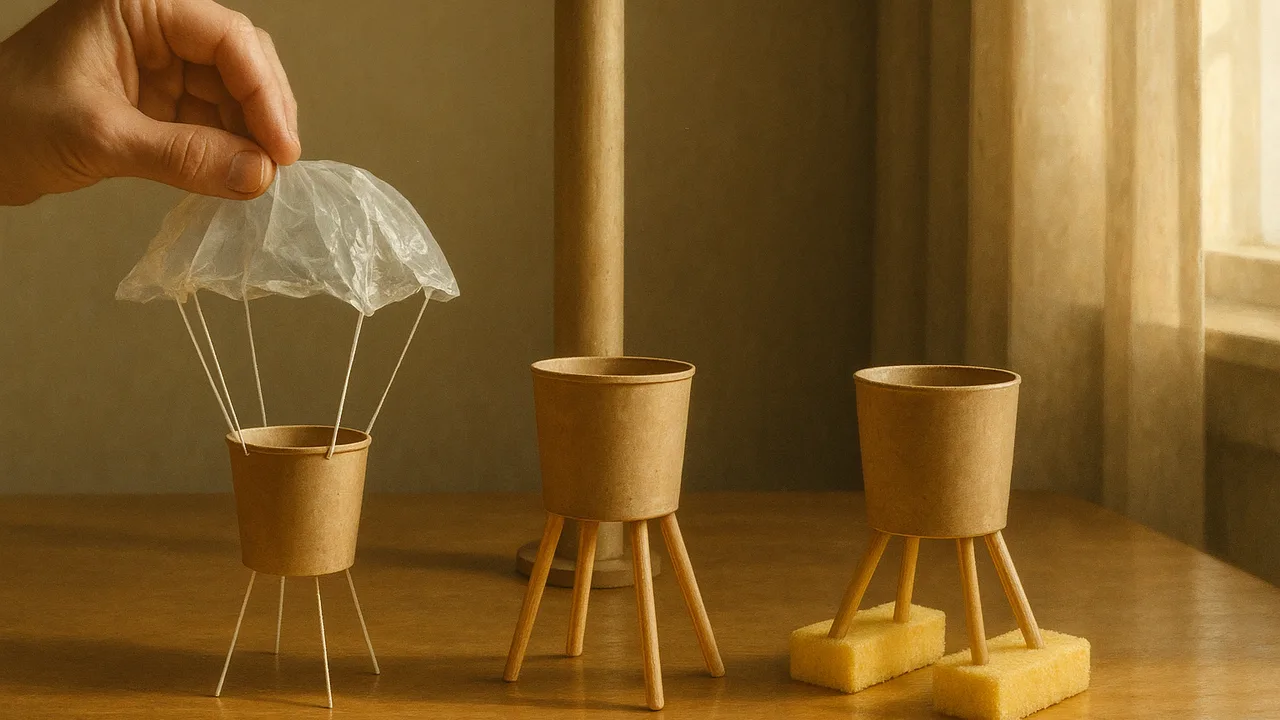
sketch three different lander designs and plan a fair drop test that produces data we can compare.
- I can organize data from tests of three or more design solutions using tables, charts, or graphs.
- I can use my model to generate data that shows how my proposed solution works and how it changes when I modify its parts.
- I can describe how I will measure the motion of an object using a reference frame and units for distance and time, measure its mass with appropriate units, and measure the forces acting on it, including balanced and unbalanced forces.
- I can identify which factors in my investigation are independent variables, dependent variables, and which ones I will keep controlled.
- I can decide how many trials I will do for each condition in my experiment.
Phase 4: Build
Warm-Up ~5 min
Do Now. Two teams test their landers. Team A drops from 1 meter. Team B drops from 2 meters. Both payloads survive. Can we say the two landers are equally good?
Why is this comparison unfair?
Instruction ~10 min
Mission engineers, never fall in love with your first idea. Real teams test several designs before they choose. Our class will build three design types, so we can compare data across at least three solutions.
Design A, the Crumple Base. A cone or cup of folded paper sits under the payload. It crushes on impact, so the lander stops over a longer distance. Design B, the Spring Legs. Straws or card strips bend outward like legs. Design C, the Cushion Cage. The payload sits in cotton, sponge or bubble wrap inside a box frame.
Planning a fair test. The independent variable is what you change on purpose, here the design. The dependent variables are what you measure: payload condition and whether the lander ends upright. Controlled variables stay the same: drop height, payload, floor surface and release method. Our reference frame is the floor, and height is measured in meters from the floor up. We also measure each lander’s mass in grams.
Worked example 1: Mei’s test plan. Mei writes: “Change: design type. Measure: crack yes or no, upright yes or no. Keep the same: 2.0 m height, hard tile floor, same egg size, released from rest. Trials: 3 per design.” Three trials show whether a result is a pattern or a lucky drop.
Worked example 2: Diego’s height ladder. Diego’s team wants to know where a design starts to fail. They plan drops at 1.0 m, 1.5 m and 2.0 m. A higher drop means the lander is moving faster at impact. That means a bigger change in motion when it stops. Diego’s ladder turns the lander into a model that generates data, not just a pass or fail.
| Design | Mass (g) | Trial | Height (m) | Payload OK? | Upright? | Notes |
|---|---|---|---|---|---|---|
| A Crumple Base | 1 | |||||
| A Crumple Base | 2 | |||||
| B Spring Legs | 1 | |||||
| B Spring Legs | 2 | |||||
| C Cushion Cage | 1 | |||||
| C Cushion Cage | 2 |
Guided Exercises ~15 min
Plan with your team. Fill in your test plan as you answer.
Independent Practice ~10 min
Write your test plan.
List your independent variable, two dependent variables, four controlled variables and the number of trials. Explain why you chose that number of trials.
Why is it important to investigate how a lander's motion changes at impact? Connect your answer to a real Moon mission.
Closure ~5 min
Plans are set. Next class, the drops begin, and the data decide.
Exit ticket: why does the class need data from three or more design types, not just one?
How confident are you that you can I can plan a fair test with variables, units and repeated trials.
Teacher notes
Materials: kit bins (paper, card, straws, rubber bands, tape, cotton balls, sponge pieces, bubble wrap, small boxes), scales in grams, meter sticks, zip bags, eggs or small water balloons.
Setup: assign design types so every type is built by at least two teams. Begin building in the last 15 minutes. Mark the 1.0, 1.5 and 2.0 m heights on a wall with tape.
Listen for: “heavier things fall faster” (in our drops, air resistance is small for compact landers, so they land at nearly the same time). Keep the mass idea on stopping: more mass needs a bigger force to stop.
Support / stretch: give a test-plan frame with blanks. Stretch: add a fourth design type of the team’s own invention.