2.11 One Model, Three Mysteries: Phases, Eclipses and Seasons
build one Sun-Earth-Moon model that explains phases, eclipses and seasons, and use it to make predictions while naming its scale limits.
- I can show and explain the size and distance relationships between Earth, the sun, and the moon in my model, and describe any scale limitations.
- I can use my model to describe how Earth rotates on its tilted axis once a day and how the moon rotates on its axis about once a month.
- I can explain how the moon orbits Earth about once a month, always showing the same side to Earth, and how the moon’s orbit is tilted compared to Earth’s orbit around the sun.
- I can describe how the Earth-moon system orbits the sun once a year, how solar energy travels in straight lines to Earth and the moon, how sunlight reflects off the moon, how the distance between Earth and the sun stays nearly the same, how sunlight hits Earth at different angles, and how Earth’s axis stays pointed in the same direction as it orbits the sun.
- I can use my model to predict the phase of the moon or the positions of Earth, sun, and moon when given information about one of them.
- I can use my model to predict when and where an eclipse will happen, based on the positions of Earth, sun, and moon.
- I can use my model to predict the season on Earth or the positions of Earth and the sun, given information about the season and location on Earth.
Phase 3: Make Sense
Warm-Up ~5 min
Do Now. Three of our Wonder Board questions were: Why does the Moon change shape? Why are eclipses rare? Why do we have seasons? One model can answer all three.
Which feature of the model explains why eclipses are rare?
Instruction ~10 min
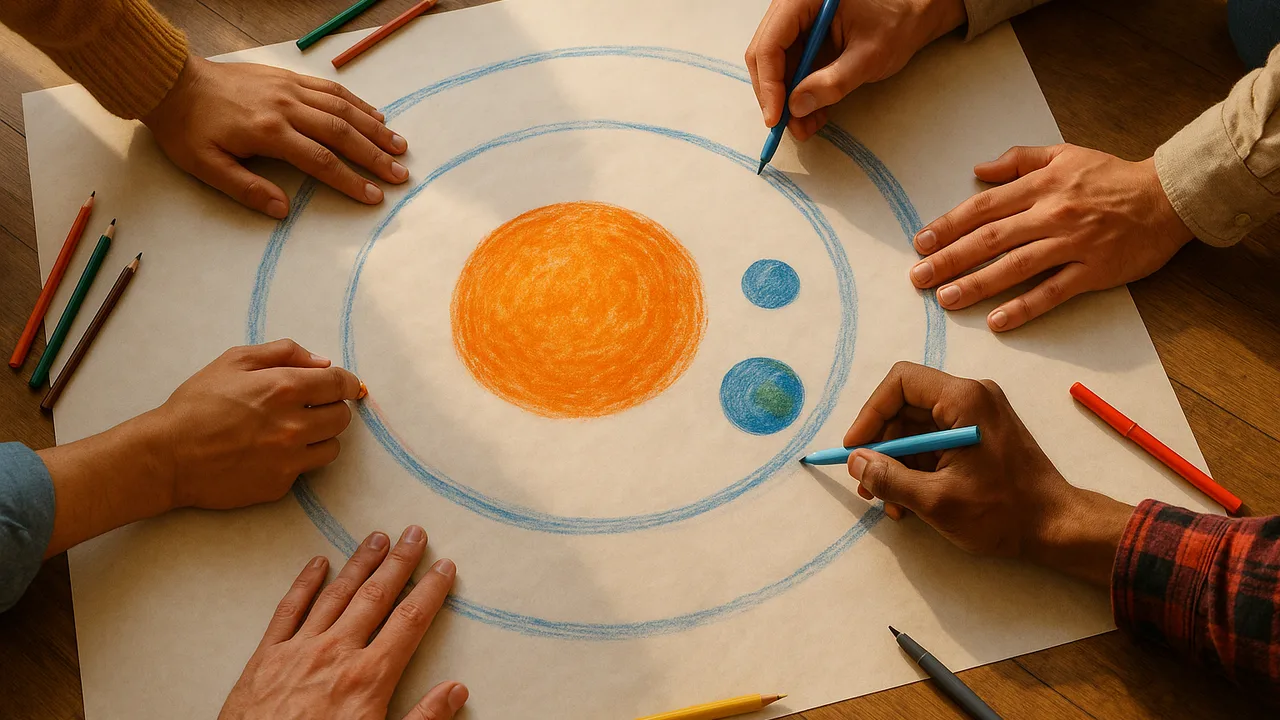
Mission engineers, build the master model. On a large sheet, each team draws a top-down Sun-Earth-Moon model for the exhibit. It must include:
- the Sun, with arrows showing sunlight traveling in straight lines;
- Earth at four places in its yearly orbit, with its tilted axis pointing the same way each time;
- the Moon at eight places in its monthly orbit, with the lit half shaded;
- labels for one solar eclipse, one lunar eclipse and the seasons in both hemispheres;
- a “scale limits” box that says what the model shows incorrectly.
| Mystery | Positions in the model | Cause | Prediction we can make |
|---|---|---|---|
| Moon phases | |||
| Solar eclipse | |||
| Lunar eclipse | |||
| Seasons |
Worked example 1: predicting from the model. Jamal knew a first quarter moon was visible. He found it in the model: a quarter of the way around after new moon. He predicted a full moon about one week later and a new moon about three weeks later. Predictions like this are why we build models.
Worked example 2: naming scale limits. Ava’s model showed the Sun the size of a plate and Earth the size of a coin, close together. She wrote: “Really, the Sun is about 109 times wider than Earth. The Moon is about 30 Earth diameters away, and the Sun is almost 400 times farther than the Moon. If I drew those distances, the page would need to be enormous.” Naming limits shows a model’s strengths and weaknesses honestly.
A happy coincidence. The Sun is about 400 times wider than the Moon, but also about 400 times farther away. That is why the Moon can just cover the Sun in a total solar eclipse.
Guided Exercises ~15 min
Use your team’s master model to answer.
Independent Practice ~10 min
Write a CER using the model.
CER: Why can a lunar eclipse happen only at full moon? Claim: “I claim that …” Evidence: “In our lamp model, …” Reasoning: “This happens because …”
How confident are you that you can I can use one model to explain and predict phases, eclipses and seasons.
Closure ~5 min
One model explains three mysteries. Next, we zoom out to see how gravity holds the whole solar system and our galaxy together.
Exit ticket: it is summer in the Southern Hemisphere. Use the model to predict the season in the Northern Hemisphere and explain why.
Teacher notes
Materials: large chart paper, markers, coins and paper plates for scale talk, the lamp-and-ball kit for checking predictions.
Setup: post a model checklist. Teams check two predictions with the physical lamp model. This lesson formatively checks every MS-ESS1-1 id.
Listen for: mixing the two tilts, and “the Moon blocks the Sun every new moon.” Keep to phases, eclipses and seasons (MS-ESS1-1 boundary); no orbital math.
Support / stretch: give a partly drawn template. Stretch: add day and night to the model and explain why a full moon is up all night.