1.20 Mid-Build Checkpoint: Atoms, Particles and Materials
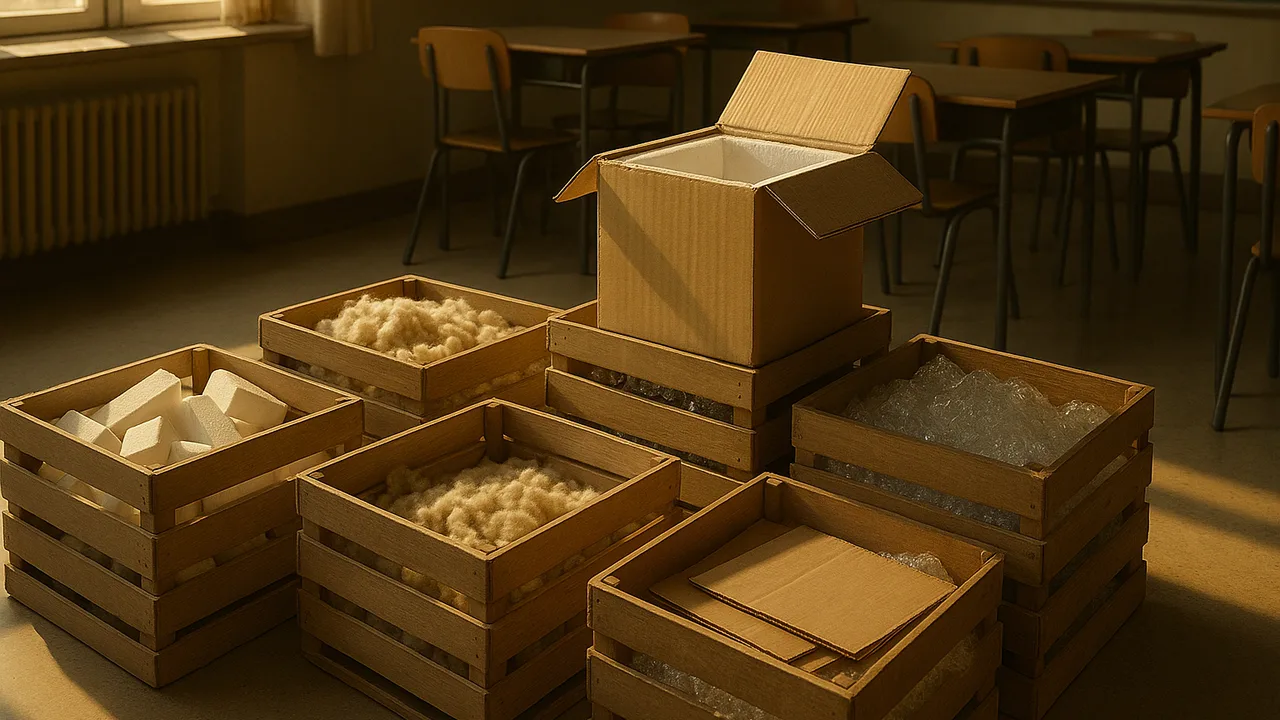
show what I know so far about atoms, molecules, particle motion, thermal energy and the materials in my cooler.
- I can create models that show individual atoms, molecules, and extended structures with repeating parts.
- I can identify and label substances as solids, liquids, or gases in my models.
- I can use my model to explain how the motion of particles is related to their kinetic energy and the temperature of the system.
- I can describe how adding or removing thermal energy changes the kinetic energy of particles and can cause a change in state.
- I can use my model to show how the state of matter (solid, liquid, gas) is connected to how particles move and interact.
- I can evaluate each source I use to decide if it is credible, accurate, and if it might be biased.
Phase 4: Build
Warm-Up ~5 min
Do Now. Write the formula for a water molecule. How many atoms does it have, and of which elements?
A water molecule (H2O) is made of…
Instruction ~10 min
Design engineers, halfway through Build, we check in. This checkpoint shows what you know and what we should practice. It is an ordinary quiz. Read each question twice.
Quick review 1: atoms, molecules and structures. All matter is made of atoms. Atoms can join into molecules. Oxygen gas (O2) is two of the same atom; water (H2O) joins different atoms. Some solids are extended structures, where atoms repeat in a pattern, like the aluminum atoms in foil or sodium and chlorine in table salt.
Quick review 2: particles, temperature and state. Particles are always moving. Adding thermal energy speeds them up, which can raise temperature or change state. Removing it slows them down. In a gas, faster particles hit the walls harder, so pressure rises.
Worked example 1: a strong model answer. Question: “Model ice and liquid water.” Kofi drew the same H2O molecules in both. Ice: an orderly repeating pattern. Liquid: close but jumbled. He wrote: “Same molecules, different arrangement, so different properties.”
Worked example 2: judging a source. Question: “Which source about foam is most credible?” Lena chose a science museum page that cites its data over a company ad, because the ad wants to sell foam and may be biased.
Guided Exercises ~15 min
Part A: answer on your own. Your teacher will review answers with the class afterward.
Independent Practice ~10 min
Part B: write in full sentences.
Draw and label models of a water molecule and of a small piece of ice. Label each as a molecule or an extended structure, and label the state.
Use a particle model to explain why the temperature in a cooler rises slowly over the day. Use the words thermal energy, temperature and kinetic energy correctly.
Closure ~5 min
Checkpoint done. Your teacher will use it to plan quick re-teach groups during critique and revision.
Exit ticket: which question was hardest? What would help you understand it better?
How confident are you that you can I can use particle models to explain matter and thermal energy.
Teacher notes
Materials: notebooks, pencils, colored pencils for models.
Setup: about 25 minutes for Parts A and B. Sort errors by idea (atoms and molecules, particle motion, pressure, sources) to form re-teach groups for 1.21 and 1.22.
Listen for: “ice molecules are different from water molecules”; “heat and temperature are the same thing.” Keep atomic models simple: no electrons or bonds needed.
Support / stretch: read questions aloud; provide a particle-drawing key. Stretch: model a polystyrene chain as a repeating unit of carbon and hydrogen atoms.