2.18 Best of Each: Combining Features with Newton’s Third Law
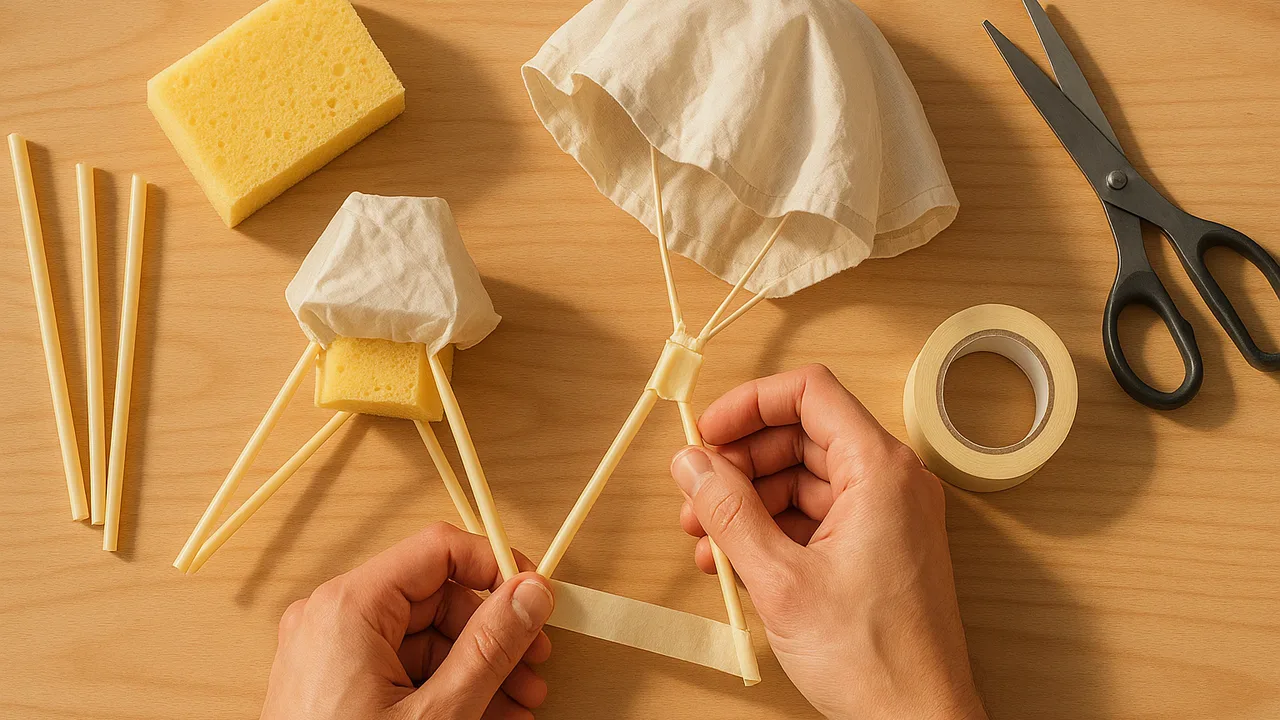
use test data and Newton’s third law to choose the best features of each design and combine them into one improved lander.
- I can make a claim about which characteristics of each design best meet the criteria and constraints, using evidence from the data.
- I can use data to identify the best features from each design that could be combined to create a better solution.
- I can use my understanding of Newton’s Third Law to analyze how well my design meets the criteria and constraints.
Phase 4: Build
Warm-Up ~5 min
Do Now. A team says: “Design C protected the egg every time, so we’ll just use Design C.” Using the sample data, write one reason this plan could fail the science center.
Which statement uses data to make a claim?
Instruction ~10 min
Mission engineers, real engineers rarely pick one design and stop. They look across all the test data. They find which features caused success. Then they combine the best features into a new design. This is called optimizing.
Newton’s third law helps explain the data. When the lander hits, the floor pushes up on it, as hard as it pushes down. Inside the lander, the cushion pushes up on the payload, as hard as the payload pushes down. A crushable or soft part lets the payload slow down over a longer time and distance. A gentler stop means a smaller push on the payload, in both directions of the pair.
Worked example 1: Ava’s feature claim. Ava writes: “Claim: a soft layer touching the payload is the feature that best protects it. Evidence: Design C, with full cushioning, was 6 of 6. Design B, with no cushion, was 2 of 6. Reasoning: the soft layer lets the egg stop gradually. The pair of forces between cushion and egg stays small.”
Worked example 2: Jamal’s hybrid. Jamal’s team combines three features. They take Design A’s wide crumple base, which kept the lander upright 5 of 6 times. They take a thin cotton layer from Design C, but not the whole heavy cage. They take Design B’s light straw frame to save mass. Their hybrid is predicted to be about 110 g. A prediction is not proof, so they will test it next round.
| Feature | From design | Data that supports it | Which criterion it helps |
|---|---|---|---|
Guided Exercises ~15 min
Fill in your feature table as you go.
Independent Practice ~10 min
Write a design claim using the CER frame.
Claim: The best features to combine are … Evidence: in our data, … Reasoning: by Newton's third law, … Write at least four sentences.
Closure ~5 min
Your hybrid is on paper. Next, a peer critique checks it before you build.
Exit ticket: which feature did you NOT take, even though it worked? Explain the trade-off.
How confident are you that you can I can use data to choose and combine the best features of several designs.
Teacher notes
Materials: class data table from 2.17, feature table handout, sticky notes in three colors (one per design type).
Setup: teams post one sticky note per useful feature under each design. Then they “shop” the wall for features. Give 10 minutes for the CER.
Listen for: “the cushion makes the force go away” (it makes the force smaller, never zero, while the egg stops). Watch for claims without numbers.
Support / stretch: provide CER sentence starters on a card. Stretch: estimate the hybrid’s mass from the parts and check it against the 150 g constraint.