1.02 Mapping the Cooler System
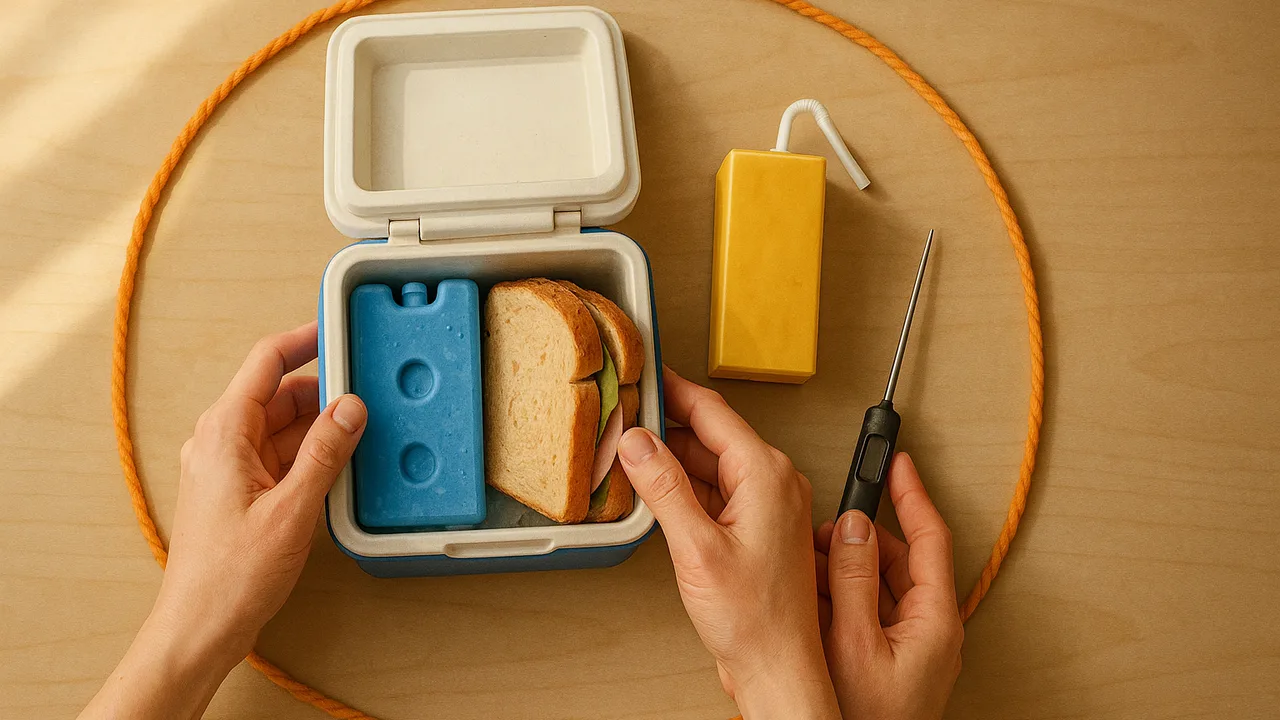
The Field Trip Lunch Cooler
How can we design a lunch cooler that keeps food cold and safe all day without electricity?
The mystery: An ice cube melts in minutes on a sunny bench, but ice stays frozen for hours inside a good cooler. A hand warmer gets hot just by being opened. What is happening to the particles?
identify the parts of the lunch cooler system, who needs it, and which parts and issues matter most.
- I can identify the system where the problem exists, including its main parts, how they relate, and what is inside or outside the system.
- I can explain who needs the problem solved, what needs must be met, and which scientific issues are important.
- I can analyze how possible solutions might affect people and the environment, and decide which issues and parts of the system matter most.
Phase 1: Spark
Warm-Up ~5 min
Do Now. Picture a lunch bag sitting on a picnic table at noon. List everything that touches it or shines on it. Then make a prediction.
Where does the energy that melts ice in a lunch bag come from?
Instruction ~10 min
Engineers draw a boundary. A system is a set of parts that affect each other. Engineers draw a boundary to decide what is inside the system and what is outside. For our project, the cooler’s walls and lid are the boundary.
Worked example 1: a system map. Priya drew a box with a thick line for the walls. Inside, she wrote food, ice packs and trapped air. Outside, she wrote sunlight, warm air, the bus floor and the picnic table. She drew arrows from the outside parts toward the food. Each arrow shows energy that could warm the lunch.
Who needs it, and what do they need? Students need safe food. Chaperones need something they can carry and watch. The bus driver needs nothing that leaks on the seats. Students with food allergies need their lunches kept separate. Each group adds needs to our list.
Worked example 2: which parts matter most? Diego’s team ranked their system parts. The walls came first, because every bit of energy must pass through them. The lid came second, since opening it lets warm air rush in. The color of the outside came third, because the cooler may sit in the sun.
Thinking beyond the lunch. Every design affects people and the environment. A cooler that is thrown away after one trip makes trash. A cooler that uses bags of ice may leak water. Good engineers ask about these effects before they build, not after.
Guided Exercises ~15 min
Build your team’s system map, then check your thinking with these cards.
Independent Practice ~10 min
Finish your own system map in your notebook.
Draw the cooler system with a clear boundary. Label at least three parts inside and three outside. Add arrows for energy. Then circle the two parts that matter most and explain why.
List three groups of people who need something from our cooler. Write one need for each group.
Closure ~5 min
Our system is mapped and our needs are listed. Next time, we zoom far inside matter itself and start building models of molecules.
Exit ticket: which scientific issue matters most for our cooler, and which part of the system does it involve? Explain in two sentences.
Teacher notes
Materials: chart paper, markers, the Wonder Board from 1.01, a sample cooler or lunch bag to pass around.
Setup: sort the Wonder Board into “we can test it” and “we need to research it” columns before the system map. Keep the map up all unit; teams add to it after each investigation.
Listen for: “cold leaks out” arrows pointing away from the food. Accept them for now and revisit after 1.06. Students may forget people who are not students; prompt with “who else touches the cooler?”
Support / stretch: provide a partly drawn map with blank labels. Stretch: add a second boundary, the bus, and describe the system inside it.