2.08 Swing It: A String-and-Ball Orbit Model
use a string-and-ball model and a simulation to show that gravity pulls objects inward and keeps them in orbit.
- I can explain with my model how gravity pulls objects together more strongly when they are more massive and less strongly when they are farther apart.
- I can use my model to show how moons orbit planets, planets and other objects orbit the sun, and stars orbit the center of the Milky Way.
- I can describe with my model that our solar system orbits the center of the Milky Way, and that the Milky Way is one of many galaxies in the universe.
- I can use my model to show that gravity pulls objects inward and keeps smaller objects in orbit around larger ones.
- I can use my model to describe what would happen if there were no gravity, such as planets moving in straight lines instead of orbiting.
Phase 2: Investigate
Warm-Up ~5 min
Do Now. The Moon has orbited Earth for billions of years. It moves fast, yet it never flies away and never falls onto Earth.
If you swing a ball on a string in a circle and let go, which way will the ball fly?
Instruction ~10 min
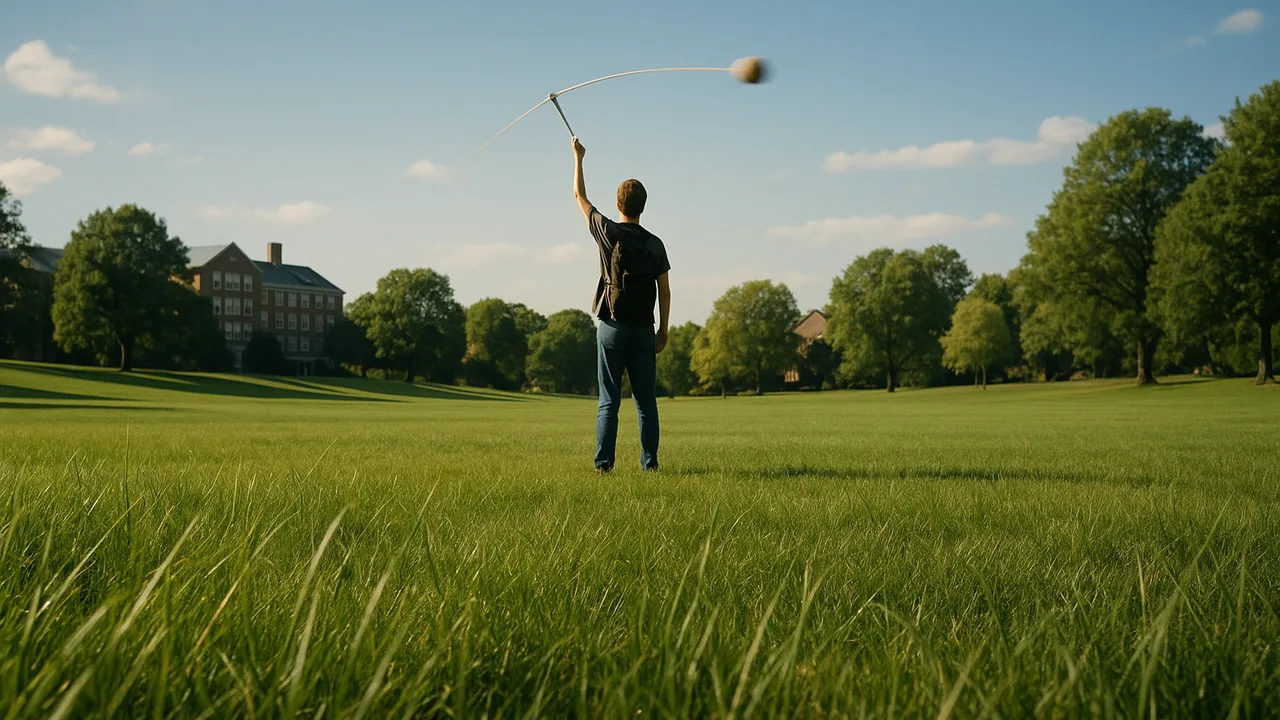
Mission engineers, build an orbit. Thread a string through a short plastic tube. Tie a soft ball to the top end and hang a few washers on the bottom end. Hold the tube and swing the ball in a flat circle over your head. The washers pull the string inward, the way gravity pulls a planet toward the Sun.
- Trial A: swing with 3 washers. Count circles in 10 seconds.
- Trial B: swing with 6 washers (a stronger pull) at the same circle size. Count again.
- Trial C: in the open area only, let go of the string and watch the path.
| Trial | Washers (inward pull) | Circles in 10 s | Path when the pull stops | What it models |
|---|---|---|---|---|
| A | 3 | — | ||
| B | 6 | — | ||
| C | 0 (released) | — |
Worked example 1: the pull points inward. Diego felt the string tug toward the center of the circle the whole time. When the pull stopped, the ball moved in a straight line. An orbiting object is always moving forward and always being pulled inward. Together they make a curved path.
Worked example 2: stronger pulls, faster orbits. With more washers, Ava had to swing faster to keep the same size circle. In space, gravity is stronger when objects have more mass and when they are closer together. That is why Mercury, close to the Sun, orbits much faster than Neptune, far away.
Gravity at every level. Moons orbit planets. Planets, asteroids and comets orbit the Sun. Our whole solar system orbits the center of the Milky Way galaxy. Gravity holds every one of these systems together.
Guided Exercises ~15 min
Answer with your data, then try the simulation.
Independent Practice ~10 min
Explain with the model.
Explain why the Moon does not fall into Earth and does not fly away. Use the words gravity, inward and straight line.
How confident are you that you can I can use a model to explain how gravity keeps objects in orbit.
Closure ~5 min
Gravity is the invisible string that holds moons, planets and even galaxies together. Next, we find out how big and how far apart these objects really are.
Exit ticket: describe what would happen to a moon if its planet's gravity stopped pulling on it. Explain why.
Teacher notes
Materials (per team): a 1.5 m string, a short smooth tube (a pen barrel with the ink removed), a soft foam ball, 6 washers, a paper clip hook, stopwatch, goggles. Devices for the PhET sim.
Setup: run trials outside or in the gym if possible. Model the release yourself first. Check the sim loads on student devices.
Listen for: “the ball flies straight out from the center” (it goes straight ahead along its path) and “there is no gravity in space.” Gravity is everywhere; it only weakens with distance. Stay qualitative: no gravity equations and no Kepler’s laws.
Support / stretch: pair a nervous swinger with a counter. Stretch: in the sim, move the planet farther from the star and compare its speed.