2.15 The Lander Brief: Modeling the Problem
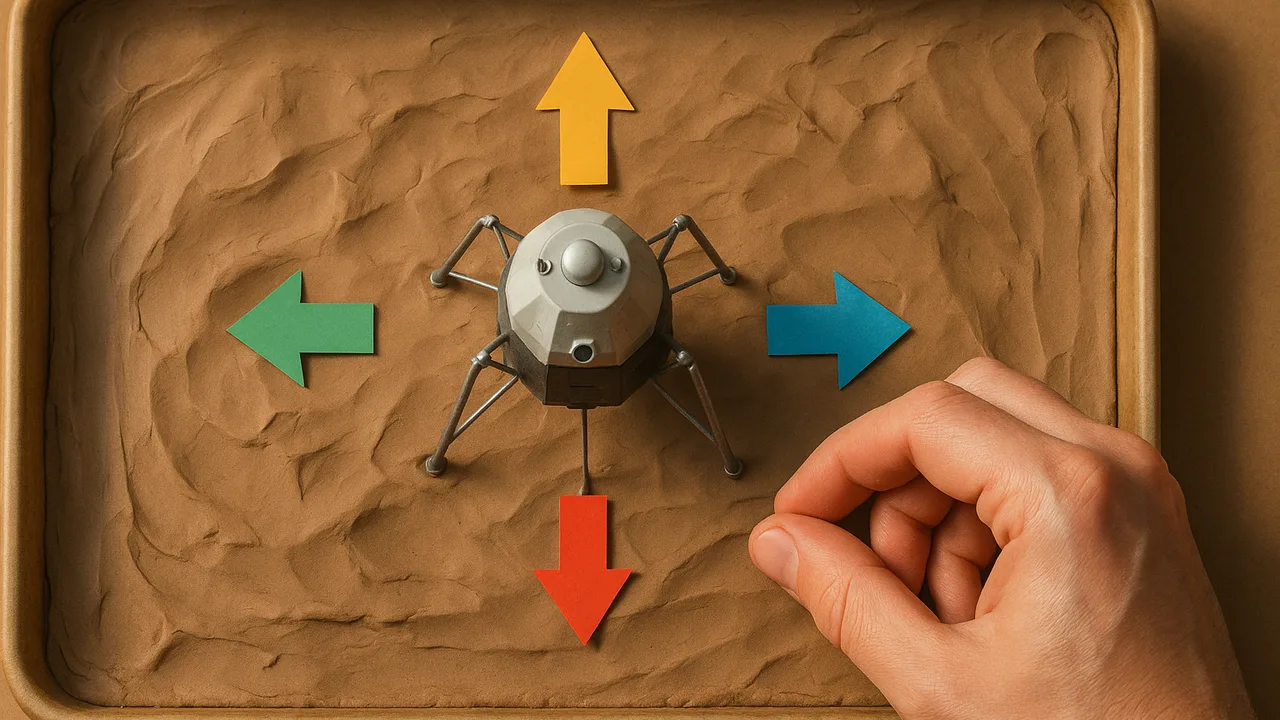
build a model of the landing problem that shows the system, the collision forces, and our criteria and constraints.
- I can develop a model that shows the problem I am trying to solve, including its criteria and constraints.
- I can identify and show the parts of my proposed solution, including the inputs and outputs in my model.
- I can design a solution to a collision problem by identifying and describing the parts of the system that are involved in the collision.
- I can describe the force that one object will exert on another during a collision.
- I can explain how Newton’s Third Law is used in my design and describe the technologies I will use to solve the problem.
- I can describe the criteria and constraints for my design, including how they help solve the problem and what limits (like cost, object mass and speed, time, or materials) I need to consider.
Phase 4: Build
Warm-Up ~5 min
Do Now. You drop a raw egg onto a hard floor and it breaks. You drop the same egg onto a thick pillow and it survives. In both drops, the egg stops. So what is different about the two stops?
When the egg lands on the pillow, how does the force on the egg compare to landing on the floor?
Instruction ~10 min
Mission engineers, the science center has a request. Their Moon Mission exhibit needs a working model of a crash-safe lander. Visitors will watch it drop and see the payload survive. Your payload is a raw egg in a sealed bag, or a small water balloon. Today you model the problem before you build anything.
Our class criteria. The payload survives a 2-meter drop with no crack or leak. The lander ends upright. A visitor can take out the payload and check it in under one minute.
Our class constraints. The lander has a mass of 150 g or less, not counting the payload. It fits inside a 20 cm cube. You may use only the class kit. No parachutes are allowed, because the Moon has no air to slow a falling lander.
A design model shows the problem. Engineers draw the system: the parts that matter and how they interact. Inputs go into the system, such as the drop height and the mass. Outputs come out, such as whether the payload survives. Newton’s third law tells us what happens at impact. When the lander pushes down on the floor, the floor pushes up on the lander. Those two forces are equal in size and opposite in direction.
Worked example 1: Priya’s system model. Priya draws a vertical line for the motion. She labels four parts: the floor, the lander frame, a cushion and the egg. She draws two pairs of arrows. The frame pushes down on the floor, and the floor pushes up on the frame. The egg pushes down on the cushion, and the cushion pushes up on the egg. Her note says: “The cushion’s push on the egg is the force we must keep small.”
Worked example 2: Jamal’s inputs and outputs. Jamal lists inputs: drop height 2 m, lander mass, payload mass and materials. He lists outputs: crack or no crack, upright or tipped, and time to open. Then he adds a limit box: 150 g, 20 cm cube, kit only, no parachute. His model now shows the whole problem on one page.
Guided Exercises ~15 min
Build your team’s problem model as you work through these cards.
Independent Practice ~10 min
Explain your model in writing.
Describe the collision in your model. Which objects push on each other at impact? Use Newton's third law in your answer.
Pick one constraint. Explain how it makes the problem harder, and why the science center might need it.
Closure ~5 min
Your model is the map for the whole build. Next, we plan three different designs and a fair drop test.
Exit ticket: the egg pushes down on the cushion with a force. Describe the force the cushion puts on the egg.
How confident are you that you can I can model a collision problem with its parts, forces, criteria and constraints.
Teacher notes
Materials: chart paper, markers, the criteria and constraints poster, one sample egg in a sealed bag to pass around.
Setup: 10 minutes on the brief, 20 minutes on team models, then a 5-minute gallery glance. Keep forces in one dimension: up and down only.
Listen for: “the floor doesn’t push, it just sits there” and “the bigger object pushes harder”. Both forces in a pair are always equal. Also listen for the idea that a cushion removes force; it makes the force smaller by making the stop longer.
Support / stretch: give a model template with blank boxes and arrow stickers. Stretch: add the lander’s legs as a separate part and draw their force pair with the floor.