2.02 Wonder Board Workshop: Criteria, Constraints and Landers
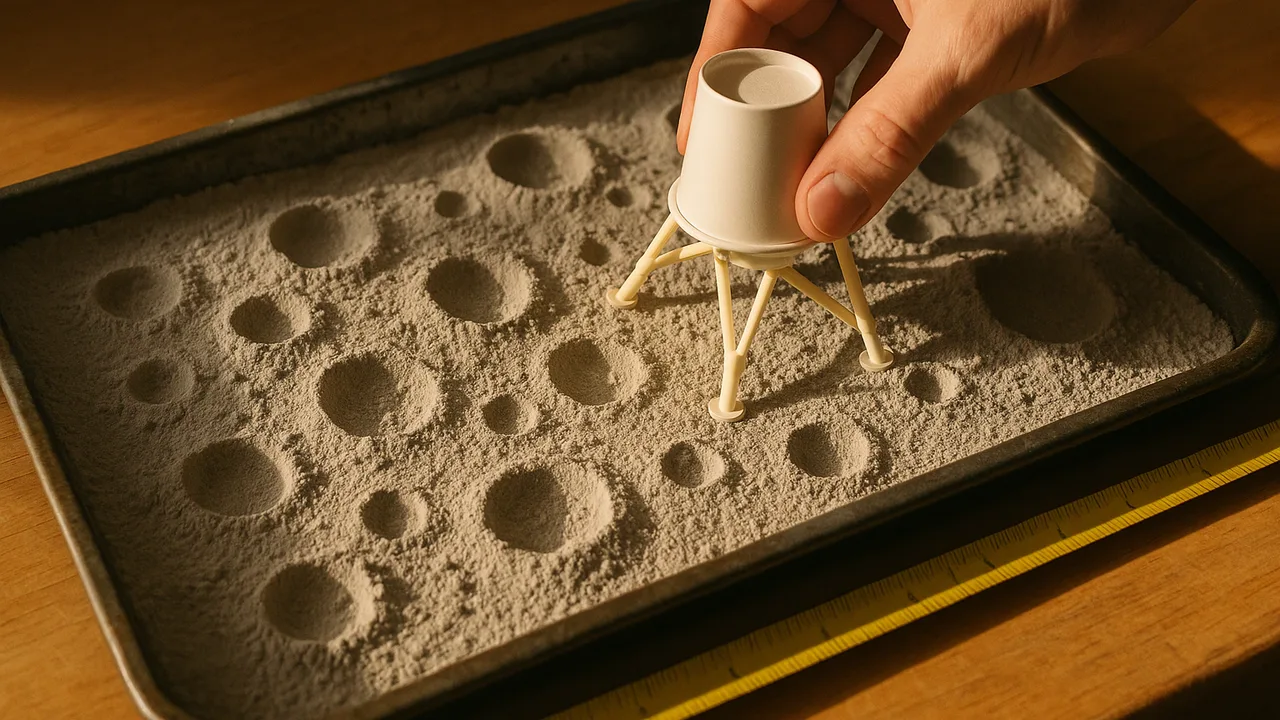
Moon Mission: A Crash-Safe Lander and a Solar System to Scale
How do forces and gravity control motion, from a bumper car to the planets, and how can we land safely on the Moon?
The mystery: The Moon changes shape over a month, but it never falls into Earth. A dropped egg breaks, yet engineers land spacecraft gently on other worlds.
sort our Wonder Board into need-to-knows and define the criteria and constraints for a crash-safe lander demo.
- I can describe the criteria and constraints for my design, including how they help solve the problem and what limits (like cost, object mass and speed, time, or materials) I need to consider.
- I can identify examples of how new technology has helped us learn more about the solar system, and how scientific discoveries have led to new engineering designs, like better telescopes or space probes.
Phase 1: Spark
Warm-Up ~5 min
Do Now. Look at our Wonder Board from last time. Some questions are about forces and landing. Others are about the Moon, the Sun and the planets. Some could be both.
Which question will we need to answer FIRST to design a lander?
Instruction ~10 min
Mission engineers, today we define the problem. We sort the Wonder Board into two columns, Forces and Landing and Earth, Moon and Space. Each sticky note becomes a need-to-know, something we must figure out before we can design.
Criteria and constraints. Criteria are what a design must do to succeed. Constraints are the limits we must work within, like cost, mass, time and materials. A good problem statement names both.
| Criteria: our lander must… | How we will measure it | Constraints: we must stay within… | Why the limit exists |
|---|---|---|---|
Worked example 1: criterion or constraint? Priya listed “The egg must not crack after a 2-meter drop.” That is a criterion; it describes success. Malik listed “Total mass under 150 grams.” That is a constraint; it is a limit. Real landers face the same limit, because every gram has to be lifted by a rocket.
Worked example 2: technology changes what is possible. People first studied the Moon only with their eyes and telescopes. Later, robot spacecraft and crewed missions landed there and brought back rocks. In 1969, the Apollo 11 crew became the first people to land on the Moon. Mars rovers have used big airbags to bounce safely to a stop. Each new tool taught scientists more, and each discovery led engineers to design better tools. Our exhibit can tell that story.
Guided Exercises ~15 min
Sort and decide with your team. The Recorder fills in the criteria and constraints chart.
Independent Practice ~10 min
Write our first problem statement on your own.
Finish this problem statement: “The science center needs a lander demo that ___ (two criteria) while staying within ___ (two constraints).” Explain why one of your constraints matters.
How confident are you that you can I can tell criteria from constraints for a design problem.
Closure ~5 min
Our Wonder Board is now a list of need-to-knows, and our lander has clear criteria and constraints. Next, we head to the Crash Lab to find out what happens to forces in a collision. First, take the 3DX field trip to the exhibit hall.
Exit ticket: name one criterion and one constraint for our lander, and explain the difference between them.
Teacher notes
Materials: the Wonder Board, two column headers, sticky notes, chart paper for criteria and constraints, images of a lunar lander and an airbag landing (public NASA images work well).
Setup: keep the class chart posted all unit; part 2 tests against it. Suggested class constraints: mass under 150 g, a set materials list, fits in a shoebox, built in two periods.
Listen for: “cheap” listed as a criterion. Cost is usually a constraint. Also listen for mixing up mass and weight; keep to “mass in grams” for now.
Support / stretch: give a sort card set of 10 statements. Stretch: ask how the criteria would change for a lander on Mars, which has a thin atmosphere, versus the Moon, which has none.